← All schools
CA

School dossier · Concord, NC

Cannon School

8 research areas · 53 documents distilled

Cannon School is also covered in 1 episode outside these research areas.
Cannon School athletics logo

Welcome Video

From the school

An introduction to Cannon School, in the school’s own words. Press play to watch.

Latest News

Contacting cannonschool.org…cannonschool.org
Listen to a deep dive on this topic
3 episodes cover Cannon School's Course Offerings
104
Upper School courses catalogued
14 AP + 13 AT
AP / advanced courses
8
Upper School departments
JrK – Grade 4Lower School Courses13 named curriculum areas — Reveal Math, TAB art, the Orff Approach, Scratch 3.0 coding, and the CHAMP fitness test.

Cannon publishes 12 named curriculum areas per grade for JrK–4 rather than a course catalog. The /academics/lower-school/curriculum path returns a 404.

All departments13 courses — scroll for full list
Language ArtsGr 1–4Core Academics

A literacy block integrating whole-class and small-group differentiated instruction across phonics, fluency, vocabulary, and comprehension.

MathematicsGr 1–4Core Academics

Uses Reveal Math to develop number sense and problem solving; Grade 4 works with multi-digit numbers, fractions, and decimals.

ScienceGr 1–4Core Academics

Inquiry-driven; by Grade 3 students generate their own scientific questions to test through experimentation.

Social StudiesGr 1–4Core Academics

Uses the Social Studies Alive! curriculum — Regions of Our Country in Grade 3, America’s Past in Grade 4.

Early Childhood ProgramJrK–KCore Academics

Curriculum builds a strong academic foundation in reading, writing, and math through hands-on, collaborative, experiential, and multi-sensory learning.

SpanishGr 1–4World Language

Combines the Communicative Language Approach with the Foreign Language in the Elementary School (FLES) approach.

ArtGr 1–4Arts & PE

Grade 3 onward uses the TAB (Teaching for Artistic Behavior) model so students work and think as artists.

MusicGr 1–4Arts & PE

Uses the Orff Approach; Grade 3 introduces the recorder including Recorder Karate.

Physical EducationGr 1–4Arts & PE

Motor-skill development including the Cannon Health and Performance (CHAMP) Test.

TechnologyGr 1–4Technology & Makers

Robotics and coding with Scratch 3.0 and block-based scripting, using Root Robotics and Edison robots.

MakersGr 1–4Technology & Makers

Problem solving through an engineering design thinking approach.

LibraryGr 1–4Technology & Makers

Research skills including use of the digital library catalog to locate materials.

School CounselingGr 1–4Technology & Makers

Addresses typical challenges and characteristics of children by age and developmental stage.

Grades 5 – 8Middle School CoursesSix core subjects plus four math tracks — a Grade 5 rotation through all three world languages, and the ThinkTank makerspace.

Cannon publishes Middle School curriculum as per-grade subject descriptions, not a named-course catalog. There is no Middle School equivalent of the 44-page Upper School catalog.

All departments17 courses — scroll for full list
EnglishGr 5–8Core Academics

Grade 5 explores genres and writing critically; Grade 6 reinforces grammar with narrative writing; Grade 7 integrates literature, writing, and grammar; Grade 8 builds all four skills.

ScienceGr 5–8Core Academics

Grade 5 studies ecology; Grade 6 classification, cells, rocks, plate tectonics, and motion; Grade 7 chemistry, the electromagnetic spectrum, astronomy, and anatomy; Grade 8 the Sun’s impact on Earth.

Social StudiesGr 5–8Core Academics

Grades 5–6 study ancient and Medieval civilizations thematically; Grade 7 covers the origins of the United States; Grade 8 emphasizes modern U.S. history as it becomes a world power.

Physical EducationGr 5–8Core Academics

Soccer, flag football, volleyball, tennis, aerobics, cardiovascular fitness and conditioning, basketball, softball, baseball, and lacrosse.

Health EducationGr 5–8Core Academics

Human growth and development, evaluating health information, decision-making, family living, nutrition, safety and first aid, and environmental health.

MathematicsGr 5–6Mathematics

Covers operations, equations and inequalities, ratio, proportion and percent, area and volume, statistics, and graphing linear equations.

Pre-AlgebraGr 6–7Mathematics

Builds on prior knowledge to dive deeper into expressions, equations, inequalities, integers, linear functions, geometry, probability, and statistics.

Seventh-Grade Algebra IAcceleratedMathematics

An accelerated option allowing seventh graders to take Algebra I.

Algebra IGr 8Mathematics

Linear equations, inequalities, polynomials, factoring, graphing, radicals, quadratics, and an introduction to trigonometry.

Accelerated GeometryAcceleratedMathematics

Parallel and perpendicular lines, congruent triangles, similar polygons, trigonometry, quadrilaterals and circles, area and volume.

World Language RotationGr 5World Languages

Students rotate through all three world languages offered at Cannon — Spanish, French, and Mandarin — before choosing one to pursue.

World Language (daily)Gr 6World Languages

Daily classes learning basic grammar and vocabulary to describe themselves and the world in the target language.

Spanish I / French I / Mandarin IGr 7–8World Languages

Students complete one of Spanish I, French I, or Mandarin I, conducted primarily in the target language.

Major Art: Strings, Band, or ChorusGr 5–6Arts & Technology

Students select one major performing art class.

Arts RotationGr 5–6Arts & Technology

A rotation through Visual Art, Theater, General Music, and Small Group Lessons in the major art.

Arts Electives (choose two)Gr 7–8Arts & Technology

Band, Chorus, Strings, Visual Art, Theater, Photography/Tech Art Fusion, Creative Explorations, and Art Magazine.

Academic TechnologyGr 5–8Arts & Technology

Blends 3D printing, virtual reality, drones, robotics, CAD design, and computer programming in the ThinkTank makerspace.

Grades 9 – 12Upper School Courses104 courses across 8 departments — 14 AP plus 13 faculty-designed Advanced Topics courses, each capped by a Signature Learning Experience.
All departments101 courses — scroll for full list
Honors English IGr 9English

A foundational course cultivating critical thinking, analytical skills, and creative expression across memoirs, plays, novels, poetry, and short stories.

Honors English II: Reading and DiscourseGr 10English

A sophomore seminar-style class reading and discussing influential literary and philosophical works from a variety of historical periods and cultures.

Honors English II: Reading and CompositionGr 10English

A process-driven sophomore course in which students read, write, and think in service of developing writing and analytical skills.

Honors English IIIGr 11English

The study of rhetoric guided by Aristotle’s appeals of ethos, pathos, and logos, culminating in a writing-portfolio presentation.

Advanced Topics: English Language and CompositionATEnglish

College-level nonfiction writing with major emphasis on revision, culminating in the Portfolio Defense signature learning experience.

Advanced Topics: English Seminar and InquiryATEnglish

College-level reading and writing emphasizing inquiry, independent research, and multi-disciplinary analysis; optional AP Seminar exam.

Honors English IVGr 12English

A senior course preparing college-bound students through diverse contemporary and canonical texts plus an Independent Reading program.

Advanced Topics: English Literature and CompositionATEnglish

College-level literary conversation about fiction and poetry, culminating in the Lit Defense signature learning experience.

Honors Creative Writing: Fiction, Poetry and ScreenwritingElectiveEnglish

Students develop individual literary voices through poetry, fiction, and screenwriting, completing a polished peer-critiqued screenplay.

Honors History of FilmElectiveEnglish

A fast-paced survey tracing cinema from its 1895 origins through the digital revolution across genres and movements.

Honors Algebra IHonorsMathematics

Introduces basic functions, their graphs, and the rules of solving equations.

Honors Principles of Geometry and AlgebraHonorsMathematics

Strengthens and applies arithmetic, algebra, and reasoning to measure the world through traditional geometry concepts.

Honors Accelerated GeometryAcceleratedMathematics

Euclidean geometry with heavy emphasis on notation, justification, and proof at greater rigor and depth than Honors Geometry.

Honors Algebra IIHonorsMathematics

Uses functions to reinforce and extend Algebra I skills, focusing on elementary functions and their properties.

Honors Accelerated Algebra IIAcceleratedMathematics

An in-depth exploration of algebraic concepts, preparing students for Accelerated Precalculus and subsequently AP Calculus and AP Statistics.

Honors PrecalculusHonorsMathematics

Further development of advanced algebraic concepts and trigonometry with heavy emphasis on functions and their properties.

Honors Accelerated PrecalculusAcceleratedMathematics

Prepares students for college-level mathematics and serves as the prerequisite for AP Calculus.

Advanced Placement PrecalculusAPMathematics

A research-based exploration of function types modeling real-world phenomena, best suited to students on track for AP Calculus BC.

Honors CalculusHonorsMathematics

Introduces the topics of a semester of college calculus at a less intense pace and depth than the AP courses.

Honors StatisticsHonorsMathematics

Exposes juniors and seniors to statistics through graphing data, normal probabilities, linear regression, and experimental design; no AP exam.

Advanced Placement StatisticsAPMathematics

Major concepts and tools for collecting, analyzing, and drawing conclusions from data, preparing students for the AP exam.

Honors Discrete Mathematics and Personal FinanceGr 12Mathematics

Explores mathematics as it relates to the social sciences plus the mathematics behind money in everyday life.

Advanced Placement Calculus ABAPMathematics

A rigorous course covering a semester of college calculus through limits, differential calculus, and integral calculus.

Advanced Placement Calculus BCAPMathematics

An intense course covering two semesters of first-year college calculus including parametric equations, infinite series, vectors, and polar functions.

Advanced Topics in Mathematics and CalculusPost-APMathematics

A student-centered seminar for students who have completed AP Calculus BC, using Phillips Exeter Academy’s Mathematics 4C and 5 curricula.

Honors Principles of Chemistry and PhysicsGr 9Science

A hands-on, inquiry-based introduction to physical science covering matter, energy transformations, motion, forces, and waves.

Honors Accelerated Principles of Chemistry and PhysicsAcceleratedScience

A challenging ninth-grade physical science course covering a broader range of chemistry and physics topics at an accelerated pace.

Honors Principles of Life ScienceHonorsScience

A comprehensive foundation in biological and environmental principles including cell biology, genetics, evolution, and ecology.

Honors Accelerated Principles of Life ScienceAcceleratedScience

In-depth life science emphasizing application-based learning and analytical reasoning from molecules to ecosystems.

Honors ChemistryHonorsScience

A guided-inquiry course developing the properties, composition, and structure of matter plus energy’s role in changing matter.

Honors Accelerated ChemistryAcceleratedScience

Covers Honors Chemistry at a faster pace plus molecular geometry, periodicity, and acid-base chemistry.

Honors Chemistry and Physics IIHonorsScience

An experimentation-driven course covering chemistry and physics concepts not included in the Honors and Accelerated courses.

Honors BiologyHonorsScience

Introductory biology connecting key concepts through lab work and guided research, culminating in a third-trimester research project.

Honors Accelerated BiologyAcceleratedScience

Major principles of biology at deeper level and faster pace, with additional lab experiences and a third-trimester research project.

Advanced Topics: Environmental ScienceATScience

The scientific principles behind the interrelationships of the natural world, culminating in an independent research project.

Advanced Placement ChemistryAPScience

A year-long general chemistry equivalent covering nine major topics from atomic structure to thermodynamics.

Advanced Placement BiologyAPScience

The equivalent of a college introductory course for biology majors, built around student-directed, inquiry-based labs.

Advanced Placement Physics 1APScience

Algebra-based introductory college-level physics covering kinematics, dynamics, energy, momentum, torque, and rotational motion.

Advanced Placement Physics CAPScience

A calculus-based mechanics course equivalent to introductory college physics for engineering or physical science majors.

Honors Marine ScienceElectiveScience

Studies the animals inhabiting the world’s oceans, including setup and maintenance of saltwater aquariums.

Honors Anatomy and PhysiologyElectiveScience

An introductory study of the anatomical structures and physiological processes of key human body systems.

Honors Seminar: Contemporary Issues in ScienceOnlineScience

An asynchronous fully online course building appreciation for scientific phenomena relevant to scientifically literate adults.

Honors World HistoryGr 9Social Studies

Surveys prehistory through the twentieth century while equipping ninth graders with core humanities skills.

Honors Accelerated World History IAcceleratedSocial Studies

The ancient world through circa 1450 CE using the skills, practices, and methods employed by historians.

Honors Civics: Foundations of Democracy and CitizenshipGr 10Social Studies

Introduces the fundamental principles of democracy, citizenship, and economics in historical and modern contexts.

Advanced Topics: World History IIATSocial Studies

Investigates world history from circa 1450 CE to the present, culminating in the Colloquium research project and policy proposal.

Honors United States HistoryHonorsSocial Studies

Examines the development of equality, liberty, democracy, rights, and opportunity in American society.

Advanced Topics: United States HistoryATSocial Studies

Hones analytical skills across themes in U.S. History, culminating in the Symposium signature learning experience.

Honors Practicum: Civil Discourse and the Social SciencesElectiveSocial Studies

Uses current events to explore economics, psychology, sociology, political science, and history; students teach mini-lessons in Lower and Middle School.

Honors PsychologyElectiveSocial Studies

Introduces psychological science while diving into topics especially relevant to high school life.

Advanced Placement PsychologyAPSocial Studies

The scientific study of human behavior and mental processes mirroring an introductory college psychology course.

Advanced Topics: United States Government and PoliticsATSocial Studies

An analytical perspective on U.S. government and politics, culminating in an Oral Arguments Supreme Court simulation.

Advanced Topics: European HistoryATSocial Studies

A hybrid senior course investigating European history from approximately 1450 to the present across seven themes.

Honors Spanish I: NoviceLevel IWorld Languages

Foundational communication, comprehension, and presentation skills on highly familiar topics.

Honors Spanish II: Intermediate FoundationsLevel IIWorld Languages

Progresses to Novice-High and Intermediate-Low proficiency across a broader range of familiar topics.

Honors Spanish III: Intermediate Mid ALevel IIIWorld Languages

Students participate in exchanges and present on a variety of topics using familiar vocabulary and learned grammar.

Honors Spanish IV: Intermediate Mid BLevel IVWorld Languages

Refines skills and broadens exposure to diverse accents from Spanish-speaking countries.

Honors Spanish V: Language with a PurposeLevel VWorld Languages

Uses Spanish for communication and leadership through institution visits and conversations with native-speaking professionals.

AP Spanish Language and Culture: AdvancedAPWorld Languages

A rigorous interdisciplinary course taught exclusively in Spanish, building proficiency toward advanced-low.

Honors French I: NoviceLevel IWorld Languages

Acquires vocabulary and skills to start communicating in French across simple communicative tasks.

Honors French II: Intermediate FoundationsLevel IIWorld Languages

Builds on French I with daily routines, past events, and future plans plus francophone cultures and current events.

Honors French III: Intermediate Mid ALevel IIIWorld Languages

Immersive oral and written exchanges within the context of culture, connections, and comparisons.

Honors French IV: Intermediate Mid BLevel IVWorld Languages

Deepens advanced grammar and vocabulary with exposure to accents from various French-speaking countries.

Honors French V: Intermediate HighLevel VWorld Languages

An intensive class equivalent to a fourth-semester college course developing all four language skills.

Advanced Placement French Language: AdvancedAPWorld Languages

An intensive class preparing students for the AP French language examination in the spring.

Honors Chinese I: NoviceLevel IWorld Languages

Introductory Mandarin covering functional communication plus Pinyin and Chinese characters.

Honors Chinese II: Novice Mid ALevel IIWorld Languages

Students discern language patterns and forms to create complete sentences and short spontaneous conversations.

Honors Chinese III: Novice Mid BLevel IIIWorld Languages

Expands characters and compound usages with emphasis on verbal usage and circumlocution.

Honors Chinese IV: Intermediate FoundationsLevel IVWorld Languages

More complex structures and current events, designed to prepare students for the AP language class.

Honors Chinese V: Intermediate Mid ALevel VWorld Languages

Emphasizes natural colloquial usage, idiomatic phrases, Hanzi writing, and essay writing.

Advanced Placement Chinese Language and CultureAPWorld Languages

Comparable to fourth-semester college Mandarin, deepening immersion in the Chinese-speaking world.

Honors Visual FoundationsPrerequisiteArts

A one-year introductory course and the prerequisite for all Studio Art and Media Arts courses.

Honors Studio-2DHonorsArts

Examines how art across two-dimensional media communicates ideas through a choice-based classroom model.

Honors Studio-3DHonorsArts

Hands-on exploration of clay, wire, wood, plaster, and found objects to create sculptures, installations, and functional designs.

Honors Studio Arts IIHonorsArts

An introduction to deep studio practice, creating a series of work based on the student’s own artistic voice.

Honors Studio Arts IIIHonorsArts

A continuation of Studio Arts II with more independent research and out-of-class project work.

Advanced Placement Studio ArtAPArts

An intensive portfolio course for students seriously interested in the practical experience of art; portfolios replace a written exam.

Advanced Topics: Art HistoryATArts

A journey across continents and centuries pairing art analysis with hands-on studio projects; prepares for the AP Art History exam.

Honors Theater IHonorsArts

Explores fundamental skills of realistic acting plus basic principles of directing and designing for the stage.

Honors Theater IIHonorsArts

Further develops acting, directing, and design through more challenging projects and greater artistic ownership.

Honors Theater in PerformanceRepeatableArts

For experienced students committing to public acting, directing, or production design including Fall One-Acts and Arts Jam.

Honors Concert ChorusRepeatableArts

Students sing a wide variety of literature composed for mixed choirs while learning healthful vocal production.

Honors String Ensemble I–IVLevels I–IVArts

Accommodates experienced instrumentalists performing traditional orchestra and chamber repertoire with rising technical mastery and leadership each year.

Honors Upper School BandRepeatableArts

Builds on middle school band across Concert Band, Big Band, and small classical Chamber Ensembles.

Honors Cannon School Jazz ComboAuditionArts

Explores modern jazz in the small combo format with daily focus on jazz theory and improvisation.

Honors Modern EnsembleRepeatableArts

Performs American Pop, Rock, R&B, and Rap with heavy use of multi-track recording via Soundtrap.

Honors Music Technology IHonorsArts

Learns the language and mechanics of music through composition using the latest music technology; designed for the music novice.

Honors Music Technology IIHonorsArts

Deepens compositional skills through Ableton Live and the Ableton Push MIDI controller.

Honors Music Technology III: Music ProductionHonorsArts

Advanced self-driven projects using industry-standard DAWs such as Ableton Live and Logic Pro.

Honors Creative Design and Engineering IHonorsArts

Project-based exploration of the Iterative Design Engineering process across woodworking, sewing, electronics, and CAD.

Honors Creative Design and Engineering IIHonorsArts

Further develops idea curation, project planning, design, and fabrication through increasingly challenging design prompts.

Honors Creative Design and Engineering StudioPermissionArts

An open-block studio for independent maker projects, evaluated through portfolio development and project check-ins.

Advanced Topics: Principles of Computer Science and CodingATInnovation & Enterprise

Introduces the breadth of computer science, covering algorithms, programs, the internet, and AI and their consequences.

Advanced Placement Computer Science AAPInnovation & Enterprise

Fundamentals of computer science through object-oriented design in Java, including data structures and algorithms.

Advanced Topics: Microeconomics: Politics and PolicyATInnovation & Enterprise

College-level microeconomics examining supply and demand, market structures, and market failure alongside public policy.

Advanced Topics: Business and Entrepreneurship with Personal FinanceATInnovation & Enterprise

A year-long project-based course where students develop and launch a business model, culminating in a Shark Tank-style pitch to investors.

Honors Business of EsportsHonorsInnovation & Enterprise

A hands-on exploration of the esports industry and entrepreneurship; students intern for the Collective Esports Company.

Honors Glocal PerspectivesGr 12Innovation & Enterprise

An immersive service-learning exploration of global and local perspectives; required for the Global Education Certificate.

Senior Colloquium: LeadershipGr 12Innovation & Enterprise

Leadership training in which students read leadership literature and collaborate to chart the curriculum.

Honors YearbookRepeatableInnovation & Enterprise

Produces Cannon’s yearbook, The Flashback, covering graphic design, copywriting, photography, and publication business.

Wellness and Long-term Athletic DevelopmentGr 11–12Physical Education

A holistic wellness and athletic development course informed by kinesiology, exercise physiology, and biomechanics.

Listen to a deep dive on this topic
Inside Cannon's Student Clubs: Councils, Competition & Community
≥19
Upper School student organizations
FLL Worlds top 100
Flagship result
~10k service hrs
Participation signal
Affinity & Identity GroupsCannon confirms affinity groups run in the Upper School — but never names a single one.

Cannon confirms affinity groups run in the Upper School — but never names a single one. Everything below is what the school does publish; the roster itself is the gap, and it is the most useful thing a parent can know before a tour.

What is published · Upper School
"We have a rich club life, ranging from the significant such as our Affinity Groups, to fun and adventurous clubs like the Star Wars Club, and service-based clubs such as the Habitat Club." Clubs are student-led and faculty-supported, meeting during and after school. That sentence is the entire published record.
Middle & Lower School
No affinity groups appear in either division. Middle School Student Life lists academic competition teams only — Battle of the Books, Elementary Battle of the Books, Science Olympiad, Model UN, Envirothon — plus Student Council.
Parents
No parent affinity groups. "Parents at Cannon" is a general volunteer network organized as Connect, Create, Cultivate and Champion, with no identity-based subgroups.
Service & Civic EngagementService is explicitly not a graduation requirement — and Upper Schoolers still log almost 10,000 hours a year.

Service is explicitly not a graduation requirement — and Upper Schoolers still log almost 10,000 hours a year. The school frames this as evidence of commitment rather than compliance, and backs it with a universal senior capstone and a week-long experiential program.

~10,000
service hours a year · Upper School
Service without a requirement

"Although service is not a graduation requirement at Cannon, students' deep sense of commitment and personal responsibility is evidenced by the collective completion of almost 10,000 service hours each year through school-wide projects and individual efforts."

111
seniors · every one completes it
Senior Capstone

A service project letting every senior immerse in a philanthropic cause they care about, ending in a presentation to faculty, staff, peers and community members with time for reflection and questions. Listed among the school's Signature Learning Experiences.

4
experience tracks · one week each January
Winterm

A week-long experiential program after winter break that "challenges students to think critically and practically, to serve others," across local-community, professional-skills and trips-and-certifications tracks. Service offerings include a Sea Island Habitat for Humanity trip and a food-bank week studying food insecurity.

In the Middle School

A grade-level service-learning model has students investigate topics, identify needs in teams and build action plans, with guest speakers from more than eight organizations including Special Olympics, the Society of St. Andrew Gleaning Network and the Cabarrus County Soil & Water Conservation District. Off-campus work runs to the Share the Harvest community garden, Salvation Army food drives and the Cabarrus County Bilingual Preschool.

INDIVIDUAL — NOT A CLUBThe Senior Capstone is an individual graduation-track project and Winterm is a curricular program — neither is a club. Because service is not required, the ~10,000 hours explicitly include individual efforts rather than club membership. The Habitat Club is the exception: it is the one named service club.
Honor SocietiesEleven honor societies — the widest span in this comparison, reaching social studies, mathematics, English, journalism, three arts and three world languages.

Eleven honor societies — the widest span in this comparison, reaching social studies, mathematics, English, journalism, three arts and three world languages. These are outcomes of achievement elsewhere in the program — a student earns their way in; nobody signs up.

SocietyDivisionWhat it recognizesFeeds from
Cum Laude SocietyUpper SchoolOverall academic excellence · chapter awarded in 2005the classroom
Maggie Coleman Chapter of Rho KappaUpper SchoolSocial studies achievement — the national social studies societysocial studies
Mu Alpha ThetaUpper SchoolMathematics achievement — the national mathematics societymathematics
National English Honor Society — Golden Quill ChapterUpper SchoolEnglish achievementEnglish
Quill and ScrollUpper SchoolJournalism — the international honorary society for high school journalistsjournalism & yearbook
The National Art Honor SocietyUpper SchoolVisual-arts achievementThe Arts
Tri-M Music Honor SocietyUpper SchoolMusic achievement and serviceThe Arts
International Thespian SocietyUpper SchoolTheatre achievementThe Arts
National Chinese Honor SocietyUpper SchoolChinese language achievementworld languages
National French Honor SocietyUpper SchoolFrench language achievementworld languages
National Spanish Honor SocietyUpper SchoolSpanish language achievementworld languages
Academic & Competitive ClubsA robotics-led slate; the Brainy Yaks reached the FLL World top 100.

A robotics-led slate; the Brainy Yaks reached the FLL World top 100. Open any row for the full research note and its source.

Brainy YaksFLL robotics (grades 6–10); top 100 of 32,000+ at Worlds, '24 & '25Verified — FLL Worlds

Cannon’s standout: a FIRST LEGO League team that won the NC Champions Award and finished top 100 of 32,000+ teams at the FLL World Championship in Houston, in back-to-back years (2024 and 2025). Its coach earned one of only four FLL Coach/Mentor Awards.

Business & academic →DECA (’26 CDC finalists), Model UN (Duke DUMUNC awards)Verified — event

DECA students reached finalist standing at the 2026 CDC (entrepreneurship, marketing, personal finance). The Model UN team attended Duke’s DUMUNC among 400+ delegates, earning Outstanding Delegate and Verbal Commendation.

EsportsCannon School Gaming — dedicated esports lab since 2021School-reported

Cannon School Gaming launched in fall 2020 and runs from a dedicated lab (converted 2021); titles include Fortnite, League of Legends, Rocket League, and Overwatch, alongside a "Business of Esports" course.

Middle School teams →Science Olympiad, Envirothon, Battle of the Books, Model UNSchool-reported

The Middle School fields several academic-competition teams; a full multi-year results history is not centrally published.

Club Catalog & OverviewOne consolidated view of every student organization Cannon names directly, across Upper, Middle, and Lower School — the school publishes no chartered directory, so this is representative, not exhaustive.

One consolidated view of every student organization Cannon names directly, across Upper, Middle, and Lower School — the school publishes no chartered directory, so this is representative, not exhaustive. Filter the named spine by interest; the full roster shifts year to year and is not fully disclosed.

Showing 15 of 15 named orgs
Brainy Yaks RoboticsCompetitive program
Flagship FLL robotics team (grades 6–10); FLL World top 100 in ’24 & ’25 (see Signature Competitive Programs)
DECACompetitive program
Upper School business competition team; 2026 CDC finalist standing (see Signature Competitive Programs)
Cannon School Gaming (CSG)Competitive program
Cross-division esports program with a dedicated lab since 2021
Model United NationsAcademic competition team
Middle & Upper School; MS team named among the academic-competition teams, US team earned awards at Duke’s DUMUNC
Science OlympiadAcademic competition team
Middle School faculty-facilitated academic-competition team
Battle of the BooksAcademic competition team
Middle School reading-competition team (plus an Elementary Battle of the Books)
EnvirothonAcademic competition team
Middle School environmental academic-competition team
Upper School Student CouncilStudent leadership
Elected Upper School student governance body
Middle School Student CouncilStudent leadership
Grades 5–8, ~4 elected students per grade; plans events and supports student life
Lower School Student CouncilStudent leadership
Elected Lower School leadership; year-long core-values initiatives
Habitat ClubService
Upper School service club; Habitat for Humanity builds incl. Winterm trips
Special Olympics Team (MS)Service
Middle School team coordinating volunteers for the Special Olympics of Cabarrus County
Affinity GroupsAffinity / belonging
Flagship category of Upper School club life under the DBE framework; no named roster published (Black affinity groups cited in reviews)
Yearbook (The Flashback)Student publication
Active Upper School publication with student editors and a dedication ceremony
Star Wars ClubInterest / social
Cited as a representative “fun and adventurous” Upper School interest club
Student-initiated modelCannon frames club life as student-led and faculty-supported, meeting during and after school (Middle School clubs meet at lunch or a designated club time). Students may found new clubs when their interests aren’t represented, so the active roster changes annually.School-reported
Lower School (JrK–4)Runs on elected student leadership, signature traditions, Adaptive Expertise (AE) “passion class” days, and after-school enrichment (After School Program + Beyond the Bell) rather than a roster of standing interest clubs — a structural difference, not a gap.Structural
Service & belongingService runs deep — ~15,000 school-wide hours a year (not a graduation requirement), Senior Capstone philanthropy projects, and a House Day of Service — but as frameworks/traditions rather than standing clubs. Affinity work sits under the Diversity, Belongingness & Engagement (DBE) commitment.School-reported
Listen to a deep dive on this topic
The Arts at Cannon School, Providence Day School, and Charlotte Country Day School
JrK–12
Program span
NCTC festival
Signature recognition
AP Studio Art
Advanced coursework
3 pillars
Ensembles / offerings
The JrK–12 Arts LadderEvery one of the 22 Upper School arts courses is Honors, AP or Advanced Topics — there is no regular-track arts course, behind a two-year arts graduation requirement.

Every one of the 22 Upper School arts courses is Honors, AP or Advanced Topics — there is no regular-track arts course, behind a two-year arts graduation requirement. Choice-based (TAB) visual art in every division since 2016-17, piloted in the Lower School back in 2011. A purpose-built 2014 performing arts center whose lobby is the student gallery.

JrK–12
choice-based art in every division
22
US arts courses — all honors or above
2 years
arts required to graduate
11,486 sq ft
Cindric center · 450 moveable seats
Lower School · JrK–4
Choice-based (TAB) visual art — drawing, painting, collage, paper sculpture, clay, fibre artStudents work "like practising artists," with autonomy over creative directionMusic built on the Orff approach, expanding into advanced ensembles laterTAB was piloted here in 2011 by Krista Johns, then adopted upward — teacher-originated, roughly 15 years deep
Middle School · 5–8
Choice-based art continues: drawing, painting, printmaking, ceramics, sculpture5th–6th grade arts rotate quarterly; 7th–8th grade are year-long electivesYear-long options include Photography & Tech Art Fusion, Creative Explorations, and Arts MagazineA separate Lower/Middle School musical for grades 3–6 — an on-ramp years before the Upper School companyVarsity Band spans grades 6–12; Varsity Orchestra is competitive, with seats to win and hold
Upper School · 9–12
Three visual pathways: Studio Arts, Media Arts & Productions, and Creative Design & EngineeringVisual: Honors Visual Foundations → Studio-2D / 3D → Studio Arts II → III → AP Studio Art; plus Advanced Topics: Art HistoryMusic: Honors Concert Chorus, String Ensemble I–IV, Upper School Band, Jazz Combo, Modern Ensemble, Music Technology I–IIITheater: Honors Theater I, II, and Theater in PerformanceDesign: Honors CDE I, II and CDE Studio
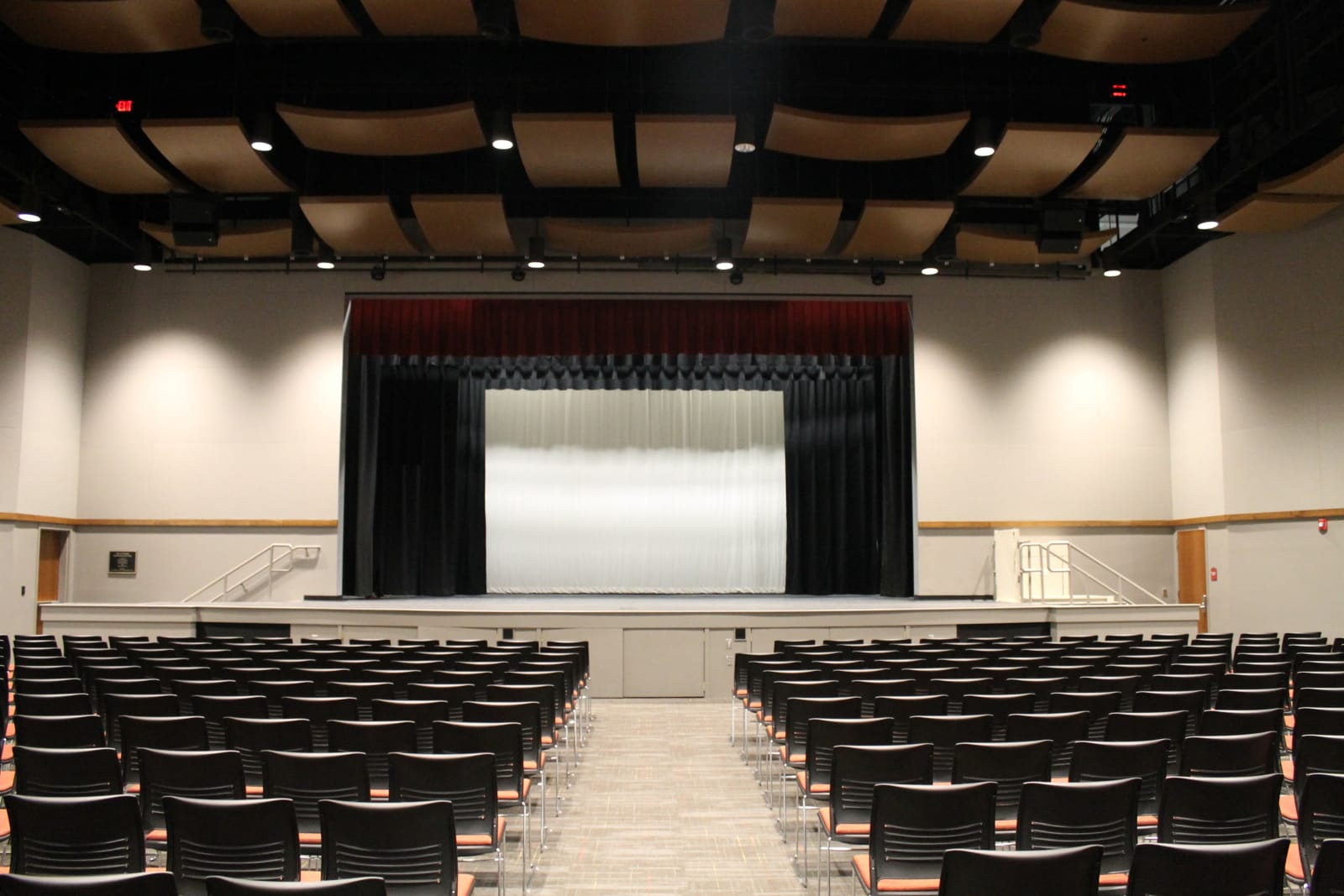
Cindric Performing Arts Center
The Leck Family thrust stage, raised 42 inches, under the curved acoustic "clouds" — 450 moveable seats on a flat floor so the room can host dances, dinners and exhibits too.
cannonschool.org — Arts Facilities
The enrichment layer — beyond the classroom
The 7:30 a.m. Varsity ensemblesVarsity Chorus, Band and Orchestra meet before school for students who want arts beyond their class schedule — which is why they appear nowhere in the course catalog. Varsity Chorus was founded by Rob Burlington, is auditioned, and runs 40 students; its popularity led to the Orchestra and Band. This is the access story: a student whose day is full of AP courses can still sing in an auditioned 40-person chorus, and a 6th grader can play alongside 12th graders. It costs a 7:30 a.m. commitment.
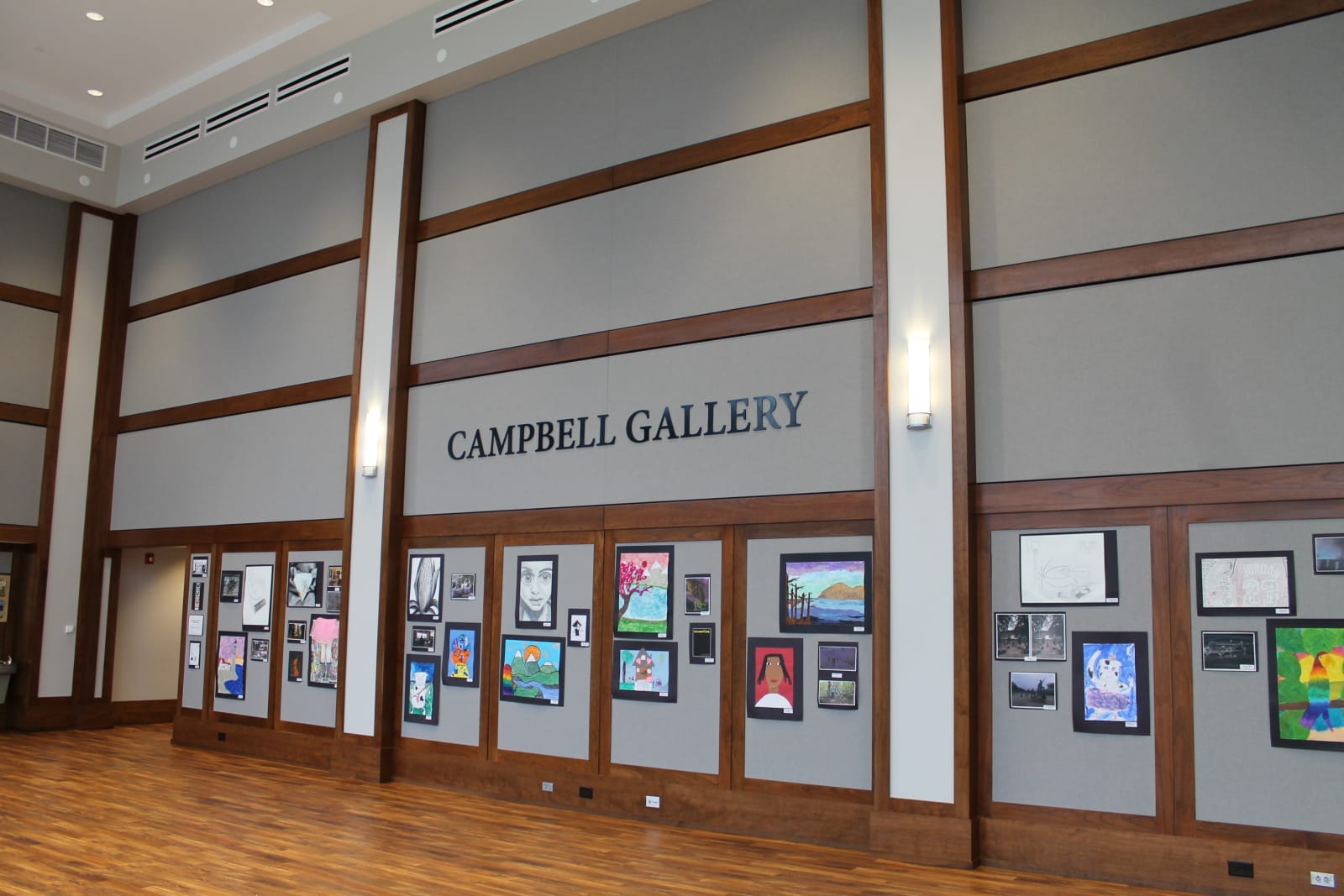
The gallery is the lobbyThe light-filled Campbell Gallery greets you as you enter the Cindric Performing Arts Center, so every concert and play audience walks through the student art exhibition. Visual and performing arts share one front door. The gallery also doubles as theatre overflow — any event can be broadcast from the house to the foyer.
The Mill & the Texas Grace Audio LabThe makerspace is called The Mill, where 3D printers run students’ designs. A recently opened Texas Grace Audio Lab supports sound engineering and music production — the facility behind the three-level music technology track.
A documented arts mission processAssigned by the Head of School in spring 2022, the three arts directors plus Dr. Regina Nixon spent a year rebuilding Cannon’s artistic mission and vision, surveying students, faculty and parents through an "I like, I wish, I wonder" exercise. The result is meant as a North Star for curriculum and extracurricular decisions. Most schools’ arts pages are marketing; this is a dated process with named owners — and a good tour topic: what actually changed as a result?
Theatre & the BlumeysTen Blumey finalist placements across 2023 and 2025, from a four-part season that runs NCTC festival play → Blumey musical → Arts Jam → Cabaret.

Ten Blumey finalist placements across 2023 and 2025, from a four-part season that runs NCTC festival play → Blumey musical → Arts Jam → Cabaret. Concord’s location does not exclude Cannon — the Blumey footprint is regional, and the school competes every winter.

The season rhythm — a four-part year
Fall
One-Acts (NCTC)
The Cannon Theater Company performs a fall play at the North Carolina Theatre Conference festival. 2025: "Say It To My Face: Five Short Plays," one of which — "Parker and the City in the Sea" by Ian Shephard — was the NCTC entry.
Winter
Musical (Blumey)
2025-26: Mean Girls: High School Version, Feb 11–14, directed by Andy Macdonald. Recent: Mamma Mia! (2025), Freaky Friday (2023).
Spring & May
Arts Jam · Cabaret
A spring Arts Jam, then an annual end-of-season Cabaret in May — an evening of short scenes, songs and award presentations.

Who runs it: Andy Macdonald, Director of Theater Arts since 2012, teaches all three Upper School theater levels and directs both the fall one-acts and the winter musical. Rob Burlington, Director of Music Arts, is music director for the winter musical — so the Blumey-competing show is co-led by the theater and music directors. No technical director is named publicly. The tech story is instead structural: the catwalk above the stage lets students assist on rigging lighting, and the AV control room at the rear of the house was, in the school’s words, "specifically designed for students to assist in the technical side of productions." Note the catalog has no course titled "Acting" or "Stagecraft" despite the website naming them — the real sequence is Honors Theater I, II and Theater in Performance, which can also be entered by doing three company productions instead of the prerequisite.

All of it happens in the Cindric Performing Arts Center on the Leck Family thrust stage, which extends into the audience on three sides. The hardwood deck is painted black and lets crews securely anchor multiple sets; a structural grid overhead handles set changes and curtain reconfiguration.

Cannon Theater Company
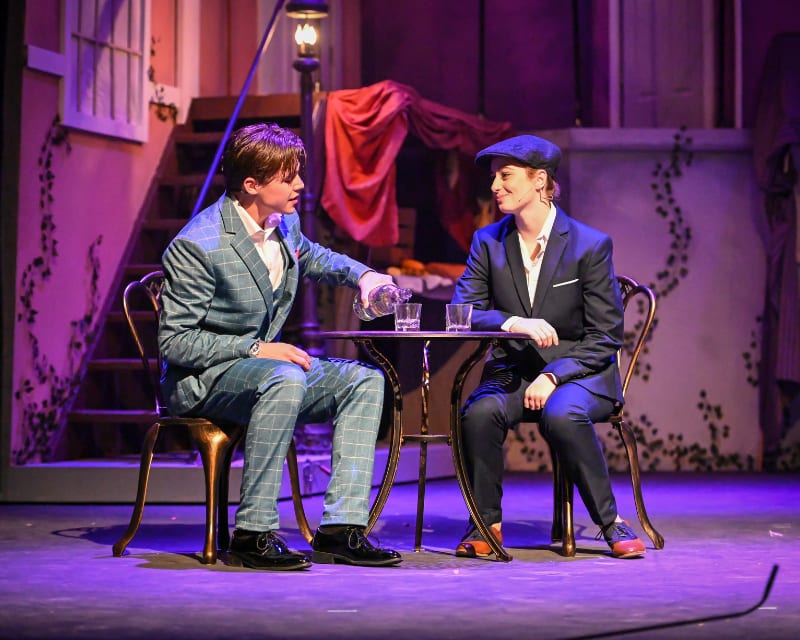
A company production on the Leck stage — built scenery, stage lighting rigged in part by students from the catwalk above.
cannonschool.org — Theater
The Blumey ledger — finalist placements by year
Year
Show
Result
2026
Mean Girls School Edition
Participating school, performing Feb 11–14. Nominees and winners for the 2026 cycle were not published at time of research.
2025
Mamma Mia!
Five finalist placements, one in every performance category: Best Actor (Griffen Evans as Harry Bright), Best Actress (Avery Fawcett as Rosie), Best Supporting Actor (Lucas Guilfoyle as Sam Carmichael), Best Supporting Actress (Shah Aashvi as Tanya), Best Featured Performer (Malcolm Musinguzi as Pepper).
2024
Not in the nominee list
Cannon does not appear in either 2024 all-nominees document. It may have participated without earning finalist placements — this is a verified absence from the nominee list, not evidence it sat the year out.
2023
Freaky Friday
Five finalist placements, again one in every performance category: Best Actor (Jonah Feeley as Adam), Best Actress (Annalise Randall-Bauer as Ellie Blake), Best Supporting Actor (Michael Wang as Mike), Best Supporting Actress (Abby Guilfoyle as Torrey), Best Featured Performer (Avery Fawcett).

Honest context: Two things a parent should hold together. The record is real and consistent — a full sweep of all five performance categories in both 2023 and 2025 — but every located line sits under a "Finalists for…" heading, and no Cannon winner line was found in any year checked. Treat this as ten finalist placements, not ten awards. On NCTC, participation is structural and every-year, but no year-by-year regional placement, state advancement or named award could be found, so no ledger is shown for it — the festival draws 3,500+ students from 100+ schools across 130+ productions, with select plays advancing from regionals to state. The director’s own framing is notably not trophy-focused: he says the judges’ feedback and seeing other schools’ work is what makes the festival special. Blumey involvement appears to reach back to at least 2019, but that page is no longer readable.

Music & the Honors PipelineA four-year strings ladder, a Hip-Hop-inclusive Modern Ensemble, and a novice-to-portfolio production track on Ableton and Logic Pro — but no documented external honors pipeline.

A four-year strings ladder, a Hip-Hop-inclusive Modern Ensemble, and a novice-to-portfolio production track on Ableton and Logic Pro — but no documented external honors pipeline. All nine Upper School music courses carry an Honors designation and most are repeatable, with the academic record reflecting rising rigour under a consistent course name.

The ensemble board
Auditioned / permission-gated
Honors Jazz Combo
Honors String Ensemble I
Prior experience — or audition if inexperienced
Honors Upper School Band
Honors Modern Ensemble
Open enrolment — no prerequisite
Honors Concert Chorus
Vertical progression — a four-year ladder
Honors String Ensemble I
String Ensemble II
String Ensemble III
String Ensemble IV
Production track — novice to portfolio
Honors Music Technology I
Music Technology II — Ableton Live & Push
Music Technology III — Ableton & Logic Pro

Rob Burlington directs Music Arts (since 2012) and teaches Middle and Upper School chorus; no band, strings, jazz or music-technology instructor is named publicly, and the catalog names no instructors. Two offerings are unusually contemporary for a K–12 department: Modern Ensemble takes "any combination of rhythm section, winds, strings, vocalists, or Hip-Hop MCs" across rock, R&B and rap, working heavily in multi-track recording via Soundtrap — a named Hip-Hop MC role in a for-credit honors ensemble is genuinely rare. The Jazz Combo is audition-only and requires a year of "Jazz 1," a course that does not appear in the Upper School catalog.

The honors ladder — and where it goes undocumented
01Join an ensemble — Concert Chorus takes anyone with no prerequisite; Band and Modern Ensemble want prior experience or a director’s audition. Performance is required and forms a large part of the grade.
02Audition up, or climb — the Jazz Combo is audition-only, and String Ensemble runs a genuine four-year ladder to "increasingly sophisticated repertoire, higher levels of technical mastery and leadership." Outside the timetable, Varsity Chorus and Varsity Orchestra are auditioned at 7:30 a.m.
03Build a portfolio instead — this is where music’s real depth sits. Music Technology I is "designed for the music novice"; II moves to Ableton Live and the Push controller and ends in "a well stocked audio portfolio"; III adds Logic Pro and self-directed projects. Backed by the new Texas Grace Audio Lab. For a student who wants to produce rather than perform, that is a real four-year path.
04External honors — not documented — no All-State or All-District selections, no NCAIS honors ensembles, no adjudicated festival ratings, no Tri-M chapter, and no named jazz festival appearances could be confirmed in any source.

That last rung is the honest finding rather than a research failure, and it is worth stating plainly: Cannon’s public arts presence documents participation and facilities in music, not an external-honors pipeline. Theatre carries the school’s entire verified external-recognition load. If your child’s goal is All-State selection, ask directly whether students audition and how they fare.

Studio to GalleryThree visual pathways behind one mandatory gateway course — studio art, media arts, and a design-engineering track running CNC, laser cutting and electronics.

Three visual pathways behind one mandatory gateway course — studio art, media arts, and a design-engineering track running CNC, laser cutting and electronics. Choice-based practice is written into the catalog itself, not just the marketing: both Studio-2D and Studio-3D are described as choice-based classrooms where students pursue themes they develop independently.

Campbell Gallery
Campbell Gallery
Hung with student work from across the divisions. It is the foyer of the Cindric Performing Arts Center, so the art exhibition is the way into every concert and play.
cannonschool.org — Arts Facilities
Studio media
2-D studio
drawing, painting, printmaking, digital production
3-D studio
clay, wire, wood, plaster, found objects
Digital painting
and illustration, within Studio Arts
Media Arts
graphic design, commercial illustration, photo manipulation, video
CDE fabrication
CAD, woodworking, metalworking, textiles, 3D printing, laser, CNC
Electronics & coding
inside an arts track — unusual at K–12
The course path
Visual FoundationsStudio-2D / 3DStudio Arts II · IIIAP Studio Art· Honors Visual Foundations is the single mandatory gateway into every visual pathway. AP offers 2-D Design, 3-D Design and Drawing portfolios and may be repeated for a second portfolio; Advanced Topics: Art History is a second AP-level option for the arts student who is not a maker
Where the work goes public
Rotating
Campbell Gallery
the lobby of the performing arts centre — every audience walks through it
Year-long
Media Arts Senior Seminar
a real-world nonprofit client project ending in a presentation of learning
Annual
Arts Magazine
the student cross-media publication, produced as a Middle School elective
Required
Museum & gallery trips
named in the catalog as required extensions of the AP Studio Art course

Krista Johns directs Visual Art — she joined in 2007, piloted TAB in the Lower School in 2011 and became director in 2022. Her framing of why choice-based works: "when you're creating work that's based on your own experiences and interests, and you're not comparing yourself to anyone next to you, you're more willing to try new things." No CDE or Media Arts instructor is named. Two caveats worth carrying to a tour: Media Arts is promoted on the website and cited as an AP prerequisite but has NO course entry in the 2025-26 catalog, and AP Studio Art's stated prerequisites name "Studio Arts I" and "Media Arts I," neither of which exists as a catalog course — so ask which courses actually satisfy AP entry. No external visual-arts recognition (Scholastic Art & Writing or otherwise) could be found for any year.

Verdict & Visit ChecklistAn arts department that weights the arts like academics — 22 courses all at honors or above, a two-year requirement, and a documented strategic mission.

An arts department that weights the arts like academics — 22 courses all at honors or above, a two-year requirement, and a documented strategic mission. The asymmetry is the thing to understand: theatre carries hard third-party validation, while music’s external recognition is undocumented and its strength lies in production instead.

Why it holds up
The arts are weighted like academics — all 22 Upper School arts courses are Honors, AP or Advanced Topics — there is no regular-track arts course — sitting behind a two-year arts graduation requirement. That is a checkable signal about GPA and transcript treatment, not a slogan.
Theatre has hard third-party validation — ten Blumey finalist placements across 2023 and 2025 — a full sweep of all five performance categories in both years — plus an every-year NCTC festival commitment.
Choice-based art is teacher-originated and 15 years deep — TAB was piloted in the Lower School in 2011 by the teacher who now directs visual art, then adopted upward once it worked. The catalog itself, not just the marketing, describes Studio-2D and 3D as choice-based classrooms.
A design-engineering track inside the arts — CDE runs CAD, woodworking, metalworking, electronics, coding, textiles, 3D printing, laser cutting and CNC milling across three levels — unusual for a K–12 arts department, and the strongest single differentiator here.
A real production path for the non-performer — Music Technology I–III takes a novice to a portfolio on Ableton Live and Logic Pro, supported by the new Texas Grace Audio Lab — and it does not depend on the missing honors pipeline.
Access without a timetable conflict — the 7:30 a.m. Varsity ensembles let a student with a full AP schedule still sing in an auditioned 40-person chorus, and put 6th graders alongside 12th graders.
Ask on the tour — tick as you go
Listen to a deep dive on this topic
Inside the Cannon School Athletic Powerhouse
1
Power 4 commits
3
Division I commits
Sports Offered47 teams across 13 sports, serving more than 300 student-athletes.

47 teams across 13 sports, serving more than 300 student-athletes. Middle School teams begin in grade 7, and 8th-graders do reach varsity — an eighth-grader scored 12 points in the 2026 state final.

21
varsity programs
47
teams across V · JV · MS
300+
student-athletes
NCISAA
4A state · CISAA conference
Depth chips:V VarsityJV Junior varsityMS Middle School
Fall · 7 varsity
FootballVJVMS
Soccer (Boys)VJVMS
Volleyball (Girls)VJVMS
Tennis (Girls)VJVMS
Cross Country (B & G)VMS
Golf (Girls)V
CheerleadingVMS
Winter · 5 varsity
Basketball (Boys)VJVMS
Basketball (Girls)VJVMS
Swimming (B & G)VMS
WrestlingVMS
Cheerleading (Winter)VMS
Spring · 8 varsity
BaseballVMS
SoftballVMS
Lacrosse (Boys)VMS
Lacrosse (Girls)VMS
Soccer (Girls)VJVMS
Tennis (Boys)VJVMS
Track & Field (B & G)VMS
Golf (Boys)VMS

Middle School basketball splits into Maroon and Gold squads to widen participation. The "47 teams" figure is the school’s own count; enumerating the published teams list yields roughly 45–50 depending on how co-ed Middle School teams are counted. Cannon has no on-campus pool — the swim team’s home venue is not published.

Winning RecordThree straight NCISAA 4A girls basketball state championships — four titles in six years, and the state’s dominant girls program.

Three straight NCISAA 4A girls basketball state championships — four titles in six years, and the state’s dominant girls program. Cannon also won three titles in 2023–24 alone: girls basketball, volleyball and boys lacrosse.

State-title matrix, last 3 seasons
Program
'23–24
'24–25
'25–26
Note
Girls Basketball
STATE
23–7
STATE
26–7
STATE
25–6
Three-peat; beat Providence Day in both the 2024 and 2026 finals
Volleyball
STATE
23–2
Ended North Raleigh Christian's 8-year reign, 3–0
Boys Lacrosse
STATE
19–3
Beat Providence Day 8–7; No. 1 in the final statewide top 25
Baseball
RUNNER-UP
swept 7–5, 9–5
Lost the D1 series to Covenant Day
Boys Basketball
Second in CISAA at 8–2; lost the 4A quarterfinal at Carmel Christian
Football
Playoff 2nd round; beat Charlotte Latin 40–21, lost to Providence Day

What they didn't win: football, girls soccer, girls lacrosse and girls swimming (Providence Day) · boys basketball (Forsyth Country Day) · baseball, in the D1 series (Covenant Day) · volleyball (North Raleigh Christian) · both golf titles and wrestling (Charlotte Latin) · girls tennis and field hockey (Charlotte Country Day) · boys soccer, boys XC and boys track (Christ School) · boys lacrosse, boys tennis, girls XC and girls track (Durham Academy).

Win percentage, confirmed records
Volleyball'23–2423–2 (.920)
Boys Lacrosse'23–2419–3 (.864)
Girls Basketball74–20 (.787)
Boys Basketball2 YRS31–25 (.554)
Season-by-season detail

Girls Basketball: 2024 beat Providence Day 62–51 · 2025 beat Wesleyan Christian 71–55 · 2026 beat Providence Day 47–37, with eighth-grader London Truesdale scoring 12. Four NCISAA 4A titles in six years (2021, 2024, 2025, 2026).

Volleyball: 2023: 23–2, sweeping North Raleigh Christian 25–21, 25–18, 25–23 to end an eight-year title reign. Both losses came to Davidson Day (the 2A champion) and Hoggard, a 2,000-student public school.

Boys Lacrosse: 2024: 19–3 and the NCISAA D1 title over Providence Day 8–7, finishing No. 1 in HighSchoolOT’s final statewide top 25 with six wins over top-10 finishers.

The College PipelineA documented floor of six college commitments across 2024–26, three of them Division I — but Cannon publishes no consolidated signing list.

A documented floor of six college commitments across 2024–26, three of them Division I — but Cannon publishes no consolidated signing list. This is the most honest number available, not a census: the school’s athletics news portal renders client-side with no indexable article text, so classes of 2024 and 2026 are almost certainly undercounted.

The funnel
Committed to college athletics (all divisions, documented)TO VERIFY6
NCAA Division I (any conference)3
Power 4 (SEC · Big Ten · ACC · Big 12)1

Treat every figure on this card as a floor. Unlike its CISAA peers, Cannon does not publish an "alumni at the next level" roster, so these names come from a regional signing-day roundup rather than the school. The recruiting story here is better told by its ranked underclassmen than by its commit count.

D1 commits by sport (■ = Power 4 share)
Swimming1
Girls Basketball1
Volleyball1
The reality check

With only six documented commitments, the by-sport split is too thin to read as a pattern. What is visible: the single Power 4 commit is a swimmer, not a basketball player, despite basketball being the school’s flagship — a reminder that title-winning programs and recruiting pipelines are not the same thing.

Ranked recruits, current cycle

Cannon’s strongest recruiting signal is its underclassmen. JaKaila Gaskin (’28, 6'3" center) is ranked No. 30 nationally by Prep Girls Hoops and No. 3 in NC for her class, a four-star with a USA Basketball profile and offers from Ohio State, Tennessee, Alabama, Auburn, Florida and Louisville. Brooke Busby (’27) has committed to Princeton. Earlier: Jaden Bradley was a five-star, No. 18 nationally, and Reigan Richardson ’21 was a McDonald’s All-American.

Full commitment roster
7 of 7
Class
Athlete
Sport
College
Conference
Level
'25John KrollSwimmingNotre DameACCP4'25Maya McCorkleGirls BasketballEast Tennessee StateSouthernD1'25Maria NixVolleyballButlerBig EastD1'25Khloe ThompsonGirls BasketballWinston-Salem StateCIAAD2'25Ari LopezNot publishedTampaSSCD2'25Lily WittgraefeNot publishedHobart & William SmithLibertyD3'27Brooke BusbyGirls BasketballPrincetonIvyD1

Brooke Busby is Class of 2027 and is listed here because her commitment is already public. Level labels and conferences were added by the researcher from each college’s NCAA status. Two athletes’ sports are not published in the source roundup and are marked as such rather than guessed.

Honors & Pro AlumniA Daytona 500 winner, a PGA Tour golfer, an NBA three-point champion and a trophy-winning pro footballer — an unusually wide set of professional paths.

A Daytona 500 winner, a PGA Tour golfer, an NBA three-point champion and a trophy-winning pro footballer — an unusually wide set of professional paths. Cannon’s pro alumni run well beyond the traditional stick-and-ball sports, into NASCAR and professional golf.

NASCAR · Class of '17
Austin Cindric
2022 Daytona 500 winner — the first rookie ever to win it — and the 2020 Xfinity Series champion. He graduated from Cannon and raced a Truck Series event at Charlotte the same day.
Cannon → Team Penske No. 2 Ford
NBA + intl · Class of '10
Jarell Eddie
Cannon's all-time leading scorer with 2,600 points. Played for the Wizards, Suns, Celtics and Bulls, won the 2015 NBA D-League Three-Point Contest, and has since played in France, Spain, Turkey and Romania.
Cannon → Virginia Tech → NBA → Europe
PGA Tour · Class of '15
Will Gordon
2019 SEC Player of the Year and a first-team All-American at Vanderbilt; turned pro in 2019 and holds a 2026 PGA Tour card. A U.S. Amateur quarterfinalist in 2018.
Cannon → Vanderbilt → PGA Tour
Pro soccer · Class of '12
Vicky Bruce
Won the 2012 NCAA College Cup at UNC, then league titles in Denmark and England. The first-ever signing for Carolina Ascent FC, winning the 2024–25 USL Super League Players’ Shield.
Cannon → UNC / Davidson → Europe → Carolina Ascent
The honors ledger
Gatorade Player of the YearJaden Bradley won the 2020 NC Gatorade Player of the Year in boys basketball as a Cannon sophomore, averaging 23.1 points, 6.4 rebounds and 6.1 assists.Statewide, 1 per sport
McDonald's All-AmericanReigan Richardson (2021) earned the honor at Cannon before going to Duke. Jaden Bradley was also a McDonald's All-American, but earned it at IMG Academy after leaving Cannon.National top-tier
2026 all-state, girls basketballTwo first-team selections — Brooke Busby (10.5 ppg, 61 three-pointers, Princeton commit) and JaKaila Gaskin (14.0 ppg, 9.2 rpg as a sophomore).Statewide
CISAA Player of the YearFour consecutive Cannon boys basketball players have won it, most recently Austin Swartz as a unanimous selection. The three prior winners are not named in public sources.League level
Athletics Hall of FameInaugural 2020 class included Vicky Bruce, Jarell Eddie, Will Gordon, Krista Gross and Anna Redding. The 2025 class added Drew Balsbough, Gabby Holloway, Trey Hoover and two championship golf teams.School culture signal
Coaching: Pedigree & ContinuityA 500-win college head coach running boys basketball, and the girls dynasty built by his own former player.

A 500-win college head coach running boys basketball, and the girls dynasty built by his own former player. Athletic Director: Chris Satterfield. Cannon’s continuity anchor and its marquee hire are former player and coach, now colleagues.

The pedigree hire · Boys Basketball, since 2024
Jim Baker
500+
career wins — 344 college, 156 high school
20 yrs
head coach at Catawba College, 344–236
95–1
at Central Cabarrus, 2021–24

Twenty seasons as an NCAA head coach at Catawba — six SAC regular-season titles, six conference tournament titles and nine NCAA regional appearances — then back-to-back NCHSAA 3A state championships at Central Cabarrus with a 65-game winning streak. Very few high schools at any level hire a coach with a two-decade college head-coaching record. His 500th win came in January 2026.

The continuity anchor · Girls Basketball, 11 seasons
Kelvin Drakeford
4
state titles in six years
3
consecutive championships, 2024–26
'08
Cannon alumnus and former Cougar

A Cannon graduate who played college basketball at Catawba under Jim Baker, then returned to his old school — five seasons in the boys program before taking the girls job in 2015–16. He led Cannon to its first-ever girls basketball state title in 2021 and has since built the state’s dominant 4A program. He also teaches Lower School PE.

Tenure ledger — head coaches & key staff
Chris SatterfieldDirector of Athletics15+ years
Shawn PowellDirector of Sports Performancesince 2014
Kelvin DrakefordGirls Basketballsince 2015
Kevin SteuerAssociate Athletic Directorsince 2022
Geoff RosserVolleyballsince 2024
Jim BakerBoys Basketballsince 2024
Jamaal BirchFootball Program Directorsince 2025

Worth knowing: the football staff includes Haruki Nakamura as safeties coach — a former NFL safety who played for the Baltimore Ravens and Carolina Panthers. Head coach Jamaal Birch arrived in 2025 from Providence Day, First Baptist School of Charleston and Oceanside Collegiate, where he was part of back-to-back state championships and coached six wide receivers to Division I scholarships.

Facilities & Athlete CareA two-floor strength center open to every student, a turf stadium with a three-booth press box, and a Novant Health partnership staffing the training room.

A two-floor strength center open to every student, a turf stadium with a three-booth press box, and a Novant Health partnership staffing the training room. Athletic training and strength & conditioning explicitly "operate as one team" here.

Randy Marion Field
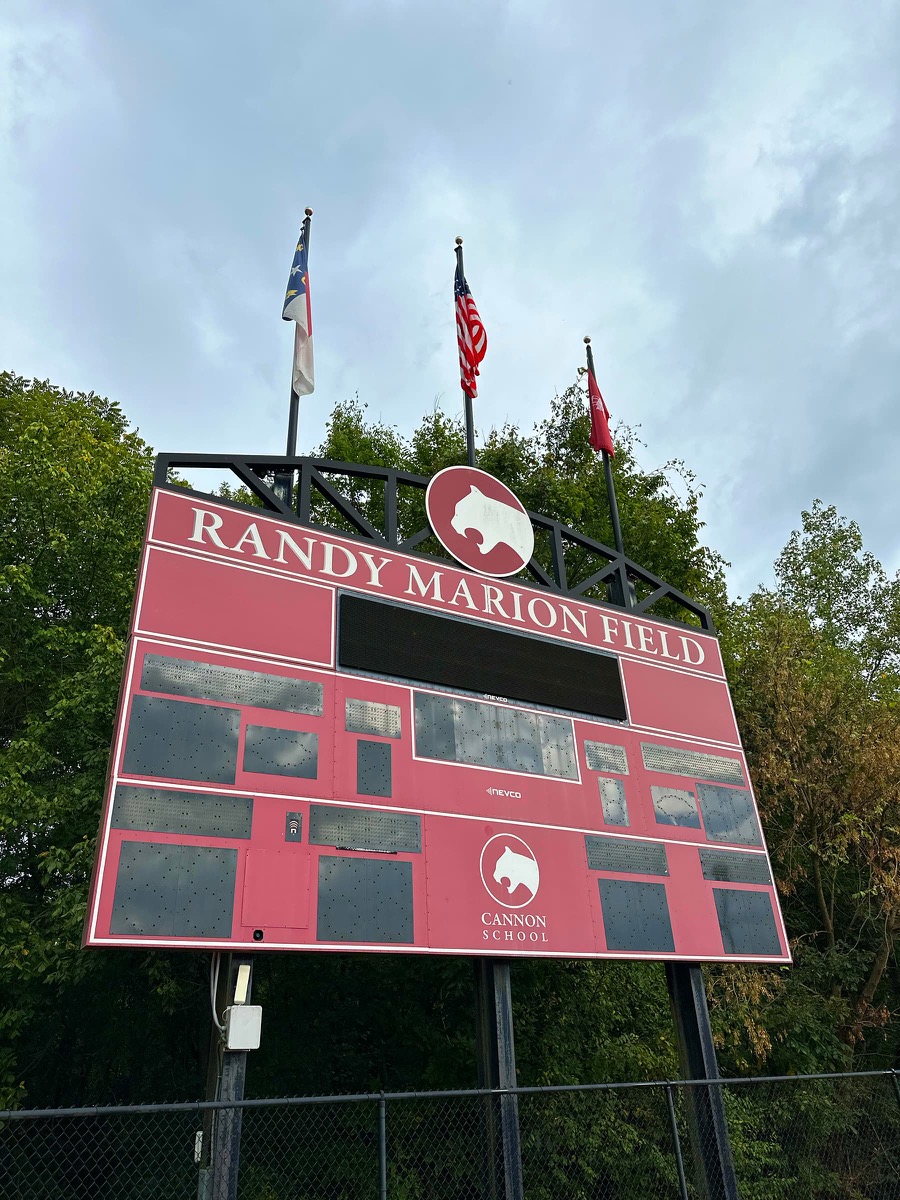
Randy Marion Field · synthetic turf
Hosts football, soccer, lacrosse and track meets, ringed by the eight-lane Tysinger Family Track
Photo: Cannon School athletics
Boswell Gym
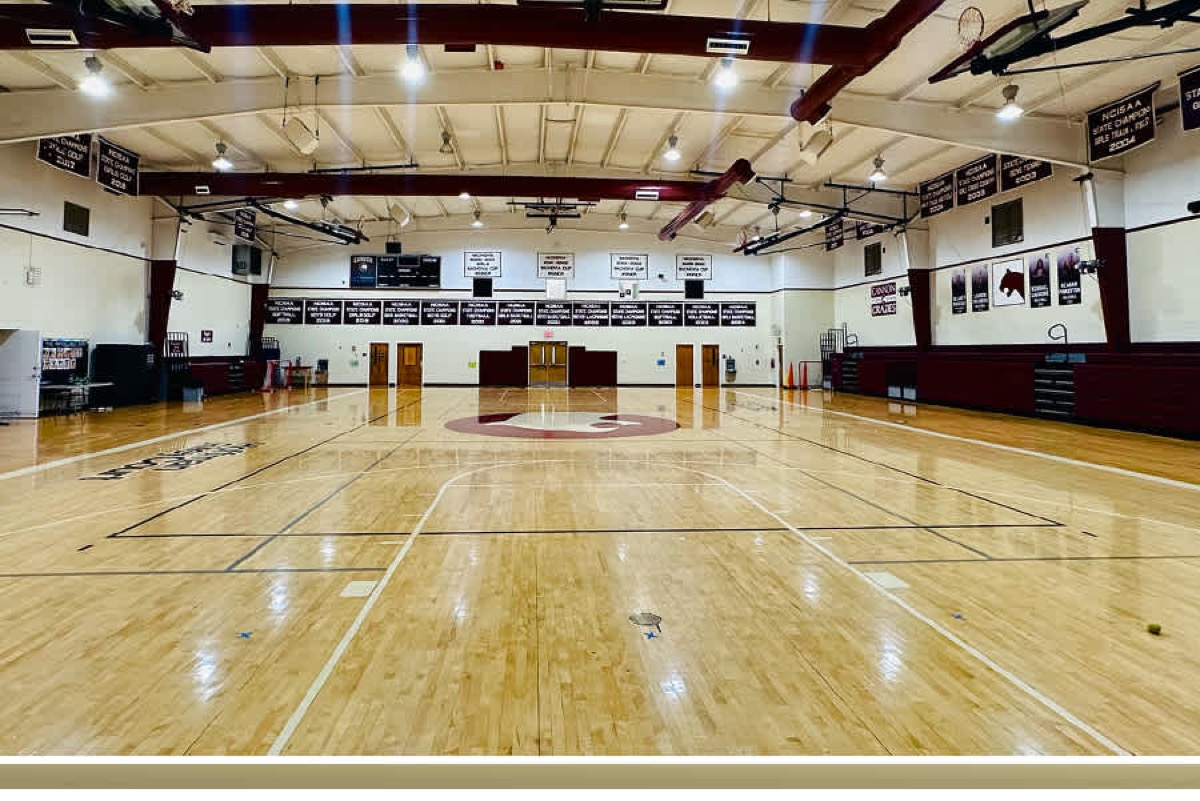
Boswell Gym · Hoffman Riley Court
Main competition gym; the court was named in January 2019 for announcers Mike Hoffman and the late John Riley
Photo: Cannon School athletics
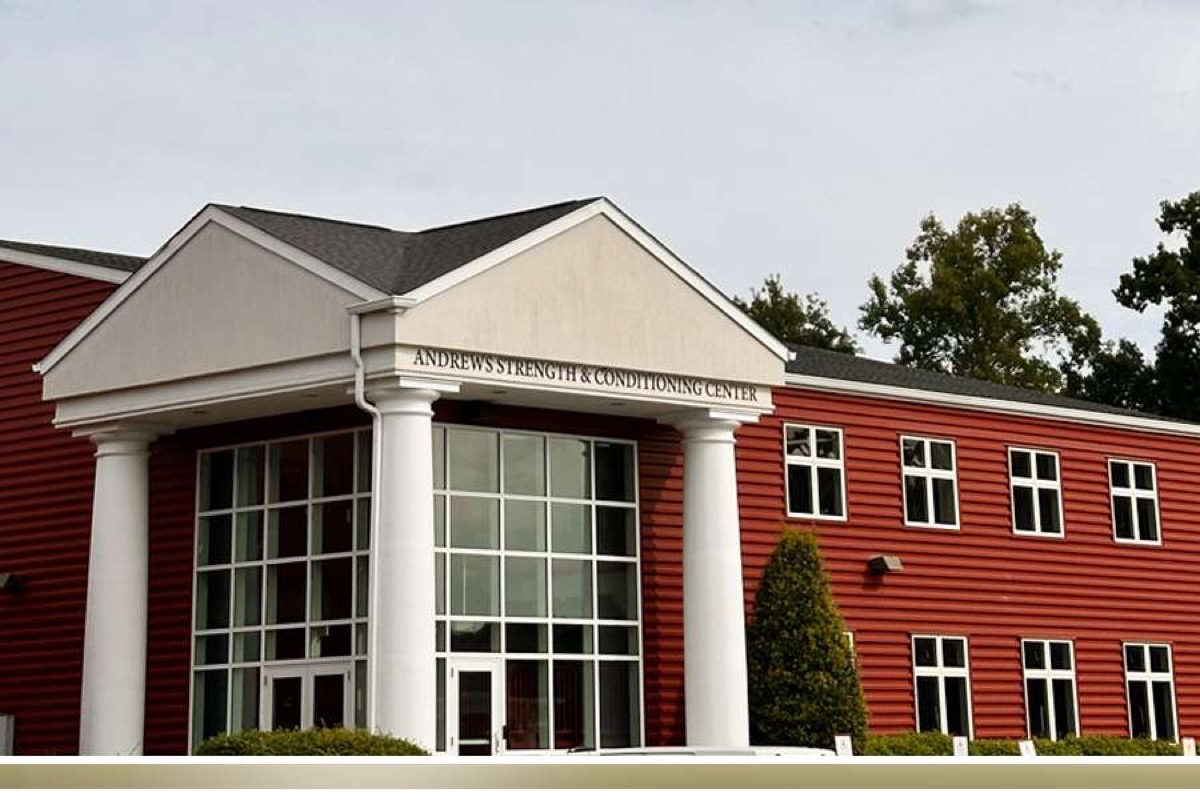
Andrews Strength & Conditioning Center
Andrews Strength & Conditioning Center · 4,100 sq ft, two floors
Eight strength stations, thirteen racks, and a second floor for rehab and low-impact cardio
Photo: Cannon School athletics
Venue ledger
Randy Marion Family Field House4,800 sq ft; three-booth press box
Tysinger Family Trackeight lanes, behind the Upper School
Hill Grimmett Multipurpose Center5,000 sq ft — wrestling, cages, agility
Snyder Baseball Fieldadjacent to softball
Softball Fieldbehind the school
Tennis Courtssix courts on two levels
Auxiliary Gymsupplemental practice gym
Soccer & Practice Fieldat the front entrance

Broadcast & game day: LocalLive and the NFHS Network carry Cannon events, with Hudl also listed; the Randy Marion Field House holds a three-booth press box for calling, video and scoring. Craig Reynolds serves as Assistant AD and Sports Information Director. The ticketing platform is not published.

The care model
Athletic trainers2 — Hayley Goldman (head) and Kelby Hurlocker, provided through a partnership with Novant Health
Team physicians2 Novant Health orthopedic surgeons — Dr. Bryan Edwards (sports-medicine fellowship with the Atlanta Falcons) and Dr. Jess Kirby
ConcussionsFollows current research and national best practices; every case documented with a personalized care and recovery plan
Return to playAthletes must hit all recovery milestones, pass functional testing, and be cleared by the trainer and, where appropriate, a physician
Safety infrastructureCustom emergency action plans for each venue, AEDs throughout, heat acclimatization plan, and First Aid/CPR/AED certification for all coaches
S&C staffShawn Powell (director, since 2014) and Duncan Hundley, running a grade-by-grade "block" system from grade 7 up

Cannon is a clinical education site for UNC Charlotte’s Master’s in Athletic Training. Note the contrast worth probing on a tour: Cannon and Charlotte Christian outsource to Novant and Atrium respectively, Charlotte Country Day uses OrthoCarolina, and Providence Day keeps care fully in-house. Seating capacities are not published for any Cannon venue.

Listen to a deep dive on this topic
Inside Cannon School College Support: Counseling, Rigor, and Where Grads Go
92%
AP scoring 3+
3 / 8
Ivy League
10 / 17
“Ivy Plus”
46 / 75
Top-75 National Universities
27 / 75
Top-75 Liberal Arts
52 / 68
Power Four
5 / 107
HBCUs
28:1
Seniors per counselor
Admission Rates at the Top NC Public UniversitiesAcross the six top-ranked NC public universities, Cannon School’s applicants were admitted at a pooled 60.8% over the last five entering classes — 479 acceptances from 788 applications.

Across the six top-ranked NC public universities, Cannon School’s applicants were admitted at a pooled 60.8% over the last five entering classes — 479 acceptances from 788 applications. UNC-Chapel Hill is the hard one: 31.7% in Fall 2025 — 20 of 63 — against far higher rates at the less-selective universities. These are UNC-system figures published by the state, not the school’s own.

788
applications to the six universities, Fall 2021–2025
60.8%
pooled admit rate — 479 of 788 across those five classes
31.7%
at UNC-Chapel Hill — 20 of 63, the toughest of the six for this school
UNC-Chapel Hill
drew the most applications in Fall 2025 (63)
The six universities — Fall 2025, with the five-year average
RankUniversityAppliedAcceptedAdmit rate from this school5-yr avg
#1UNC-Chapel Hill Flagship · Chapel Hill · the most selective of the six632031.7%37.4%273 applied · 102 in
#2NC State University Flagship STEM · Raleigh523465.4%58.1%236 applied · 137 in
#3UNC Charlotte Hometown campus · largest admit rates of the six2525100.0%96.0%99 applied · 95 in
#4East Carolina University Greenville · eastern NC1212100.0%96.8%62 applied · 60 in
#5UNC Wilmington Coastal · mid-selectivity171270.6%64.9%94 applied · 61 in
#6UNC Greensboro Piedmont Triad88100.0%100.0%24 applied · 24 in

Read each row as a joint figure: the rate at which that university admitted this school’s applicants — not the university’s overall admit rate, and not a measure of the school’s own selectivity. Applied/Accepted are the Fall 2025 entering class; the 5-yr column pools Fall 2021–2025 as sum(accepted)/sum(applied), so a heavy year counts more than a light one. Counts travel with every rate because several cells are single-digit.

TO VERIFYRank order follows the US News National Universities table for NC publics. That qualifier matters: Appalachian State is ranked in Regional Universities South, a different list, so “top 6 in NC” is not self-defining. Re-score when the next edition lands.
The Transcript Colleges SeeCannon publishes something almost no peer does — an explicit maximum AP/AT load by grade, capping a four-year transcript at eleven advanced courses and barring freshmen entirely.

Cannon publishes something almost no peer does — an explicit maximum AP/AT load by grade, capping a four-year transcript at eleven advanced courses and barring freshmen entirely. That ceiling is the key to reading a Cannon transcript: “most rigorous” here has a hard, published limit, and the 92% scoring 3+ comes from students who chose to sit an optional exam.

21
advanced courses — 13 AP plus 8 school-designed Advanced Topics
92%
of AP exams scored 3+ (425 exams, 197 students, Class of 2025)
0 / 1 / 4 / 6
published max AP/AT courses in grades 9 / 10 / 11 / 12
No rank
“Cannon School does not rank students”
Depth past the AP catalog
MathematicsThe ceiling is AP Calculus BC / AP Statistics — there is no published post-BC course, no multivariable calculus and no linear algebra. An “AT: Calculus with Applications” listed in 2024–25 has disappeared from the 2025–26 table.
Computer scienceAP Computer Science only, with no post-AP course and no data structures — thin relative to the rest of the advanced catalogue.
Advanced TopicsEight school-designed AT courses sit alongside the APs and carry the same 1.0 quality point, several with no corresponding College Board exam at all — for example AT: Design Thinking for Entrepreneurship.
Beyond campusNo Global Online Academy membership and no dual-enrolment partnership is published — this was checked specifically.
How the grade is engineered to be trusted
Weighted narrowly, and deliberatelyAT and AP courses carry 1.0 quality point; Honors and Honors Accelerated are not weighted at all. Both weighted and unweighted GPAs are calculated from Cannon coursework only.
No rank, and a modest ceilingNo rank, no decile or quintile table — but the narrow weighting plus the eleven-course cap means the weighted top decile tops out around 4.28. Cannon does not produce inflated 4.9 GPAs, which needs context for readers used to heavier schemes.
A per-discipline rigour keyBold entries in the profile’s course table mark the “most demanding coursework in that discipline per appropriate grade level”, so a reader can see the ceiling subject by subject rather than guessing.
TO VERIFYAP exams are OPTIONAL — “students in AT/AP classes have the option of sitting for the appropriate AP exam”. The 92.39% scoring 3+ therefore rests on a self-selected pool and is not directly comparable with schools that mandate the exam. The 197-student denominator is also undefined: it most likely means all Upper School exam takers rather than members of the 111-person graduating class.
PUBLICATION GAPNo National Merit ledger of any kind is published — no Semifinalist, Finalist or Commended counts in any year, on either profile or in news posts. Repeated searches surfaced only a 2011 item naming a single Scholar. AP Scholar counts and the share scoring 4–5 are likewise unpublished; Cannon reports only the 3+ threshold.
DISCREPANCYThe full grading scale appeared in the 2024–25 profile and was dropped from the 2025–26 edition — a disclosure regression, since a reader of the current profile cannot map a letter grade to a quality point.
The Counseling EngineCannon promises something structural that most schools do not: a student keeps the same college counselor for all four years, rather than being handed off in junior year.

Cannon promises something structural that most schools do not: a student keeps the same college counselor for all four years, rather than being handed off in junior year. Five staff, zero turnover across two published profiles, and a co-director model — plus the regional case-studies programme it physically hosts.

28:1
the school’s published ratio — reachable only counting seniors
5
staff — two co-directors, two associates, one coordinator
4 years
the same counselor for a student’s whole Upper School career
SCOIR
platform, alongside an annually refreshed School Profile
Who's in the room
Co-Director
Courtney Brayboy
Cannon runs an unusual shared top role rather than a single director.
Co-Director
Heidi Waibel
The roster is identical across the 2024–25 and 2025–26 profiles.
Assoc. Director
Adrian LeFevre
Assoc. Director
Connie Stavrakas
Coordinator
Clay Morrell
Zero turnover across at least two years is itself a stability signal.
The published programme — parent-facing, by grade
9–10Foundational
ACT/PSAT Interpretations for freshman and sophomore parentsCounseling begins in ninth grade as a stated four-year programme
11In earnest
College Admission Case Studies EventCollege Admission Deans PanelBoth aimed at junior parents
12Intensive
College Kick-OffTransitioning your child beyond Cannon
The mechanics the office owns
Applications
The admission process
Financial aid process
Transcript requests
Testing interpretation

That is the published scope. Note what is absent from it: essay coaching or brainstorming workshops, a teacher-recommendation coordination process, interview preparation, and any scholarship-search service are none of them explicitly claimed — consistent with the absence of a scholarship-dollar headline.

Reach & tools
Hosts the Lake Norman Area College Admissions Case Studies Program and College Fair, co-hosted with Davidson Day — Cannon is the venue
Second annual edition held 26 April 2026, confirmed independently from a college’s own registration portal
SCOIR · an annually refreshed School Profile · CEEB 340879
TO VERIFYThe marketed “28:1 ratio” only works as seniors per counselor (111 ÷ 4). Measured across the 423-student Upper School it is nearer 106:1, and the school never states the denominator — so 28:1 should not be read as a whole-Upper-School caseload.
PUBLICATION GAPNo counselor tenure, prior background, degrees or biographies are published — names and titles only, so director tenure is unknown. Neither rep-visit counts nor counselor campus-visit counts are published in any form. Note that Davidson Day’s published “80+ reps a year” belongs to Davidson Day, not Cannon.
PUBLICATION GAPThe student-facing curriculum is unpublished: seminar cadence, one-on-one meeting counts, essay workshops and junior conference timing appear nowhere. Cannon publishes what it invites parents to, not what it does with students. A four-year self-exploration strand described in the 2024–25 profile was cut from the 2025–26 edition without explanation.
Where Graduates GoCannon publishes what most schools here do not — an actual matriculation list. 58 institutions enrolled a Class of 2023 graduate, including Stanford, Duke, Penn, UCLA and the Air Force Academy.

Cannon publishes what most schools here do not — an actual matriculation list. 58 institutions enrolled a Class of 2023 graduate, including Stanford, Duke, Penn, UCLA and the Air Force Academy. That list is far stronger evidence than the acceptance rollup beside it, which aggregates three graduating classes and has not been refreshed since the Class of 2024.

98%
of the Class of 2025 to four-year colleges · 2% to two-year
58
institutions where a Class of 2023 student actually enrolled
111
graduating seniors — the second largest class in school history
3 of 8
Ivy League on the 2022–24 acceptance list
The selectivity buckets
TierOn list
Ivy League — Brown, Cornell, Penn; absent Harvard, Yale, Princeton, Dartmouth, Columbia3 / 8
“Ivy Plus”10 / 17
Top-75 National Universities46 / 75
Top-75 Liberal Arts27 / 75
Power Four52 / 68
HBCUs — Historically Black Colleges & Universities5 / 107

Counts are computed from the same list you can filter at right, scored against the 2026 U.S. News tables — derived analysis, not school-reported. The Ivy count is reported strictly: the list contains “Columbia College”, which almost certainly means Columbia College in South Carolina, Chicago or Missouri rather than Columbia University, since the latter would be printed as “Columbia University”. Read loosely it would be 4 of 8; both readings are stated rather than one being picked.

Every acceptance, 2022–2024 — filter & search
283 shown · 283 institutions · bold = a Class of 2023 student enrolled
Agnes Scott College Liberal Rank #67
American University National Rank #88
Auburn University National Rank #102
Baylor University National Rank #88
Belmont University National Rank #213
Boise State University National Rank #301
Boston College National Rank #36
Boston University National Rank #42
Bowdoin College Liberal Rank #5
Brown University National Rank #13
Bryn Mawr College Liberal Rank #30
Bucknell University Liberal Rank #30
Campbell University National Rank #343
Chapman University National Rank #110
Clemson University National Rank #75
Colgate University Liberal Rank #22
Columbia College
Cornell University National Rank #12
Davidson College Liberal Rank #13
Denison University Liberal Rank #34
DePauw University Liberal Rank #58
Drew University Liberal Rank #84
Drexel University National Rank #80
Duke University National Rank #7
Eckerd College Liberal Rank #135
Elon University National Rank #117
Emory University National Rank #24
Fordham University National Rank #97
Furman University Liberal Rank #45
Gardner-Webb University National Rank #384
George Mason University National Rank #117
Georgetown University National Rank #24
Gettysburg College Liberal Rank #58
Goucher College Liberal Rank #126
Grand Canyon University National Rank #395-434
Guilford College Liberal Rank #172
Hamilton College Liberal Rank #13
Harvey Mudd College Liberal Rank #10
Hofstra University National Rank #183
Hollins University Liberal Rank #135
Howard University National Rank #88
Juniata College Liberal Rank #92
Kansas State University National Rank #158
Kenyon College Liberal Rank #45
Lafayette College Liberal Rank #30
Lehigh University National Rank #46
Liberty University National Rank #395-434
Macalester College Liberal Rank #28
Middlebury College Liberal Rank #13
Muhlenberg College Liberal Rank #70
New York University National Rank #32
Oberlin College Liberal Rank #58
Old Dominion University National Rank #293
Pepperdine University National Rank #84
Point Park University National Rank #318
Presbyterian College Liberal Rank #163
Purdue University National Rank #46
Quinnipiac University National Rank #179
Rice University National Rank #17
Roanoke College Liberal Rank #126
Saint Louis University National Rank #102
Samford University National Rank #179
Seton Hall University National Rank #158
Spelman College Liberal Rank #37
St. John's University National Rank #151
Stanford University National Rank #4
Syracuse University National Rank #75
Temple University National Rank #102
Texas A&M University National Rank #51
The New School National Rank #213
Tufts University National Rank #36
Union College Liberal Rank #44
University of Alabama National Rank #169
University of Arizona National Rank #127
University of Arkansas National Rank #183
University of Charleston National Rank #395-434
University of Dayton National Rank #143
University of Denver National Rank #117
University of Florida National Rank #30
University of Georgia National Rank #46
University of Kentucky National Rank #143
University of Lynchburg National Rank #329
University of Miami National Rank #64
University of Oklahoma National Rank #110
University of Oregon National Rank #110
University of Utah National Rank #151
University of Vermont National Rank #132
Vanderbilt University National Rank #17
Vassar College Liberal Rank #13
Villanova University National Rank #57
Wesleyan University Liberal Rank #13
Wheaton College - IL Liberal Rank #50
Wheaton College - MA Liberal Rank #76
William & Mary National Rank #51
Wingate University National Rank #373
Wofford College Liberal Rank #67
Xavier University National Rank #208
Scholarship & named-award headline
No merit-scholarship total publishedMorehead-Cain: a 2015 recipient, nothing currentU.S. Air Force Academy enrollment (Class of 2023)Cum Laude Society chapter since 2005

This is Cannon’s single largest outcome-data gap. No merit-scholarship dollar figure appears on either profile or in any news post, and no current Morehead-Cain, Park, QuestBridge or ROTC outcome is published. Cannon does publish $3,000,000 in tuition assistance to 24% of its students — but that is the school’s own inbound financial aid, not college merit money, and the two must not be conflated.

Honest caveat: the headline list is explicitly “College Acceptances” across three graduating classes (2022, 2023, 2024) — roughly 330 students, each generating multiple acceptances. An institution appearing there does not mean a Cannon student attended, or that an acceptance happened in any particular year. Prefer the Class of 2023 matriculation list, which is real enrollment. Note also that the 2025–26 profile dropped the acceptance list entirely, so the newest available data is already one full cycle stale. This window begins in 2022, a year earlier than the 2023 floor the other schools here share: Cannon publishes only this single pre-aggregated block with no per-class breakdown, so the 2022 acceptances cannot be split off without discarding the list, and the school has published nothing newer to replace it.

TO VERIFYThe profile’s bold “enrolled” markers for the Class of 2024 did not survive PDF text extraction, so the enrolling markers here come from the separately published Class of 2023 matriculation list instead. They are real enrollments, but for a different class than the acceptance list’s bold key describes.
The Applicant's EdgeCannon’s differentiator is a set of course-embedded research experiences that end in a public defence — including one judged by an external committee of science professionals and business leaders.

Cannon’s differentiator is a set of course-embedded research experiences that end in a public defence — including one judged by an external committee of science professionals and business leaders. The spike here is built inside the curriculum rather than bolted on: take the course, and the defensible artefact is a requirement rather than an option.

Lever 1 — Build the spike
BIOREX — the Biological Research Experience, embedded in Honors Biology. Students form a hypothesis, test it, analyse it statistically and present to a committee of faculty, science professionals and local business leaders. External judging is what separates this from a class project.
Symposium and Portfolio Defense — an original historical argument defended in the spring of junior year (AT: U.S. History), and a multi-draft digital portfolio presented in AT: American Language and Composition.
Independent Study — petition-based, and unusually the student co-develops the course content and the assessment rubric, then produces an end-of-year artefact.
Senior Capstone — a philanthropic service project with a culminating public presentation to faculty, staff, peers and community. It is the one near-universal senior experience, though service itself is explicitly not a graduation requirement.
Global Education Certificate — fully specified: World History I–II plus three levels of a world language, a senior Glocal Perspectives course with a capstone essay and presentation, and at least two of three global experiences. Awarded at Senior Night.

Entrepreneurship and Engineering exist as course tracks with real depth — Honors Design Thinking & Entrepreneurship Lab, Creative Design and Engineering I–III, The Mill makerspace — but there is no published distinction or credential for either, so they should be read as tracks rather than certificates. No required internship or externship programme is published.

Lever 2 — The school’s leverage
The profile publishes its own ceiling — the maximum AP/AT load by grade, with a footnote that maths placement governs whether a student can reach it. Disclosing the cap protects students from being read against an unlimited-load norm they were never allowed to attempt.
Integrity signalling — the office “reports out-of-school suspensions and expulsions through time of graduation to any colleges and universities that request this information”: a disclose-on-request posture consistent with current NACAC norms.
Institutional memberships — NACAC, SACAC and ACCIS, alongside a Cum Laude Society chapter awarded in 2005 and membership of the Independent Curriculum Group, which is what makes the school-designed AT tier and the optional-exam stance coherent rather than idiosyncratic.
Hosting regional admissions traffic — Cannon is the venue for the Lake Norman case-studies programme and fair, pulling visiting admissions officers onto its own campus at regional scale rather than only sending students out.
Whole Class AnalyticsCannon publishes a top-10% band and a middle-50% band for both tests and both GPAs — a genuinely useful shape, reported in a format that is not percentiles.

Cannon publishes a top-10% band and a middle-50% band for both tests and both GPAs — a genuinely useful shape, reported in a format that is not percentiles. The most informative figure is the unweighted middle 50% of 3.57–3.94: the median Cannon student sits in the high-B-plus to A-minus range before any weighting.

SAT score percentiles — Class of 2025 · number of testers not published
Percentile10th25th50th75th90thMean
SAT total122013801470

Cannon publishes a middle-50% band and a top-10% band only. The middle-50% endpoints conventionally ARE the 25th and 75th percentiles, so those columns are real; the top-10% figure is shown in the 90th column as the floor of that band (1470–1590). No mean, median, section subscores, or tester counts are published for either test.

ACT score percentiles — Class of 2025 · number of testers not published
Percentile10th25th50th75th90thMean
ACT composite253133

Same reporting format: the 90th column shows the floor of the published top-10% band (33–36). Without a tester count there is no way to tell what share of 111 seniors sat either exam, which materially limits how far these bands can be read.

GPA distribution — Class of 2025, cumulative through grade 11 · transfers excluded
Weighted · top 10%
4.22–4.28
a modest ceiling, by design
Weighted · mid 50%
3.67–4.11
the middle of the class
Unweighted · top 10%
3.96–4.00
effectively straight A’s
Unweighted · mid 50%
3.57–3.94
high B+ to A− before weighting

These are bands, not a quintile table — no full quintile or decile breakdown, median GPA, or per-band student count is published. The modest weighted ceiling follows directly from the 1.0-quality-point cap and the eleven-course AP/AT maximum, which is a transparency point in Cannon’s favour but needs context for readers used to heavier weighting schemes.

Learning differences through the process
Three named Upper School specialistsMichelle Donah, Tere Hurtado and Jennifer Ridenhour — substantial staffing for 423 Upper School students, and among the best-documented learning support in this set.
The student owns the planStudents actively participate in creating their own personalized learning plans with specific accommodations, supported by a formally constituted team: the student, parents, teachers, the Assistant Head for Academics, the Student Dean, the Upper School Counselor and the advisor.
Where it reaches the applicationFor juniors and seniors the programme provides guidance on requesting College Board and ACT testing accommodations — the specific service that converts learning support into college-application support.
The surrounding structureThe Academic Resource Center for maths, writing, science and world languages; 1:1 academic coaching on executive function; and a faculty-facilitated, peer-led Academic Lab.

Not published: how many students are on formal learning plans, whether accommodations carry a fee, and specialist credentials.

The middle & the non-traditional path
The list is printed honestlyThe acceptance list runs from MIT, Stanford and Bowdoin down through Rowan-Cabarrus, Cape Fear and Central Piedmont community colleges, Brevard, Barton, Catawba, Mars Hill, Wingate, Limestone, Methodist, Gardner-Webb, Guilford, Lenoir-Rhyne and Coker. A school optimising for prestige would omit these; Cannon prints them, and discloses its 2% two-year figure rather than burying it.
A design-weighted arts pathwayPratt, Parsons, SAIC, SCAD, Ringling, FIT, FIDM, UNCSA and Emerson — deep and visual/design-weighted rather than music-conservatory-weighted, despite strong ensemble offerings.
Other non-traditional destinationsInternational universities (St Andrews, Edinburgh, Aberdeen — a confirmed 2023 enrollment, University College Dublin, McGill, Toronto); service academies and the military (Air Force Academy, The Citadel, VMI); technical institutes (Rose-Hulman, WPI, Stevens, Colorado School of Mines, RPI); HBCUs (Howard, Spelman, NC A&T, NC Central, Winston-Salem State).
DISCREPANCYThe 2024–25 profile published NO test scores at all, stating that because of test-optional review “test scores for the Class of 2025 are not reported”. The 2025–26 profile then published a full Class of 2025 testing distribution. Same class, opposite decisions, one year apart, unexplained — the later figures are shown here.
TO VERIFYAll four GPA bands are identical to the hundredth across the Class of 2024 and Class of 2025 tables. An exact four-band match across two different cohorts is statistically unlikely, so this may be carried-forward data rather than a genuinely stable distribution.
PUBLICATION GAPNo gap-year statistic, policy or counselling service is described anywhere — and since 98% four-year plus 2% two-year accounts for the whole class, the published outcomes leave no room for a gap-year cohort at all.
Verdict & Visit ChecklistA stable, structurally honest programme — four-year counselor continuity, a published load ceiling, real research defences, and a genuine matriculation list — wrapped in thinner outcome disclosure than its larger peers.

A stable, structurally honest programme — four-year counselor continuity, a published load ceiling, real research defences, and a genuine matriculation list — wrapped in thinner outcome disclosure than its larger peers. Most of what is missing here is publication rather than practice, which makes almost every gap a question a tour can answer.

Why it holds up
Four-year counselor continuity, stated in writing — students keep the same college counselor for their whole Upper School career rather than being handed off in junior year — and the five-person roster shows zero turnover across two published profiles.
The rigour ceiling is disclosed, not implied — a published maximum of 0/1/4/6 AP or AT courses by grade caps a transcript at eleven, so colleges read “most rigorous” against a limit the school itself states.
Research experiences with real external judging — BIOREX is presented to a committee including science professionals and local business leaders, Symposium demands an original historical argument, and Independent Study has the student writing the rubric.
It publishes an actual matriculation list — 58 institutions where a Class of 2023 graduate genuinely enrolled — Stanford, Duke, Penn, UCLA, USC, Vanderbilt, Middlebury, Vassar, Georgia Tech, UNC, UVA, William & Mary and the Air Force Academy. That is stronger evidence than any acceptance rollup.
Learning support is named and reaches the application — three named Upper School learning specialists, student-authored personalised learning plans, and explicit guidance for juniors and seniors on requesting College Board and ACT accommodations.
Grades are not inflated — Honors courses carry no weight at all and only AT/AP add a point, so the weighted top decile tops out near 4.28 rather than in the high 4s.
Ask on the tour — tick as you go
Listen to a deep dive on this topic
After School at Cannon School, Providence Day School, and Charlotte Country Day School
6:00 PM
Latest pickup time
≈$378/mo
Cost of after-school care
The Coverage MapOne uniform program covers JrK through grade 8 from 3:00 to 6:00 p.m. — no age-based cutoff, no split between Lower and Middle School, and a genuine drop-in option.

One uniform program covers JrK through grade 8 from 3:00 to 6:00 p.m. — no age-based cutoff, no split between Lower and Middle School, and a genuine drop-in option. Upper School has nothing. Every division dismisses at 3:00, so the coverage question here is simply whether a child is in grade 8 or below.

2 pm3 pm4 pm5 pm6 pm
JrK – Grade 8
dismissal 3:00
After School Program · 3:00–6:00 · $3,784/yr
Grades 9–12
dismissal 3:00
No after-school program — ASP is JrK–8 only
Early-dismissal days
dismissal 11:45
ASP runs 11:45–4:00 — pack a lunch, the cafeteria is closed
JUN–JULCamp Cannon — ages 4–18, 8 June to 31 July 2026, open to non-Cannon families. Before care 7:30–9:00 a.m. $50/wk, after care 4:00–5:30 p.m. $60/wk, or $90/wk combined. RNs and a certified athletic trainer on site.

The price on the bar is the full-time annual rate — 5 days a week, and Cannon publishes a single annual figure rather than a monthly one. 1–4 days a week runs $1,018–$3,290 or skip the contract entirely at $11.5 an hour; open The Cost Planner below for the full ladder. These are 2025-26 rates — no 2026-27 card is published.

Middle School: students are supervised only until 3:15 p.m. — after that they are sent to After School Care and billed, whether or not the family opted inBefore school: no paid program — free arrival from 7:30 a.m. onlyDismissal changes: must be submitted via Veracross by 1:00 p.m. the same daySnack: nut-free snacks provided daily; some may contain dairy or gluten

PUBLICATION GAPTeacher-workday and holiday coverage is not published at all — only early-dismissal days are addressed.

PUBLICATION GAPJrK and Kindergarten dismissal is not published separately; both are grouped under Lower School’s 3:00 p.m.

TO VERIFYThe school uses two names for one program — ASP on the program page and ASC (After School Care) in the Middle School handbook — which suggests the documentation is not tightly maintained.

The Cost PlannerCannon prices After School as a single annual contract by days per week — with a real drop-in alternative at $11.50 an hour and no contract at all.

Cannon prices After School as a single annual contract by days per week — with a real drop-in alternative at $11.50 an hour and no contract at all. These rates are 2025-26, the most recent published, and they survive only on an orphaned backup page — the live fee pages carry no dollar figures whatsoever.

Days / week
Grade · pickup slot (per year)1 day
VERIFIED
2 days
VERIFIED
3 days
VERIFIED
4 days
VERIFIED
5 days
VERIFIED
$1,018$1,904$2,658$3,290$3,784
Fees & fine print
Registration fee$25
Registration fee if enrolled earlywaived
Drop-in care$11.5 / hr
Late pickup$1 / min

Registration runs through Veracross. The $1/minute late fee applies to drop-in families too — 20 minutes late is $20 nearly double the hourly rate. The registration waiver was tied to enrolling before 1 August in 2025-26; whether it repeats is not published.

Your estimate
JrK–Grade 8 · 3:00–6:00 pm
5 days / week, until pickup
$3,784/ year
≈ per afternoon$21
Or skip the contract entirely. Drop-in is $11.5 an hour with no commitment. A family needing two afternoons a month pays roughly $100 a year instead of $1,904 — the most forgiving occasional-use option in this set.

STALEEvery figure above is 2025-26, not 2026-27. No current rate card is published anywhere — the live Back-to-School Center was emptied and now simply points families to the My Cannon Portal. Treat these as a one-cycle-old floor and expect an increase.

PUBLICATION GAPThe pricing is effectively hidden from prospective families. The rate card exists only on an orphaned backup URL inside a collapsed accordion; the program page, the tuition page and the official Non-Tuition Fees PDF all omit it — that PDF even lists "After School Program" and "Beyond the Bell" as fee-bearing while assigning them no amount, though it prices everything else down to a $98 AP exam.

PUBLICATION GAPSibling discounts, financial-aid applicability to After School, and the billing cadence — annual up front, per semester, or monthly — are all unpublished.

TO VERIFYThe ladder rewards heavy users: five days ($3,784) costs only about 3.7× the one-day rate, so the marginal day gets steadily cheaper. Five-day care is roughly 13% of JrK tuition.

A Day Inside + EnrichmentThe school describes homework help, sports, art, cooking, nature and a garden — but never says when any of it happens.

The school describes homework help, sports, art, cooking, nature and a garden — but never says when any of it happens. What Cannon does publish in real detail is Beyond the Bell: three 10-week enrichment sessions a year, with a genuine day, grade band, provider and fee for every class.

The program, in the school’s words
safe, nurturing environmenthomework assistanceplay sportsart activitiescookexplore naturethe garden

"Cannon School’s After School Program (ASP) provides students in grades JrK - 8 with a safe, nurturing environment. Students have the opportunity to receive assistance with their homework, play sports, participate in art activities, cook, discover and explore nature, and experience cultivating and observing our garden." The school adds that experiences "foster their individual, developmental, social, and emotional needs" so that "the students truly become adaptive experts". The Admission FAQs stress the flexibility: care "can be used on an as-needed, drop-in basis".

Beyond the Bell — Session 3, spring 2026

Three 10-week sessions run each year for JrK–grade 8, plus private music lessons. The 22 classes below are the most recent published catalog, 9 March to 22 May 2026 — recovered from the school’s own session brochure. Fees are shown per class and per session. Note that Beyond the Bell is a separate purchase from ASP: a 3:00–4:00 class does not cover you to 6:00.

Grade
22 of 22 classes
ClassDayGradesFee
3 v. 3 Basketball
Small-sided games with Kelli Waller
Mon2–6$22/class · $176
Jr. Cannon Cheer
Cheer fundamentals with Nash & Colacion
MonJrK–2$25/class · $200
Engineering Design
Build-and-test challenges run by BrickEd
MonK–2$25/class · $200
Kaleidoscope of Crafts
Mixed-media making with McKinsey & Raphael
Mon2–4$25/class · $200
LEGO Robotics Team
Team build-and-program with Lisa Nussbaumer
Mon3–5$23/class · $184
Puppet Playhouse
Puppet making and performance with Rhiannon Bresalier
MonJrK–2$20/class · $160
Baking with Chef Craig
Kitchen skills and recipes with Craig Rosekrans
Tue1–3$25/class · $250
Art on The Go
Run by AR Workshop Concord; 3:00–4:30
Tue3–8$25/class · $250
Motion Makers
Dance with Art in Motion Dance
TueK–2$20/class · $200
Nature Games
Outdoor exploration and games with Kelli Waller
TueJrK–4$22/class · $220
CSF Soccer Academy
Coached by Carolina Soccer Factory
TueK–6$25/class · $250
Wonder Lab: Art & Science
Cross-disciplinary making with Mayo & Cavicchi
TueJrK–1$25/class · $250
Ballet Class
Taught by Le Petit Ballet Co.
WedJrK–2$30/class · $300
Beginner String Orchestra
Ensemble strings with Anne Marie Samuel
Wed1–8$30/class · $300
Golf Academy
Run by Better Golf for Kids
WedK–5$25/class · $250
Junior Sculptors
Three-dimensional art with Alex Bresalier
WedJrK–2$20/class · $200
Let's Get Organized
Executive-function skills for Middle School, with Sherrill & O’Brien
Wed5–8$25/class · $250
Young Athlete Performance (YAPP)
Athletic development with Donnie Hayes
Wed2–4$18/class · $180
Hands On History
Object-based history with Stephanie Lee
Thu4–8$20/class · $200
Introduction to Photography
Camera basics and composition with Danielle Sandlof
Thu3–6$20/class · $200
Make It Melt! Perler Beads
Bead art with Dobbins & Fox
ThuK–4$25/class · $250
Masterpiece Makers
Painting and drawing with Danielle Lucas
ThuK–3$25/class · $250

TO VERIFYPrivate music lessons run alongside for K–8: cello $25/class (Mon/Wed), guitar $25 (Wed/Fri), voice $30 (Tue/Thu), piano $30 (Mon/Tue/Thu) and violin or viola $30 (Tue/Thu).

STALEThis is the 2025-26 Session 3 catalog — the newest published. No 2026-27 Beyond the Bell catalog has been posted yet, so the specific classes will change even though the price band and structure are likely to hold.

PUBLICATION GAPNo hour-by-hour daily rhythm and no staff-to-child ratios are published for the After School Program itself, and Middle School has no separate program description — grades 5–8 sit inside the same JrK–8 program.

Verdict & Visit ChecklistThe most flexible program here for occasional users, with the deepest published enrichment catalog — wrapped in pricing that is technically public but practically invisible.

The most flexible program here for occasional users, with the deepest published enrichment catalog — wrapped in pricing that is technically public but practically invisible. The rate card survives only on an orphaned backup page, the figures are a year old, and grades 9–12 get nothing.

Why it holds up
Long, uniform coverage — 3:00 to 6:00 p.m. every regular day across the whole JrK–8 span, with no age-based cutoff and no split Lower/Middle program.
Early-dismissal days are covered, 11:45 a.m.–4:00 p.m., which several peers here do not do at all.
True drop-in at $11.5 an hour with no contract. A family needing two afternoons a month pays around $100 a year rather than committing to $1,904 — the most forgiving occasional-use model in this set.
A sharp price ladder — five days costs only about 3.7× the one-day rate, so heavy users get a real discount rather than a linear bill.
The deepest published enrichment catalog of the six — 22 distinct classes in a single session spanning robotics, ballet, chess, pottery, golf and photography, each with a named provider and a real fee.
Enrichment is modestly priced and transparent — $18–$30 per class, mostly $144–$300 for a 10-week session, with full refunds for cancelled classes and a make-up week.
An executive-function class for Middle School ("Let’s Get Organized") — a genuinely unusual offering at this age.
Watch-outs
!No after-school coverage for grades 9–12 at all. A family with an Upper Schooler and a Lower Schooler gets care for only one.
!The pricing is practically hidden. The rate card exists only on an orphaned backup URL inside a collapsed accordion, while the live page, the tuition page and the official fee PDF all omit it. A family doing normal research will not find it.
!The published rates are 2025-26, so expect an increase for 2026-27 that is not yet knowable.
!The $1/minute late fee is steep and applies to drop-in families too — 20 minutes late costs $20 nearly double the hourly rate.
!Enrichment and care are separate purchases. A 3:00–4:00 Beyond the Bell class does not cover you to 6:00, so the costs stack.
!The Middle School 3:15 rule can bill you in without an opt-in — a parent 20 minutes late for a 3:00 pickup may find their child moved into paid care.
!No published daily rhythm and no staff-to-child ratios, so you cannot tell how much of the three hours is homework versus free play.
!Teacher workdays and holidays are unaddressed, and there is no paid before-school care — only free arrival from 7:30 a.m.
Ask on the tour
Listen to a deep dive on this topic
Summer Camp at Cannon School, Providence Day School, and Charlotte Country Day School
7
Weeks of summer camp
251
Camps published
4–18
Ages served
7:30 AM–5:30 PM
Wrap-around care
The Camp Catalog251 camp-week offerings across seven weeks — roughly 180 distinct titles, sorted into the school’s own five categories.

251 camp-week offerings across seven weeks — roughly 180 distinct titles, sorted into the school’s own five categories. The season runs June 8 to July 31, 2026, closed for Juneteenth and for the whole week of June 29–July 3. Week 2 is a four-day week and every tier is priced down for it.

60 of the 251 offerings are listed below, sampled across all five categories, every price tier and all seven weeks. The full catalog is the "Camp Planning Workbook" on pp. 5–11 of the school’s 2026 brochure, linked in the sources. Camp Cannon indexes by age, not grade, except for a handful of school-readiness camps that name a rising grade.

Grade
76 of 76 camps
CampWhenGradesPrice
Adventure CampSports & Games
The premium all-day outdoor camp — $490.00 in a five-day week and $392.00 in the four-day one.
Mon–Fri
9:00 - 4:00
Weeks 2, 5
10-15$490
NarniaPerformance Arts
The other $490.00 premium all-day camp — a full-scale theatrical production.
Mon–Fri
9:00 - 4:00
Week 7
8-15$490
Musical Theater in a WeekPerformance Arts
A full-day musical staged inside a single week.
Mon–Fri
9:00 - 4:00
Weeks 1, 3
7-11$450
Charlie & The Chocolate FactoryPerformance Arts
Full-day production camp.
Mon–Fri
9:00 - 4:00
Week 4
8-15$450
How to Train Your DragonPerformance Arts
The four-day-week production camp, priced at $392.00.
Mon–Thu
9:00 - 4:00
Week 2
8-15$392
Play With Clay: Ceramics CampVisual Arts
Full-day ceramics, offered to two age bands in different weeks.
Mon–Fri
9:00 - 4:00
Weeks 1, 3
8-12$450
Engineering DesignSTEM & Academics
Full-day engineering, offered to two age bands.
Mon–Fri
9:00 - 4:00
Weeks 1, 3
9-12$450
Rockin' RoboticsSTEM & Academics
Full-day robotics.
Mon–Fri
9:00 - 4:00
Week 3
9-12$450
Aeronautics & RocketsSTEM & Academics
Full-day rocketry, offered to two age bands in consecutive weeks.
Mon–Fri
9:00 - 4:00
Weeks 4, 5
5-8 / 9-12$450
Stop Motion AnimationVisual Arts
Full-day animation, offered to two age bands.
Mon–Fri
9:00 - 4:00
Weeks 4, 5
5-8 / 9-12$450
Crime Scene InvestigationSTEM & Academics
Full-day forensics, offered to two age bands in the final two weeks.
Mon–Fri
9:00 - 4:00
Weeks 6, 7
9-12 / 5-8$450
Creative Writing CampSTEM & Academics
Full-day writing for the older band.
Mon–Fri
9:00 - 4:00
Week 6
11-14$450
College Essay BootcampSTEM & Academics
Rising seniors only, offered morning and afternoon in two separate weeks — the school’s one $350.00 tier.
Mon–Fri
9:00 - 12:00 & 1:00 - 4:00
Weeks 1, 7
Rising 12th$350
SAT & ACT Score Boost Boot Camp: Math MasterySTEM & Academics
Test preparation for rising grades 9 to 12.
Mon–Fri
9:00 - 12:00
Week 4
Rising 9th-12th$245
SAT & ACT Score Boost Boot Camp: Reading & English MasterySTEM & Academics
The verbal counterpart, in the same week.
Mon–Fri
1:00 - 4:00
Week 4
Rising 9th–12th$245
Literacy CampSTEM & Academics
Reading support for rising 5th to 8th graders, offered in four consecutive weeks.
Mon–Fri
9:00 - 12:00
Weeks 3, 4, 5, 6
Rising 5th–8th$245
Jump Into CannonSTEM & Academics
A school-orientation camp — offered to rising JK/K and to rising 1st–4th in different weeks.
Mon–Fri
9:00 - 12:00
Weeks 5, 6, 7
Rising JK & K$225
Ready, Set, First GradeSTEM & Academics
First-grade readiness.
Mon–Fri
9:00 - 12:00
Week 6
Rising 1st$225
Leadership Launch!STEM & Academics
The oldest camp in the catalog — leadership for teens.
Mon–Fri
9:00 - 12:00
Week 6
14-17$225
Cannon SoccerSports & Games
Soccer with the school’s coaching staff, across the widest age band in the sports catalog.
Mon–Fri
9:00 - 12:00
Weeks 1, 3, 7
5-15$225
Cannon BaseballSports & Games
Baseball, offered in four of the seven weeks.
Mon–Fri
9:00 - 12:00
Weeks 2, 3, 6, 7
4-13$225
Cannon Basketball Hoops AcademySports & Games
Basketball skills.
Mon–Fri
9:00 - 12:00
Weeks 1, 4
6-14$225
Cannon Track & Field CampSports & Games
Track and field.
Mon–Fri
9:00 - 12:00
Weeks 1, 7
10-14$225
Cannon Lacrosse--BoysSports & Games
Boys lacrosse in the closing week.
Mon–Fri
9:00 - 12:00
Week 7
6-13$225
Cannon Lacrosse--GirlsSports & Games
The girls’ edition, run the same week.
Mon–Fri
9:00 - 12:00
Week 7
6-13$225
Cannon SoftballSports & Games
Softball.
Mon–Fri
1:00 - 4:00
Week 1
7-14$225
Intro to Cannon FootballSports & Games
Football in the four-day week.
Mon–Thu
9:00 - 12:00
Week 2
8-12$180
Girls Flag FootballSports & Games
Girls flag football in the four-day week.
Mon–Thu
9:00 - 12:00
Week 2
8-13$180
Boys Flag FootballSports & Games
The boys’ edition.
Mon–Fri
9:00 - 12:00
Week 1
8-11$225
Cannon CheerSports & Games
Cheerleading in the four-day week.
Mon–Thu
9:00 - 12:00
Week 2
4-10$180
GolfSports & Games
Golf instruction; $180.00 in the four-day week and $225.00 otherwise.
Mon–Fri
9:00 - 12:00
Weeks 1, 2, 6
5-13$225
Busy Bees Active AdventuresSports & Games
Active play for the youngest campers, offered in three weeks.
Mon–Fri
9:00 - 12:00
Weeks 1, 2, 3
4-9$245
We're Going to the ParkSports & Games
A different Concord park every day — the school’s most-repeated outdoor camp.
Mon–Fri
9:00 - 12:00
Weeks 1, 3, 5, 7
4-10$225
Super Sports SamplerSports & Games
A multi-sport sampler, offered morning and afternoon across four weeks.
Mon–Fri
9:00 - 12:00 & 1:00 - 4:00
Weeks 1, 3, 4, 6
5-11$225
Classic Summer FunSports & Games
The closest thing Cannon has to a traditional day camp — classic camp games and activities.
Mon–Fri
9:00 - 12:00
Weeks 5, 7
6-10$245
FishingSports & Games
Fishing on the school’s 65-acre Coddle Creek campus, four weeks running.
Mon–Fri
9:00 - 12:00
Weeks 4, 5, 6, 7
7-13$245
ChessSports & Games
Chess, offered in the final four weeks.
Mon–Fri
1:00 - 4:00
Weeks 4, 5, 6, 7
5-14$225
Esports - SilverSports & Games
The entry esports tier.
Mon–Fri
9:00 - 12:00
Weeks 1, 6
7-12$245
Esports - GoldSports & Games
The older esports tier, running to age 17.
Mon–Fri
1:00 - 4:00
Weeks 1, 6, 7
10-17$245
Dungeons and DragonsSports & Games
Tabletop roleplaying, ages 10 to 17.
Mon–Fri
1:00 - 4:00
Week 4
10-17$225
KarateSports & Games
Martial arts instruction.
Mon–Fri
1:00 - 4:00
Week 5
8-12$225
Street HockeySports & Games
Four-day-week hockey for the older band.
Mon–Thu
1:00 - 4:00
Week 2
11-15$180
Veterinary ScienceSTEM & Academics
Animal science, offered in three consecutive weeks.
Mon–Fri
9:00 - 12:00
Weeks 1, 2, 3
9-12$245
Science in the ForestSTEM & Academics
Field science in the campus wetlands.
Mon–Fri
9:00 - 12:00
Week 1
6-8$245
Farm CampSTEM & Academics
Agriculture and animal care.
Mon–Fri
9:00 - 12:00
Week 3
5-9$225
Chicken CampSTEM & Academics
Poultry keeping — one of the more unusual camps in any of these catalogs.
Mon–Fri
9:00 - 12:00
Week 4
6-9$225
Exploradores: Cultural Competence Through Spanish ImmersionSTEM & Academics
Spanish immersion, offered in the first two weeks.
Mon–Fri
9:00 - 12:00
Weeks 1, 2
8-14$225
Intro to RoboticsSTEM & Academics
Entry-level robotics.
Mon–Fri
1:00 - 4:00
Weeks 3, 7
6-10$245
Robotics: FLL Competition ExperienceSTEM & Academics
Competitive FIRST LEGO League robotics.
Mon–Fri
9:00 - 12:00
Week 6
9-13$245
Robotics: Robo-Wrestling StyleSTEM & Academics
Combat robotics in the closing week.
Mon–Fri
1:00 - 4:00
Week 7
9-13$245
Flight SchoolSTEM & Academics
Aviation and flight principles.
Mon–Fri
9:00 - 12:00
Week 4
10-14$245
Race School: From the Garage to the TrackSTEM & Academics
Motorsport engineering — fitting for a Concord campus.
Mon–Fri
1:00 - 4:00
Week 4
10-14$245
Minecraft: Modding MastersSTEM & Academics
Game modding for the older band.
Mon–Fri
9:00 - 12:00
Week 5
8-15$225
Roblox: 3D World BuildersSTEM & Academics
World-building and scripting.
Mon–Fri
9:00 - 12:00
Week 7
8-15$225
NASA: Journey Into Outer SpaceSTEM & Academics
Space science.
Mon–Fri
1:00 - 4:00
Week 6
7-11$245
Music Tech for BeginnersSTEM & Academics
Music production, offered in three weeks.
Mon–Fri
1:00 - 4:00
Weeks 2, 4, 6
10-14$225
Open Art Studio: Create Your WayVisual Arts
Unstructured studio time, offered in four weeks.
Mon–Fri
1:00 - 4:00
Weeks 3, 4, 5, 7
4-11$225
Watercolor WondersVisual Arts
Watercolour painting, offered in three consecutive weeks.
Mon–Fri
1:00 - 4:00
Weeks 1, 2, 3
6-12$245
Art: The Teen SeriesVisual Arts
The oldest visual-arts band — ages 12 to 17.
Mon–Fri
1:00 - 4:00
Week 1
12-17$245
Barn Quilt Design PaintingVisual Arts
A regional craft tradition, offered in two weeks.
Mon–Fri
1:00 - 4:00
Weeks 5, 7
10-15$245
Photography BasicsVisual Arts
Introductory photography.
Mon–Fri
1:00 - 4:00
Week 4
11-15$225
Mosaic MakersVisual Arts
Mosaic craft.
Mon–Fri
9:00 - 12:00
Weeks 1, 3
8-11$245
Girls Beauty CampVisual Arts
Offered in two weeks, ages 9 to 16.
Mon–Fri
1:00 - 4:00
Weeks 3, 6
9-16$245
Irish DanceVisual Arts
Traditional Irish dance, offered in the first two weeks.
Mon–Fri
1:00 - 4:00
Weeks 1, 2
7-14$225
Wicked Dance CampPerformance Arts
Themed dance.
Mon–Fri
9:00 - 12:00
Week 3
7-14$245
Improv ComedyPerformance Arts
Improvisational theatre.
Mon–Fri
9:00 - 12:00
Week 6
8-12$245
Intro to PodcastingPerformance Arts
Audio production for the older band.
Mon–Fri
1:00 - 4:00
Week 5
11-15$225
Short FilmmakingPerformance Arts
Filmmaking for the older band.
Mon–Fri
1:00 - 4:00
Week 1
11-14$225
Cooking with Chef CraigCulinary
Cooking with a named chef, offered in two weeks.
Mon–Fri
1:00 - 4:00
Weeks 1, 5
9-13$245
Baking with Chef CraigCulinary
The baking counterpart.
Mon–Fri
1:00 - 4:00
Week 3
9-13$245
Little Chefs: Dessert AcademyCulinary
Desserts for the younger band.
Mon–Fri
9:00 - 12:00
Weeks 1, 4
6-10$245
The Candy ShopCulinary
Confectionery.
Mon–Fri
1:00 - 4:00
Weeks 1, 4
8-12$245
The Bakery ShopCulinary
Bread and pastry, offered in two weeks.
Mon–Fri
9:00 - 12:00
Weeks 3, 5
8-12$245
The Confectionery ShopCulinary
Sweets for the oldest culinary band.
Mon–Fri
1:00 - 4:00
Week 5
10-14$245
Deliciously Homemade & From ScratchCulinary
Scratch cooking.
Mon–Fri
1:00 - 4:00
Week 3
10-14$245
Cooking Around the WorldCulinary
International cooking for the youngest culinary band.
Mon–Fri
1:00 - 4:00
Week 6
4-7$245

TO VERIFYThe brochure and a Week 5 orientation email the school sent give slightly different care and lunch windows (before care ending 8:30 vs 9:00; lunch 12:00–12:30 vs 12:00–1:00). The brochure times are the published policy and are what appear here; the email reflects how that particular week actually ran.

TO VERIFYThe brochure lists *Adventure Camp* without naming its 2026 destinations. In 2024 it travelled to the US National Whitewater Center and Crowders Mountain; whether those are the 2026 destinations is unconfirmed.

The Summer Cost PlannerCamp Cannon is the only one of these programs that takes a deposit — 50% at registration, the balance due May 15.

Camp Cannon is the only one of these programs that takes a deposit — 50% at registration, the balance due May 15. Seven weeks are available. Week 2 is a four-day week and every tier drops for it: $180.00 and $196.00 half-day, $392.00 all-day.

Weeks of summer
Camp tierPer week

Week 2 only (June 15-18, closed for Juneteenth).
$180

Week 2 only.
$196

The base half-day rate.
$225

The premium half-day rate.
$245

Its own tier, for rising seniors.
$350

The standard full-day rate.
$450

Adventure Camp and Narnia.
$490
Add-ons
Your estimate
All-day camp · 9:00 - 4:00
3 weeks of camp
$1,400for the summer
Camp, per week$450
Total per week$450
One-time fees$50
≈ per camp day$93
Registration opened February 15 at 8:00 p.m. A 50% deposit secures a spot, with the balance due May 15, 2026 — the only deposit structure among these five programs. Deposits are fully refunded before May 15; on or after that date there are no refunds at all. The school says plainly that "some popular camps fill very shortly after registration opens."
Fees & fine print
Membership fee (per camper, non-refundable)$50

Before and After Care together are $90 a week — the school’s combination rate, $20 less than the two toggles above separately.

Lunch Care and Lunch Service are alternatives, not additions — $25 to stay and eat a packed lunch, or $35 for the hot meal plus the same supervision. Turning both toggles on would over-count. Pizza Fridays are free for anyone registered for lunch that day, and snacks are $1 each.

Camper shirts are an optional $15 at registration, and changing or transferring a camp on or after May 15, 2026 costs $25 per transaction.

STALETwo things changed between 2024 and 2026 that older camp-directory listings still get wrong: the lunch hour itself is now a paid add-on (it used to be free, with only the food charged), and the $25 "registration fee" became a $50 membership fee.

PUBLICATION GAPCannon publishes no sibling discount, no multi-week discount and no camp financial aid. The only price break in the 2026 brochure is the structural one for the four-day Week 2.

Listen to a deep dive on this topic
Affordability — The Financial Aid Roadmap: Overcoming W-2 Self-Rejection
$32,070
Top tuition
24%
% receiving aid
$3M
Aid awarded / year
In-Depth ReportTuition & Financial Aid — Deep Dive Report · 2026–27 school year · figures as of 23 Jul 2026

Tuition & Financial Aid — Deep Dive Report

2026–27 school year · figures as of 23 Jul 2026

Unpublished ≠ deficient. "Not published" flags a transparency gap — never a judgement that the aid programme is small or unwelcoming.

Published ≠ current. Every dollar figure carries the school year it applies to. Undated school figures are flagged, not guessed.

K–12 aid only. Tuition assistance while enrolled — not college aid. Not financial advice. Roughly 81% of this series' questions could be answered from published sources.

Meters show how fully each section could be answered from published evidence — a disclosure score, not a rating of the school.

SECTION 01

The Tuition Table — Price by Band

Published tuition by bandprior yearcurrent
Junior K$21,450+4.5%
Kindergarten$22,300+4.5%
Grades 1–4$26,080+4.5%
Grades 5–8$29,870+4.5%
Grades 9–12$32,070+4.5%

Five bands, priced by band rather than by individual grade. What tuition includes is not stated affirmatively. The live site publishes only current rates, but archived copies of the tuition page carry 2021–22 through 2025–26 — every band rose about 4.5% into 2026–27.

NOT PUBLISHEDTuition-table specifics
  • New-student vs returning-student rates
  • Half-day, part-week or partial-enrolment variants for JrK or K
  • What tuition includes, stated affirmatively
  • Rate history on the live site — recovered only from archived copies
SECTION 02

Beyond Tuition — The Real Cost of Attendance

Eleven confirmed components for a Grade 9 student — 4 unpricedAll-in estimate not built: ~36% unpriced > 33% threshold
Tuition — five bands, priced
Required class trip · $400 (gr. 9)
Student books · $300–500
Personal device · $600–1,200
Winterm course · $0–500
AP exams · $98 per exam
Bus service · $1,990 round-trip
Annual dining figure · no rate
Athletic team packs & equipment · no rate
Arts supplies & instrument rental · no rate
Tuition Refund Plan · no rate

A narrow miss: the estimate is built only where at least two-thirds of components can be priced. For the Lower School the question does not arise — the 2026–27 fee document lists cost categories with no dollar figures at all, though the 2024–25 edition did price them.

Deposit, 2026–27

$2,000, or $650 for families applying for aid — both non-refundable, both applied toward tuition. Because both are credited against the bill, the deposit is not an additional cost; it is the first instalment.

Bus tariff, 2026–27

Round-trip $1,990 first child · $1,890 each sibling. One-way $1,270 · $1,200. Activity bus $290 per athletic season. Drop-in $12 daily one-way, plus a new $200 one-time annual registration fee.

SECTION 03

The Aid Engine — Process, Forms & Timeline

15 Feb 2026Single deadline for the 2026–27 year — application via Clarity
1 MarFirst-round admission decisions for applications received by 15 Jan — aid decisions are decided separately
Not publishedWhen an aid decision reaches a family, or whether it arrives before, with or after the admission decision
Every yearGrants determined annually; families reapply each year through Clarity so awards reflect changed circumstances
Platform & cost to apply

Clarity Tuition · $65 per household, non-refundable, charged by the platform · waivers applied automatically for qualifying incomes. Flat regardless of how many children or schools. Decided by a committee of the director of financial aid, the director of business and finance, and an associate director of admission.

Divorced or separated parents

Both custodial and non-custodial parents must each complete a Clarity application. Remarriage creates a new family unit — step-parent income and assets are treated as relevant, though obligations to a new family are considered. Cannon will not allocate a grant proportionally between two households.

NOT PUBLISHED

No appeals or reconsideration process · no mid-year change-of-circumstance policy · no release date for aid decisions. Hazard: the total awarded appears only in the Student Profile, a document written for college admissions offices — a family reading the financial aid page top to bottom would never encounter it.

SECTION 04

Merit, Discounts & Special Programmes

ALL AID IS NEED-BASED
Published grant ranges by band, 2026–27
JrK–Grade 4$1,000–$8,000
Grades 5–8$1,000–$11,000
Grades 9–12$1,000–$26,000

Scale $0–26,000. No grant covers full tuition. The school also states that maximum-grant families pay $3,000 per student per year — which does not reconcile with the $26,000 ceiling against $32,070 Grades 9–12 tuition, a difference of $6,070 rather than $3,000.

No merit track

On two separate pages Cannon states plainly that it offers no merit scholarships, and specifically no academic, arts or athletics scholarships. All grants are strictly need-based, and a grant is not a loan — it is not owed back to the school.

NOT PUBLISHED

No sibling tuition discount · no employee remission · no clergy, military or first-responder discount · no indexed or variable tuition. The pages are silent rather than negative — silence is not a stated "no". A sibling rate *is* published for bus service ($1,890 vs $1,990 round-trip).

State programme ending

North Carolina Opportunity Scholarship participation concludes after 2025–26. Recipients ran 11 ($45,000) in 2020–21 to 149 ($654,168) in 2024–25; the 2025–26 figure is not published in a retrieved source.

SECTION 05

Paying the Balance — Plans & Contract Terms

Annual
Tuition minus deposit, due 1 June. No fee published.
Bi-annual
Two equal payments due 1 June and 1 November. No fee published.
10×
Ten-month bank draft
Ten equal monthly payments drafted on the 5th or the 15th, June through March. No administrative fee.
10×
Ten-month by check
Ten equal monthly payments due on the 1st, June through March. $200 administrative fee for 2026–27, due 1 June.
Card payments

Accepted for any plan except the ten-month bank draft. American Express, Discover, MasterCard and VISA — VISA credit cards only, no VISA debit. 3.5% convenience fee on all card transactions.

NOT PUBLISHED — CONTRACT TERMS

What a family owes on withdrawal before the year begins · what is owed on mid-year departure · whether any tuition is refundable and on what schedule · late-payment consequences · arrears and enrolment. No prepayment discount and no third-party lender is named. The Tuition Refund Plan's cost, and whether it is required, sit in a document that is not publicly readable.

SECTION 06

Trend, Reach & the Questions to Ask

$395,830
full JrK–12 run at 2026–27 rates — our arithmetic, tuition only, not a projection
$128,280
a Grades 9–12 run at 2026–27 rates
Aid trend — two years

Awarded aid moved $2,700,000 to 23% of students (2024–25) to $3,000,000 to 24% (2025–26). Tuition over the same span rose about 4.5%, so aid grew roughly in step with price.

SIX YEARS OF RATES, FROM THE ARCHIVE

The live site publishes only the current year, but archived copies carry 2021–22 onward. Most bands track 2–4.5% a year, with one exception: Grades 5–8 jumped 8.5% in 2023–24 and 7.5% in 2024–25, well outside the pattern elsewhere in the table — worth asking about if your child is entering middle school.

FEE TREND, 2024–25 → 2026–27

Senior trip $2,000 → $2,300 · sophomore trip $1,000 → $1,300 · Washington D.C. trip $1,100 → $1,200 · Grade 9 trip $500 → $400 (down) · AP exam, marine science trip, Chromebook fee and Grade 5 trip all unchanged.

Each is unanswerable from published sources and materially affects what a family pays or receives.

  1. Q1Which figure governs the largest grants — the published $26,000 Grades 9–12 ceiling, or the statement that maximum-grant families pay $3,000 per student per year?
  2. Q2What is the average grant, and the median? How many students or families receive aid?
  3. Q3When is a financial aid decision released relative to the admission decision?
  4. Q4Is there a process for appealing an award, and what happens if our circumstances change mid-year?
  5. Q5What does the Tuition Refund Plan cost, and is it required?
  6. Q6What should we budget for dining, athletic team packs, and arts supplies or instrument rental?
  7. Q7What do Lower School activities cost? The current fee document names them without pricing them.
  8. Q8What were the published tuition rates for each band in the last three years?
Tuition History & SourcesBand · 2021–22 · 2022–23 · 2023–24 · 2024–25 · 2025–26 · 2026–27

Tuition by band and school year

Band2021–222022–232023–242024–252025–262026–27
Junior Kindergarten (JrK)$18,330$18,790$19,540$19,930$20,530$21,450
Kindergarten$18,965$19,440$20,315$20,720$21,340$22,300
Grades 1–4$20,350$21,160$22,535$23,830$24,960$26,080
Grades 5–8$22,500$23,395$25,380$27,285$28,580$29,870
Grades 9–12$25,080$26,075$27,770$29,300$30,690$32,070

Year-over-year increases (computed from the published figures above, for reference only)

Band21–22 → 22–2322–23 → 23–2423–24 → 24–2524–25 → 25–2625–26 → 26–27
Junior Kindergarten+2.51%+3.99%+2.00%+3.01%+4.48%
Kindergarten+2.50%+4.50%+1.99%+2.99%+4.50%
Grades 1–4+3.98%+6.50%+5.75%+4.74%+4.49%
Grades 5–8+3.98%+8.48%+7.51%+4.75%+4.51%
Grades 9–12+3.97%+6.50%+5.51%+4.74%+4.50%

These percentages are derived arithmetic from the sourced dollar figures and are clearly labeled as such; the dollar figures themselves are all directly sourced. Note the unusually large 2022–23 → 2023–24 jump in the upper three bands.

More Charlotte-area schools

Independent research on Charlotte-area private schools. Notes are distilled, lightly-cleaned extracts of source documents — verify specifics with each school.