School dossier · Charlotte, NC
Charlotte Christian School
9 research areas · 56 documents distilled
Welcome Video
From the schoolAn introduction to Charlotte Christian School, in the school’s own words. Press play to watch.
Latest News
Admissions
Compare on AdmissionsGrade-by-Grade Application Guide — JK/K · 1 · 2–4 · 5–12
One portal. Everything runs through myCCS: inquire, apply, upload every document, and read your decision on the portal's decision tab — all in one place.
The deadlines are for priority, and admissions roll after them. Every date below is the 2027–28 cycle. These are CAIS priority dates; after them the school "maintains rolling admissions where grade level space permits."
One shared spine in every band — inquire and join myCCS → apply with the $100 fee → upload the birth certificate → send recommendations and records → complete the CAIS test or the ISEE → meet the school (a playdate for the youngest, a family interview for the rest) → decision on the myCCS decision tab → return the enrollment contract. What changes is which assessment, which application deadline, and which decision track you land on.
- Inquire, and join myCCSFall 2026
"By completing an online inquiry form, you will be added to myCCS." The portal is where your personalized admissions checklist lives, and every later item on this list is uploaded or tracked there.
- Attend A Closer LookOct 2026
Two JK–K sessions are published — Oct 8, 2026 at 8:30 a.m. and Oct 22, 2026 at 9:30 a.m. RSVP through the website or by emailing the admissions office. Recommended, not marked required.
- Submit the application + $100 feeby Jan 2
Two weeks earlier than every other grade: "on or before January 2, 2027 for JK/K." The fee is non-refundable and is charged per child.
- Upload the birth certificateby Jan 15
Uploaded to myCCS. "For families with two households, please upload a copy of your custody agreements" — a document the other Charlotte schools do not ask for up front.
- Request the teacher recommendationby Jan 15
The request window is bounded at both ends: "After November 1, please request the teacher recommendation from your child's current teacher through the checklist in myCCS. The recommendation should be completed before January 15, 2027." That completion date falls after the Jan 2 application deadline — not a misprint.
- CAIS testing — WPPSI-IVby Feb 1
"Contact a CAIS psychologist to schedule WPPSI-IV Test (Wechsler Preschool and Primary Scale of Intelligence - Fourth Edition). Request that scores be sent to Charlotte Christian School." You book the psychologist directly from the CAIS booklet's provider list — the school does not arrange it, and the fee is paid to the psychologist rather than to the school.
- The on-campus playdatescheduled for you
Unique to the youngest bands, and the school schedules it, not you: "After an application has been received the admissions office will schedule a 45-minute on-campus playdate. Families will meet with a member of the admissions team and/or lower school administration." Nothing to book — apply, and the office reaches out.
- Decision → contractFeb 26 → Mar 5
The decision is posted to the myCCS decision tab on February 26, 2027 at 4 p.m. — six weeks ahead of the Grades 1–12 track — and the signed enrollment contract is due March 5, 2027 at noon. The contract carries a $1,500 per-student enrollment fee, non-refundable and applied to the tuition balance, plus a $1,250 new-family fee the first time a family enrols.
Aid runs through Clarity — the school moved off SSS by NAIS, and no school code is used — is need-based only and is capped at 50 percent of tuition. The Clarity application carries its own $65 fee, separate from the $100 admissions application fee, and takes under an hour. Prospective families apply by Jan 22, 2027; families already at the school apply by Nov 1, 2026. Awards are made only after a student is accepted.
Exactly what changes between bands
| JK / Kindergarten | Grade 1 | Grades 2–4 | Grades 5–12 | |
|---|---|---|---|---|
| Application due | Jan 2, 2027 | Jan 15, 2027 | Jan 15, 2027 | Jan 15, 2027 |
| Assessment | CAIS — WPPSI-IV | CAIS — WPPSI-IV | CAIS — WISC-V | ISEE — CCS hosts Jan 23, 2027 |
| File materials due | Jan 15, 2027 · CAIS testing Feb 1, 2027 | Feb 26, 2027 | Feb 26, 2027 | Feb 26, 2027 |
| Recommendations | Current teacher — own deadline, Jan 15, 2027 | Current teacher | Teacher + records: current year and two prior years | English + Math (Gr 5–6); add Principal/Counselor (Gr 7–12) |
| Meeting the school | 45-minute on-campus playdate, scheduled by the office | 45-minute on-campus playdate, scheduled by the office | Family interview once the file is complete | Family interview once the file is complete |
| Band-only requirement | Recommendation cannot be requested before Nov 1 | — | Two prior years of records | Handwritten applicant questionnaire |
| Decision posted | Feb 26, 2027, 4 p.m. | Apr 9, 2027, 4 p.m. | Apr 9, 2027, 4 p.m. | Apr 9, 2027, 4 p.m. |
| Contract due | Mar 5, 2027, noon | Apr 16, 2027, noon | Apr 16, 2027, noon | Apr 16, 2027, noon |
| A Closer Look | Oct 8, 2026, 8:30 a.m. · Oct 22, 2026, 9:30 a.m. | Covered by the JK–K sessions | None published — contact admissions | Nov 3, 2026, 9:30 a.m. (5–8) · Nov 11, 2026, 10:30 a.m. (9–12) |
| Sibling rule | A sibling of a JK–K applicant is decided on the JK–K track — Feb 26, 2027 — regardless of the grade applied for. | |||
| Constant in every band | $100 non-refundable application fee · the myCCS portal and its personalized checklist · a birth certificate, plus custody agreements for two-household families · a $1,500 enrollment fee at contract · rolling admissions after the priority dates, where grade-level space permits | |||
The admissions office
7301 Sardis Road, Charlotte, NC 28270 · main 704-366-5657, ext. 6502Course Offerings
Compare on Course OfferingsJK – Grade 4Lower School Courses
Charlotte Christian publishes Lower School subject strands with grade-band content tables, not named courses. There is no Lower School course catalog.
JK covers Heroes of the Faith, God’s Love for All, and the Truth of God’s Word; K a Survey of the Bible; Gr 1 Creation through the Promised Land; Gr 2 The Gospels; Gr 3 Israel.
Grade 4 studies Acts and the Early Church plus a Case for Christ study, an introductory apologetics course that caps lower school biblical learning.
Reading uses a structured literacy approach with phonemic awareness and phonics in early grades, shifting to morphology and active comprehension later.
Progresses from small moments and seed stories to narrative, informative, and persuasive styles via a workshop model with one-on-one conferencing.
Emphasizes the "why" over rote memorization, moving from concrete manipulatives to pictorial representation to algorithmic understanding.
JK covers My Five Senses, Animals, Weather and Sky, and Plants, progressing to Grade 4 Soils Rocks and Landforms, Environments, and Energy in the STEM Lab.
JK covers friends and family, beginning maps, great Americans, and community helpers, progressing to Grade 4 North Carolina geography, history, economics, and government.
A Lower School enrichment class in visual art.
A Lower School enrichment class in music.
A Lower School enrichment class in the media center.
A Lower School enrichment class in physical education.
A Lower School enrichment class in Spanish.
Cross-curricular projects plus keyboarding taught from K through Grade 4.
Grades 5 – 8Middle School Courses
Charlotte Christian publishes grade-by-grade Middle School subject sequences; elective names are published without descriptions.
The fifth-grade Bible sequence, studying the prophecy of Christ in Genesis.
The sixth-grade Bible sequence, covering Exodus through Malachi.
The seventh-grade Bible sequence, covering the New Testament.
The eighth-grade Bible sequence, studying the Gospel of John.
The fifth-grade mathematics course.
Standard and advanced sixth-grade mathematics tracks.
Three seventh-grade placement tracks, up to full high-school Algebra 1.
Three eighth-grade placement tracks, up to Geometry.
The fifth-grade science course.
The sixth-grade science course.
The seventh-grade science course.
The eighth-grade science course.
The fifth-grade social studies course.
The sixth-grade social studies course.
The seventh-grade social studies course.
The eighth-grade social studies course.
A rotation through the school’s three language options.
Students choose one of French, Latin, or Spanish to introduce.
The first half of Level 1 in the chosen language.
The second half of Level 1 in the chosen language.
Grade 5 Music and Visual Art; Grades 7–8 add ACT 2, Creative Media, Digital Music, Exploratory Art, Guitar, MidKnight Knews, Stagecraft, and Ukulele.
Grade 5 Knights Skills; Grade 6 Coding, Creative Media, Design Lab, RoboKnights; Grades 7–8 add 3D Solid Modeling and Innovation.
Grade 5 Global Knights; Grade 6 Leadership and Study Skills; Grades 7–8 add Public Speaking, Game Changers, Kingdom Council, Multicultural Studies, and Speech & Debate.
Both run as described strands across all four grades, without per-grade course titles published.
Grades 9 – 12Upper School Courses
Covers the historical flow of the Old Testament, acquainting students with the background, content, and message of each book.
An overview of the New Testament books covering the validity of Scripture, geography of Bible lands, and the life of Messiah Jesus.
Surveys the essential doctrines of the Christian faith using both systematic and historical theology to answer "What is a Christian?"
Trains students to analyze and evaluate the truth claims of other faith systems, examining ancient, Eastern, Judaic, and Islamic religions plus cults.
Equips students to articulate and live out their Christian faith, with first semester on apologetics and second on cultural engagement.
Introduces high-school-level critical thinking, reading comprehension, research, and writing through a Survey of Genres.
Differs from English 9 in intensity, pace, and depth, with more reading, independent work, and complex writing assignments.
A Survey of American Literature built on the questions "what does it mean to be an American" and "what does freedom mean," from a biblical perspective.
Differs from English 10 in intensity, pace, and depth, demanding mastery of abstract concepts.
A Survey of World Literature asking "What does it mean to be an engaged global citizen?" through literature of Latin America, Africa, and Asia.
Differs from English 11 in pace and depth with focused intensity on fine-tuning already strong writing skills.
A Survey of European Literature and Legacy examining adulthood, choices, and consequences from Greek and Roman classics through modern Europe.
Differs from English 12 in pace and depth with focused intensity on refining strong writing skills.
An intensive course teaching students to read purposefully for complexity and nuance and write persuasively for varied audiences.
Focuses on reading, analyzing, and writing about imaginative literature — fiction, poetry, and drama — from various periods.
Equips students with practical techniques to control the fear of public speaking, fulfilling the speech graduation requirement.
A general survey of children’s literature from early childhood books to young adult novels, pairing texts with their film versions.
A workshop course spanning poetry, short story, humor and satire, personal essay, memoir, and creative nonfiction.
Explores classic science fiction and fantasy — Lewis, Tolkien, Rowling — examining themes, symbolism, and allegory from a Christian worldview.
Examines Orwell, Huxley, and Collins through a Christian lens to analyze what happens when societies reject God to build a "perfect" world.
A rigorous course in both the creation and critical analysis of poetry, covering rhythm, imagery, metaphor, and structure.
Reviews pre-algebra skills and introduces integers, functions and graphs, equations and inequalities, linear and quadratic functions, and polynomials.
A thorough introduction to classical Euclidean geometry emphasizing deductive reasoning via lines, angles, triangles, circles, polygons, and solids.
Covers Euclidean geometry in a more formal, proof-centered approach at a more rigorous and faster pace.
Study of the real number system emphasizing functions and their properties, including matrices, polynomial, exponential, and rational functions.
Covers the Algebra II function content plus probability and a deeper understanding of trigonometric concepts.
A fast-paced course taking a deep look at the real number system, functions, probability, and trigonometry in detail.
Further development of modeling and applying linear, polynomial, exponential, trigonometric, power, and logarithmic functions plus sequences and series.
For students who enjoy mathematics without the depth or stress of an AP course, adding analytic trigonometry, vectors, and an introduction to limits.
Covers the topics of a freshman college algebra course with in-depth study of functions, analytic trigonometry, vectors, and discrete mathematics.
A college-level course following a first-semester college calculus curriculum covering limits, derivatives, and integrals; single-blocked.
Follows first- and second-semester college calculus, adding sequences, infinite series, and parametric, vector, and polar functions; double-blocked.
Develops statistics — collecting, organizing, analyzing, and interpreting data — plus an elementary introduction to probability.
A fast-paced treatment of statistics and probability including distributions, statistical estimation and testing, and linear regression.
Examines and simulates probability distributions to predict and estimate future events, analyzing relationships via correlation and regression.
Follows AP Calculus with multivariable functions, vector-valued functions, curvature, double and triple integrals, and differential equations.
Integrates class work with laboratory experience covering molecular life, cell structure and function, metabolism, genetics, and classification.
For students with exceptional math and science skills, covering Biology topics with increased breadth and depth.
Explores the composition, structure, properties, and transformation of matter through atomic theory, stoichiometry, bonding, and equilibrium.
For students with exceptional aptitude in math and science, covering topics with increased breadth, depth, and lab time.
A general overview of Newtonian mechanics plus electricity, magnetism, light, and sound, with heavy emphasis on hands-on laboratory work.
Investigates matter from subatomic particles to galaxies, training students to solve problems scientifically through classical mechanics and E&M.
Covers mechanics and fluids using an algebra-based approach, equivalent to the first semester of introductory college physics.
Focuses on college-level biological principles and methodology, investigating cell structure and function, genetics, and ecology in depth.
The equivalent of a general college chemistry course, investigating topics in depth and at a brisk pace.
An interdisciplinary college-level course on ecosystems, human population dynamics, resource use, pollution, and climate change.
A hands-on interdisciplinary elective on the interrelationships of the natural world, identifying environmental problems and evaluating solutions.
Explores the cosmos including constellations, the solar system, radiation and matter, black holes, galaxies, and dark matter.
A survey of the structure, function, and interactive dynamics of the human body, with case studies and required dissections.
Applies basic biological, chemical, and physical science principles to crime scene investigation, from the crime scene to the courtroom.
Applies advanced science principles to crime scenes, focusing on laws and evaluation of evidence through extensive lab work.
Studies geography, world religions, and major developments from early civilizations through the mid 1300–1400s.
Differs in intensity and depth, with primary-source analysis, document-based questions, and more writing to prepare for AP World History.
Surveys c. 1200 onward, exploring the political, religious, social, and ideological forces that shaped the modern world.
Adds select honors-level topics, depth, and writing skills preparing students for future AP social studies courses.
A college-level survey of major civilizations, events, religions, and ideologies from c. 1200 through the end of the twentieth century.
Surveys American history from Native American settlements to the end of the twentieth century against the backdrop of world and current events.
Differs in intensity and depth, emphasizing examination of primary sources and writing assignments.
Studies cultural, economic, political, and social developments shaping the U.S. from c. 1491 to the present.
Gives a broad-based understanding of the institutions and purposes of American government, the political process, and civil liberties.
Covers American government in greater depth and requires a semester research paper on the inner workings of government.
Gives a broad-based understanding of the free-market economic system including macroeconomic and microeconomic elements.
Covers economics in greater depth and requires a semester research paper demonstrating deeper analysis of economic theory.
Gives a critical perspective on economics, politics, and government through general concepts and case studies of American political reality.
An appreciation of the science of psychology across self, body, mind, environment, and mental health, integrating a Christian perspective.
Studies the historical development and contemporary discipline of psychology across biology, cognition, and social functioning.
Familiarizes students with various cultures and the problems resulting from people living in groups, covering deviance, family, and poverty.
An overview of psychological theories and research relating to sport and exercise participation at both individual and group levels.
The French sequence emphasizing the five National World Language Standards from a biblical perspective; levels III+ add the AAPPL proficiency test.
College-level French language and culture.
Introduces the language of the ancient Romans through texts on daily life, family, mythology, and travel.
The intermediate Latin sequence at standard and honors levels.
Reads Vulgate, Martial, Eutropius, Catullus, Ovid, and Caesar.
Reads Vergil’s Aeneid and Pliny the Younger’s Letters.
The Spanish sequence building all four language skills across standard and honors levels.
Explores the six AP curriculum themes.
A survey of Peninsular and Latin American literature, taught as an independent study course.
Introduces foundational computer science concepts, digital representations of data, and programming and app design using Swift.
Teaches students to be app developers using iOS development tools, industry best practices, and design, prototype, and test of an original app.
Introduces computer science through programming, emphasizing object-oriented programming and design using Java, data structures, and algorithms.
Introduces the fundamentals of Google SketchUp and AutoCAD with a focus on residential architecture.
Uses Google Sheets, Excel, and Numbers to solve real-world problems while learning statistics, combinatorics, binary logic, and graph theory.
A project-based dive into Adobe Photoshop and Animate for basic to intermediate graphic media and animation principles.
Builds on Digital Design I to write, illustrate, and animate a children’s book, and applies web design and augmented reality.
A hands-on, project-based course applying the engineering design process using 3D modeling software and 3D printers.
Delves deeply into the engineering design process covering mechanisms, strength of materials and structures, automation, and kinematics.
A student-run help desk support program in which students lead technology support, troubleshooting, and tech integration.
Develops fundamentals of circuit and signal design, microcontroller programming, sensors, and autonomous operation using Boe-Bot and VEX v5.
An introduction to visual art concepts across drawing, painting, graphic design, and ceramics.
Creative development of artistic skills with 2D and 3D creations plus contextual art history.
An advanced studio precursor to AP, building a portfolio across drawing, painting, collage, 3D, printmaking, and digital.
A portfolio in 2D art, 3D art, or drawing per College Board guidelines, with work beginning in summer.
Art across the globe from prehistory to the present; open enrollment.
Three-dimensional forms in clay, plaster, wire, metal, wood, textiles, architectural models, and found objects.
Apprentice-model production of large works for real-life patrons.
Listed on the guide’s AP roster; the school publishes no course description for it.
A performance-based ensemble for concerts, chapels, and community events.
The Upper School wind ensemble.
Chamber repertoire for strings, woodwinds, and brass, meeting at 7 a.m. twice weekly.
Swing, Latin, rock, and funk with focus on improvisation.
The Zero Hour choral ensemble for experienced singers.
An open-enrollment course developing music literacy and ensemble singing.
Chords, strumming, finger-style technique, and notation across classical, contemporary Christian, popular, and folk styles.
Explores pop, jazz, folk, musical theatre, and art song with healthy vocal technique; satisfies fine arts or speech.
Leads worship in chapels with musician and production tracks.
An honors-level acting team with acting and production tracks competing in one-act competition.
Scenic design, set construction, properties, lighting, audio engineering, costume and make-up, stage management, and dramaturgy.
A variety of dance genres from around the world, counting toward either PE or fine arts.
Recording and editing audio and video with Logic Pro X and Premiere Pro.
Creating beats and music in GarageBand using loops, MIDI, and music theory.
Song recording, mixing, arranging, and composition in Logic Pro X.
Camera operation, exposure, and visual composition; students supply their own DSLR.
Writing, planning, shooting, and editing video using Celtx and Adobe Premiere.
The making, history, and language of film and how films communicate worldview.
Produces a weekly news magazine airing to all upper school students and posted on YouTube.
Finance, marketing, entrepreneurship, management, economics, leadership, and human resources.
Deeper business fundamentals plus personal finance.
The communication process and a working knowledge of culture for meaningful global engagement.
Sponsorship in sport including the rules and laws surrounding name, image, and likeness.
College fit, money and time management, relationships, and the basics of college admission including an application essay and activities résumé.
Truth, logic, and argumentation, formal and informal fallacies, and sound syllogisms; fulfills the speech requirement.
Biblical principles of stewardship applied to spending, saving, credit, and debt.
One week in second semester of nontraditional enrichment courses, mission and service trips, and career shadowing.
Aerobic exercise, movement training, nutrition, mental health, and strength training, required in Grade 9.
Athletic strength and conditioning, pass/fail and repeatable to 1 credit.
NFHS rules, game management, and 2-person crew mechanics preparing students for certification.
NFHS rules, game management, and 2-person crew mechanics preparing students for certification.
Advances to 3-person crew mechanics; runs on an alternate-year rotation.
Produces the JK-12 yearbook, with honors credit available to juniors and seniors in their second or third year.
Student Clubs
Compare on Student ClubsGlobal & Cultural Groups
A Diversity & Belonging office coordinating two global-awareness student groups, a monthly parent group, and a dedicated student prefect — framed around global cultures rather than identity. Charlotte Christian publishes no identity-based affinity groups; its diversity framing is denominational and global, with families drawn from more than 130 different churches.
Service & Civic Engagement
Service is a graduation requirement here — every Upper Schooler earns 1.0 Winterim credit across four years, a quarter-credit at a time. Knights Serve, anchored in Micah 6:8, is the umbrella; Winterim is the structural commitment that makes service unavoidable rather than optional.
A week-long experiential program every March mixing mission trips, cultural travel, internships and on-campus options — 19+ offerings in 2026, each embedding service. Graded pass/fail outside the GPA, and it appears on the report card every year.
"Beginning in sixth grade, students are encouraged to earn service hours each year" — framed as learning "the joy of selflessly serving others in the name of Jesus Christ." Note the verb is encouraged, not required.
Samaritan’s Purse, The Odd Sock, Bright Blessings, Roof Above and Harvest Center, with Congregations for Kids named alongside them. Middle School Kingdom Impact Day is the division-wide service day, tied to the six-kingdom house system.
Individual 2026 trips carry their own partners — SCORE International in the Dominican Republic, Samaritan’s Feet at Camp Harrison, Give Kids the World and Make-A-Wish at Disney, Surfrider Foundation and Save Your Hood in Greece, Crossroads Christian Academy in Panama, and Nourish Up, Crisis Assistance and Congregations for Kids on Serve Charlotte.
Honor Societies
Five recognition societies — one academic, three arts, one world language. These are outcomes of achievement elsewhere in the program — a student earns their way in; nobody signs up.
| Society | Division | What it recognizes | Feeds from |
|---|---|---|---|
| National Honor Society | Upper School | Scholarship, leadership, service and character | classroom + service |
| National Art Honor Society | Upper School | Achievement in visual art | The Arts |
| Tri-M Music Honor Society | Upper School | Achievement and service in music | The Arts |
| International Thespian Society | Upper School | Achievement in theatre | The Arts |
| Spanish National Honor Society | Upper School | Achievement in Spanish | world languages |
Academic & Competitive Clubs
Clubs span six fields; the Middle School Chess Team placed 2nd. Open any row for the full research note and its source.
Chess TeamCompetitive Middle School team — earned 2nd place at a tournamentVerified — event
Chess is a Middle School after-school club with a competitive team; school news reported the team earning second place at a tournament ("Making Their Move"). It is the one documented competitive result in this slate.
US academic clubs →DECA, Debate, Model UN, Latin ClubOfficial list
The Upper School lists a business/marketing chapter (DECA), a student-led Debate club, Model UN, and a Latin Club tied to the classical world-languages program. Per-club competitive records are not published.
Robotics →VEX teams across Upper, Middle, and Lower SchoolOfficial list
A VEX VRC Robotics Competition Team for grades 9–12, VEX competition teams in Middle School innovation electives, and a recently-added competitive Lower School robotics team.
Club Catalog & Overview
23 named Upper School organizations across four categories, part of 35 across JK–12; the younger divisions rotate, so their counts are named minimums. Filter the Upper School roster by category; there is no single published directory.
The Arts
Compare on The ArtsThe JK–12 Arts Ladder
Four fine-arts branches — Digital Arts, Music, Theatre and Visual Art — with a transcript-level arts credential and an honor society for each discipline. Roughly 43–44 named courses and ensembles across JK–12, staged in a purpose-built 518-seat Center for Worship and Performing Arts that also holds a black box theater and a scene shop.
Theatre, the Blumeys & CITA
A four-award Blumey sweep in 2013 including Best Musical — and in 2024, a finalist slot in all five acting categories for Tarzan. Three mainstage musicals a year cast from Grade 4 up, plus four competition circuits: NCTC high school and middle school festivals, the CITA Secondary Theatre Festival, and the English Speaking Union Regional Shakespeare Competition.
Who runs it: Two audition-only competition teams carry the competitive work: ACT 1 (high school) and ACT 2 (middle school). The tech track is better resourced than the school advertises — technical directing and stage management are two of the seven theatre electives, the venue includes a scene shop and dressing rooms per the contractor, and students place in technical categories externally (a CITA Technical Theatre Costume Design award, plus the 2013 Blumey win for Best Lighting Execution). Caution on personnel: the only theatre staff names findable anywhere date to a 2016 news post — Angela Tomaselli (ACT 1) and Conrad Bear (ACT 2) — and may be stale. No current director or technical director is published, and no faculty are named on any of the four branch pages.
Productions are staged in the Center for Worship and Performing Arts, which also hosts weekly chapel and assemblies — a dual-purpose room by design. The black box theater gives the program a second space that does not compete with the chapel calendar.
Honest context: The 2013 Best Musical win is the program’s headline arts achievement and it is confirmed directly by Blumenthal Arts. But there has been no Blumey win, and no top-6 nomination, since — the 2024 Tarzan result is real and impressive as a whole-cast showing, yet it sits one tier below nomination, in a field that had grown from 17 schools to 50. The CITA record is the school’s most distinctive credential because the circuit suits its identity, but it rests on a single published year: 2016. The school describes CITA honors as earned "each year," and that framing has one data point behind it. Separately, no specific NCTC award could be found for any year.
Music & the Honors Pipeline
Instrumental music from Grade 5 by instrument family, climbing to six Honors ensembles — and a Carnegie Hall Honors Performance Series placement. uKnight Worship makes the faith integration structural rather than decorative: a credit-bearing Upper School worship ensemble.
No music faculty, directors or chairs are named anywhere on the school’s pages. The Honors label on all six Upper School ensembles implies placed or selective entry, but the music page never states an audition requirement — so the tiering above reflects the published structure rather than a confirmed auditioned/open split. Note one real asymmetry: there is no music theory course of any kind named, so no AP Music Theory, even though the visual branch reaches AP twice.
No named student or year could be found for any honors-ensemble placement, so no count is given. The frequently-repeated claim of "Excellent and Superior ratings at local music festivals" could not be verified at any source — it does not appear on the school’s music page — and is therefore omitted here rather than repeated.
Studio to Gallery
Two AP ceilings in Visual Art plus a separate nine-elective Digital Arts branch running professional software — Logic Pro X, Ableton, Premiere Pro, Photoshop. Student work lives year-round in the Huge Gallery’s "Blue Ribbon Collection," curated across all three divisions.
No visual art or digital arts faculty are named on either branch page. A dedicated Digital Media Studio is named but not described — no size, equipment or station count, and no separate broadcast studio, green screen or recording booth is documented despite a Broadcasting course. The school calls the program "award-winning" and confirms participation in Scholastic Art & Writing, Festival in the Park and the Patriotic Art Competition, but not one individual visual-art award with a student name and year could be found — so no award counts appear here. A specific studio-media list (ceramics, printmaking, sculpture, fibres, kiln, wheel, darkroom) is also unpublished; the page speaks generically of "a variety of media."
Verdict & Visit Checklist
A Best Musical Blumey, a purpose-built two-venue arts facility, a transcript-level arts distinction — and a program whose faculty are entirely unpublished. The faith integration is structural rather than decorative, which is both the program’s distinctive asset and the thing a comparing parent should probe.
Sports
Compare on SportsSports Offered
22 sports and more than 50 teams, with over 80% of students in grades 7–12 playing. Forty-three state championships across seven different sports — a record concentrated heavily in baseball and football.
The school’s published figure of 22 sports counts boys’ and girls’ editions separately and includes girls’ golf, which is not on the current live teams page. Charlotte Christian competes in NCISAA 4A and the CISAA; its Head of School, Barry Giller, is president of the NCISAA Board of Directors.
Winning Record
Eighteen baseball state championships — the deepest single-sport dynasty in the Charlotte private-school field — capped by a 28–7 title run in 2026. Football supplies the second pillar with nine titles, though Providence Day has ended the Knights’ season in each of the last three years.
What they didn't win: football, girls soccer, girls lacrosse and girls swimming (Providence Day) · boys basketball (Forsyth Country Day) · girls basketball (Cannon) · softball (Covenant Day) · wrestling and both golf titles (Charlotte Latin) · girls tennis and field hockey (Charlotte Country Day) · volleyball (North Raleigh Christian) · boys soccer and both boys distance titles (Christ School) · boys lacrosse, boys tennis and girls track (Durham Academy).
Baseball: The 2026 NCISAA 4A championship over Metrolina Christian was the program’s 18th state title and lifted the school’s all-time total to 43. Head coach Reid Fronk is a 2004 Charlotte Christian graduate who played in the Tampa Bay Rays organization.
Football: Providence Day has ended the Knights’ season three years running — playoff losses in 2023 and 2024, then the 2025 state final, 42–6. The run to that final included a 55–48 win over Rabun Gap-Nacoochee, the Georgia program that had beaten Providence Day for the 2024 title.
Wrestling: 2026 produced the best team finish in program history — runner-up with 199.5 points — with Max McNeer winning the 175 lb state title and three more Knights placing.
The College Pipeline
38 college commitments across the classes of 2024 and 2025, 26 of them Division I and 8 Power 4. More than 100 Division I signees across the 2014–2025 classes — one of the deepest sustained pipelines in the Charlotte private-school field.
These totals cover the classes of 2024 and 2025 only — the school’s published "Knights in College" roster stops there, and no Class of 2026 list exists as of July 2026. The true three-class figure is therefore higher. At 68%, the Division I share of commitments is the highest of any school in this comparison.
Football is the volume engine at nine Division I commits, but the Power 4 placements are spread unusually wide — wrestling to NC State, softball to Florida State, lacrosse to Penn State and track to Kentucky each produced a P4 signee from a single athlete. Charlotte Christian converts across many sports rather than concentrating in one.
No top-100 national recruit is confirmed in the 2024–2026 classes; L.J. Porter appears among 247Sports’ 2026 North Carolina football recruits, though his numeric rank is not published. The instructive case is the inverse: Stephen Curry left in 2006 with no major-conference scholarship offer and 31 point guards ranked ahead of him, and Virginia Tech — his father’s alma mater — offered only a walk-on spot.
The Class of 2026 is not represented: the school publishes no 2026 commitment list as of July 2026, so every figure here is a floor for the three-class window. Level labels and conferences were added by the researcher from each college’s NCAA status.
Honors & Pro Alumni
Stephen Curry — four-time NBA champion, two-time MVP and the league’s all-time three-point leader — leads a ledger of 35 professional alumni. Charlotte Christian retired his No. 20 in the same small gym where he played, on January 24, 2017.
Coaching: Pedigree & Continuity
Both marquee coaching seats turned over inside twelve months — a 25-year basketball tenure ended, and a former NFL receiver took over football. Athletic Director: Andrew Ross. Head of School Barry Giller is president of the NCISAA Board of Directors.
A Wake Forest star receiver with 184 career catches who played professionally for the Washington Redskins and in the Arena and indoor leagues. He was offensive coordinator at West Florida for its NCAA Division II national title, then went 49–21 at Forest Hills with two fourth-round playoff runs, the school’s first winning season since 2015, and 2025 Union County Coach of the Year. The most credentialed outside hire in the department’s recent history.
The defining tenure in school athletic history — and it closed in April 2025. Brown coached Stephen Curry, Seth Curry and Anthony Gill, sending ten players to the professional ranks, while serving as Upper School Principal from 2017. He stepped down at 51 citing the strain of the dual role, and remains Principal today. Luke Boythe, a 1998 graduate and former player who twice served as Brown’s assistant, succeeded him.
Worth knowing: the school does not publish coach names for roughly fifteen of its sports, so this ledger covers only the programs with documented leadership. Baseball’s Reid Fronk is a 2004 graduate who pitched in the Tampa Bay Rays organization before returning to win the 2026 state title, and the late Greg Simmons — who built the 17-title baseball dynasty and died in 2023 — has the baseball field named for him.
Facilities & Athlete Care
A 53,000 sq ft athletic center broke ground in November 2025, joining a 5,400 sq ft weight room and the small gym where Stephen Curry played. Care is a hybrid model: two in-house athletic trainers plus a third embedded through a partnership with Atrium Health.
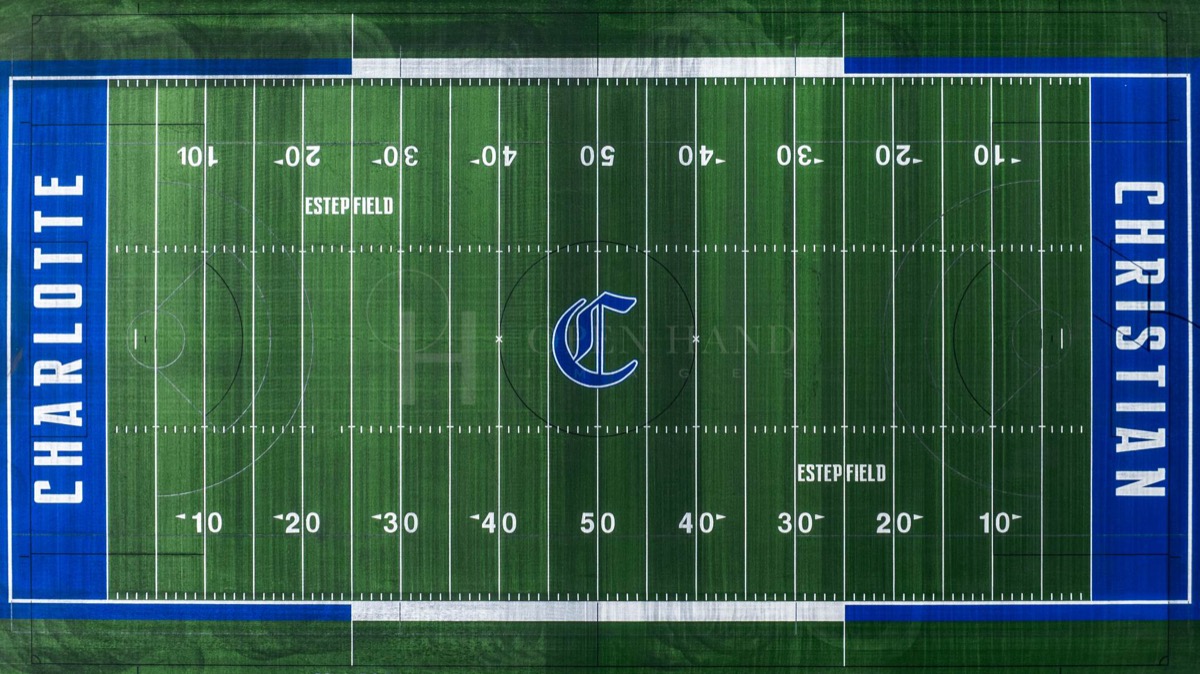
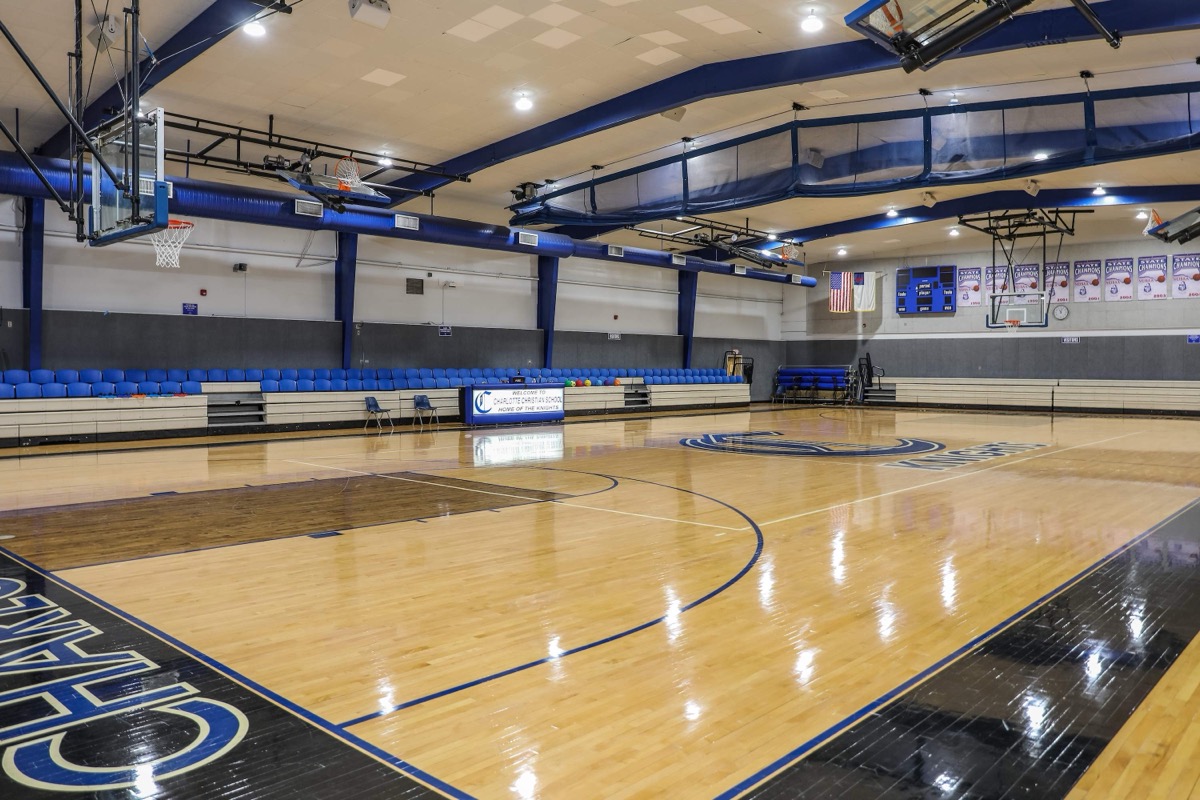
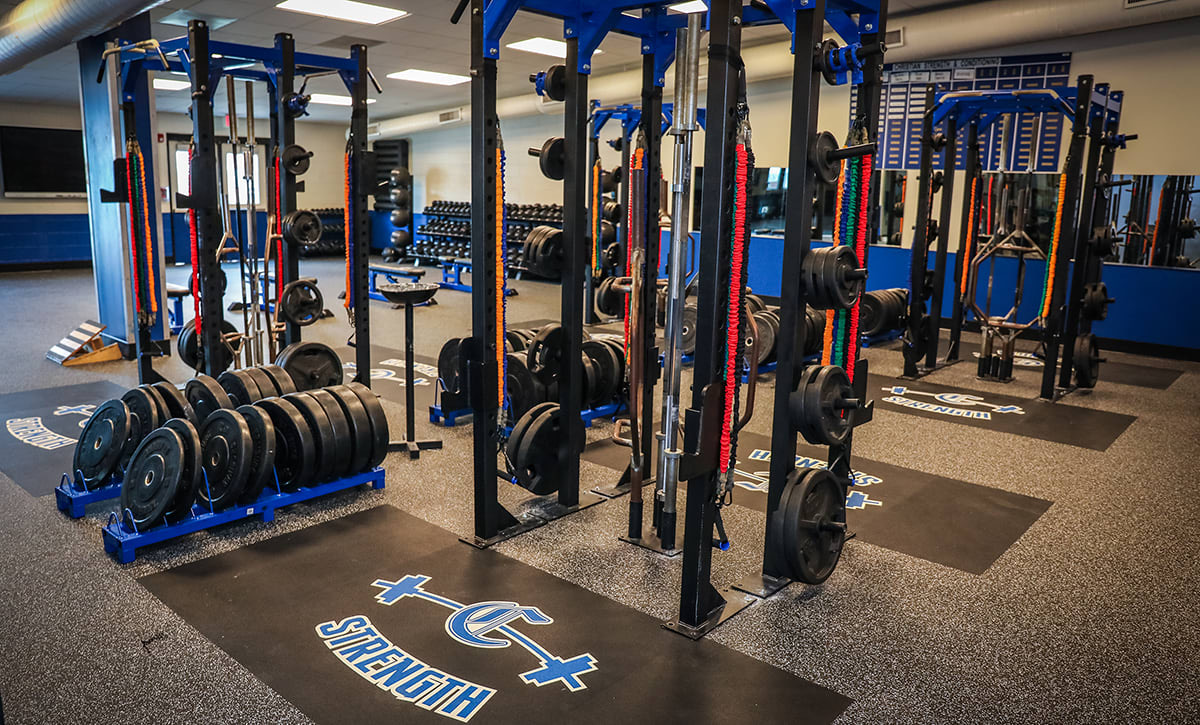
Broadcast & game day: Events stream on the school’s YouTube channel, with NCISAA events also on the NFHS Network, and tickets run through HomeTown Fan. Notably, the school charges admission only for varsity football, varsity basketball and NCISAA playoff events — every other contest is free. Football uses Division I-grade wireless sideline communications.
The hybrid model is the thing to probe on a tour: two employed trainers plus an Atrium-provided third sits between Providence Day’s fully in-house staff and Cannon’s fully outsourced Novant arrangement. Seating capacities are not published for any Charlotte Christian venue.
College Support
Compare on College SupportAdmission Rates at the Top NC Public Universities
Across the six top-ranked NC public universities, Charlotte Christian School’s applicants were admitted at a pooled 54.8% over the last five entering classes — 382 acceptances from 697 applications. UNC-Chapel Hill is the hard one: 26.3% in Fall 2025 — 10 of 38 — against far higher rates at the less-selective universities. These are UNC-system figures published by the state, not the school’s own.
| Rank | University | Applied | Accepted | Admit rate from this school | 5-yr avg |
|---|---|---|---|---|---|
| #1 | UNC-Chapel Hill Flagship · Chapel Hill · the most selective of the six | 38 | 10 | 26.3% | 28.2%163 applied · 46 in |
| #2 | NC State University Flagship STEM · Raleigh | 31 | 14 | 45.2% | 35.4%206 applied · 73 in |
| #3 | UNC Charlotte Hometown campus | 11 | 8 | 72.7% | 86.6%119 applied · 103 in |
| #4 | East Carolina University Greenville · eastern NC | 9 | 8 | 88.9% | 96.3%80 applied · 77 in |
| #5 | UNC Wilmington Coastal · mid-selectivity | 15 | 9 | 60.0% | 57.8%109 applied · 63 in |
| #6 | UNC Greensboro Piedmont Triad · largest admit rates of the six | 3 | 3 | 100.0% | 100.0%20 applied · 20 in |
Read each row as a joint figure: the rate at which that university admitted this school’s applicants — not the university’s overall admit rate, and not a measure of the school’s own selectivity. Applied/Accepted are the Fall 2025 entering class; the 5-yr column pools Fall 2021–2025 as sum(accepted)/sum(applied), so a heavy year counts more than a light one. Counts travel with every rate because several cells are single-digit.
The Transcript Colleges See
Students in AP classes are required to sit the exam, and 89% of 2024’s exams scored 3 or higher — a rate earned on a mandated rather than self-selected pool. Charlotte Christian publishes the fullest AP dashboard in this set: exams, students, pass counts and a full AP Scholar breakdown, two years deep. Four credits of Biblical Studies are the transcript’s defining signature.
| Class | National Merit & College Board honors |
|---|---|
| 15-yr (2024–25 profile) | 14 Finalists · 48 Commended Scholars |
| 15-yr (2021–22 profile) | 16 Finalists · 45 Commended Scholars |
| 2025 | 1 Commended Scholar (Jack Krause) — press separately names a Semifinalist the school does not listTO VERIFY |
| 2025 | 4 College Board National Recognition awards — 1 African American, 3 Hispanic (Class of 2024: 5) |
Both National Merit figures are rolling 15-year windows, which is why the Finalist count can fall from 16 to 14 while Commended rises from 45 to 48 — strong older years drop out of the window. That is arithmetically possible rather than an error, but the school does not explain it, and no per-class-year ledger is published in any edition.
The Counseling Engine
Two college counselors split the alphabet and carry all four grades each — roughly 47 seniors apiece — under a director who has held the seat at least four years. The distinctive structure is Junior Seminar: a required, graded half-credit course with a mock admission committee and two mandatory college visits, rather than an optional evening programme.
Test-optional strategy is an explicit counseling topic rather than an unstated assumption — notable given only about 84% of the class sat the SAT and 35% the ACT.
Where Graduates Go
409 acceptances for 94 graduates, and 99% of graduates go on to a four-year college — but only about a sixth of the accepting institutions actually enrolled anyone. Charlotte Christian is the only school here that gives Christian colleges and HBCUs their own named tiers, and 14% of recent graduates attend a Christian college.
| Tier | On list |
|---|---|
| Ivy League — Cornell and Dartmouth; Yale appears only on the older list | 2 / 8 |
| “Ivy Plus” | 4 / 17 |
| Top-75 National Universities | 30 / 75 |
| Top-75 Liberal Arts | 7 / 75 |
| Power Four | 40 / 68 |
| HBCUs — Historically Black Colleges & Universities | 10 / 107 |
Counts are computed from the same 186-institution list you can filter at right, scored against the 2026 U.S. News tables — derived analysis, not school-reported. Six of the eight Ivies are absent from the 2023–25 list; Harvard, Princeton, Brown and Penn appear on neither published list. Top-75 boundary placements in the 40–75 band are indicative, as the ranking source could not be machine-verified in full.
185 college names link to their homepages.
The Class of 2025 total is printed in the school’s own Celebrating Seniors booklet as “$640,000” — a digit is missing, and the school’s website renders the same figure as “more than $6.4 million”, which is used here. Publishing roughly ninety individually named awards is unusually granular. Morehead-Cain, QuestBridge and ROTC outcomes are not published, and no federal service academy appears on either list.
Honest caveat: this is an acceptance list across three graduating classes, not a matriculation list. The asterisk marks enrollment for the Class of 2025 only — and Duke, Cornell, Georgetown, Notre Dame, Emory, USC, UVA, Michigan, William & Mary, Colby and Boston College all carry no asterisk, meaning no Class of 2025 graduate enrolled at any of them. The most selective actual enrollments were Dartmouth (a football signee), Davidson (a golf signee), NYU (the valedictorian) and UNC–Chapel Hill (five students). The window starts at 2023, matching the floor the other schools here share; the Class of 2026 has not yet been published as a graduating class, so no 2026 acceptance list exists to extend it forward.
The Applicant's Edge
The Academic Conservatory is the real differentiator — a transcript-noted arts credential — and Winterim puts every student somewhere off campus each January. The second lever is a Christian-college network most peer schools do not have: NACCAP membership and a named Christian-college tier that 14% of graduates actually use.
The school does not publish a disciplinary-disclosure policy — whether and how suspensions or honor violations reach the secondary school report is absent despite NACAC membership.
Whole Class Analytics
A full five-quintile GPA table, published every year — and a visible three-year grade inflation in it, with every boundary rising while the bottom floor fell. The median student sits in the third quintile at roughly 3.69–4.06 weighted; because Honors adds 0.5 and AP a full point, a 4.277 top-quintile floor implies a heavy advanced load rather than a perfect record.
| Percentile | 10th | 25th | 50th | 75th | 90th | Mean |
|---|---|---|---|---|---|---|
| SAT total | — | 1110 | — | 1340 | — | — |
The school publishes the composite middle-50% band and a tester count only. Those endpoints ARE the 25th and 75th percentiles; the mean, the median and any Reading or Maths section split are unpublished, so none is interpolated here.
| Percentile | 10th | 25th | 50th | 75th | 90th | Mean |
|---|---|---|---|---|---|---|
| ACT composite | — | 23 | — | 29 | — | — |
79 SAT plus 33 ACT testers against 94 graduates implies substantial overlap, and since test-optional strategy is an explicit counseling topic, some graduates likely sat neither. The school publishes no combined “share who tested” figure.
All five quintiles are the school’s own published figures. Comparing them with the Class of 2022 table shows material movement in three years: every quintile boundary rose — the first-quintile floor from 4.133 to 4.277 and the third from 3.56 to 3.686 — while the fifth-quintile floor FELL from 2.179 to 1.941. The distribution rose at the top and stretched at the bottom. No unweighted distribution is published.
This is the weakest-documented area in the entire research set. No named learning specialist, no named learning-differences programme, no psycho-educational testing, no 504 or accommodation-plan process, no extended-time policy and no College Board accommodations coordination could be found. Given the school gates Honors and AP placement on an A in the prerequisite course AND mandates AP exams, that combination makes this a priority question rather than a footnote.
Verdict & Visit Checklist
A structurally rigorous, transparent transcript — mandatory AP exams, a full published quintile table, a granular AP dashboard — attached to the thinnest learning-support disclosure in this set. The academic reporting is unusually honest. The gaps are concentrated in exactly one place, which makes the tour questions easy to aim.
After School
Compare on After SchoolThe Coverage Map
Lower School is covered to 6:00 p.m. and Middle School only to 5:00 p.m. — a full hour earlier, and one of the sharpest split deadlines in this set. Two cheap "Bridge Care" tiers exist purely to close the gap between the JK-K bell and the grades 1–4 bell. Upper School has no after-school care at all.
dismissal 2:20
dismissal 2:40
dismissal 3:00
dismissal 3:20
The to-6:00 price is the full-time monthly rate — 5 days a week; 1–4 days a week runs $125–$295. Bridge Care is a flat $125 a month whatever the day count, which is what makes it such a cheap way to close the gap to the grades 1–4 bell. Open The Cost Planner below to price any combination.
PUBLICATION GAPNo teacher-workday or holiday-break care is published anywhere. On breaks, families are likely on their own.
TO VERIFYThe Extended Day page references a 3:15 p.m. middle-school figure, which is the carpool-clearance deadline rather than the bell. The MS packet reconciles it: dismissal 3:00, carpool by 3:15, auto-billed to Extended Day from 3:20.
The Cost Planner
Lower School Extended Day is a single flat monthly ladder by days per week — one price to 6:00 p.m., with no pickup-time tiers to choose between. These are current 2026-27 rates, and they are 32–52% above the 2024-25 packet — the steepest increases landed on the mid-week tiers.
| Grade · pickup slot (monthly) | 1 day VERIFIED | 2 days VERIFIED | 3 days VERIFIED | 4 days VERIFIED | 5 days VERIFIED |
|---|---|---|---|---|---|
| $125 | $175 | $245 | $295 | $325 | |
| $125 | $125 | $125 | $125 | $125 | |
| $125 | $125 | $125 | $125 | $125 |
Billed monthly on days attended per week (Lower School) or hourly attendance (Middle School). All changes must be in writing. Bridge Care is a flat monthly rate — the days-per-week columns do not vary it.
TO VERIFYRates rose sharply between 2024-25 and 2026-27: +32% at one day a week, +52% at two, +48% at three, +37% at four and +35% at five. Budget forward rather than off older figures.
TO VERIFYThe 3:05 p.m. auto-billing rule is expensive: miss the 2:40 carpool by 25 minutes and a $50 drop-in is charged. There is no grace tier between "on time" and a full drop-in day.
TO VERIFYThe sibling discount is thin — 25% for the third student only, applied to the lowest of the three rates. Two-child families get nothing.
PUBLICATION GAPBridge Care is published as a flat $125/month without a days-per-week breakdown, so the columns above repeat that one published figure rather than implying five distinct prices.
A Day Inside + Enrichment
Charlotte Christian is the only school here that publishes an actual timed daily schedule — and it protects a 45-minute homework block in both divisions. The Middle School program is deliberately cohort-differentiated, "tailored to the developmental needs of our two distinct cohorts — grades 5 and 6, and grades 7 and 8."
"Through organized activities and supervised free time, the Extended Day program is designed to enrich the intellectual, spiritual, social, and physical development of students." Middle School runs the same shape on a compressed clock — attendance and snack 3:00–3:30, activity 3:30–4:00, homework and reading 4:00–4:30, then free play to 5:00. Snack is not provided in either program: "Please send your student with a snack and water bottle." Pickup authorisation is explicit and enforced — "We will not release your child to anyone other than the parents or those authorized," with ID checks early in the year.
PUBLICATION GAPThe after-school club catalog is deliberately private: descriptions and registration go out only through the parents’ weekly *Focus* email. The school names the clubs — art, coding, flag football, lacrosse, running, soccer and STEM in Lower School; mountain biking, wrestling, chess, baseball, cheer and esports in Middle School; plus Junior Knights basketball and intramural cheerleading — but publishes no day, no grade range and no fee for any of them.
TO VERIFYClubs run in an "eight-week stretch of both semesters for an additional fee" — two sessions a year, priced separately from Extended Day. The amount of that fee is never stated.
PUBLICATION GAPNo staff-to-student ratio and no program capacity are published for either division, and both published schedules are hedged "subject to change as needed".
Verdict & Visit Checklist
The most operationally transparent program here — a published schedule, a protected homework block, and a genuinely clever Bridge Care tier — wrapped around rates that have risen very fast. The two hard edges are the split 5:00/6:00 deadlines between divisions and a club catalog you cannot see until you are already a parent.
Summer Programs
Compare on Summer ProgramsThe Camp Catalog
133 camp sessions across six weeks — and every single one is a three-hour half-day. There is no full-day camp. A full day is built by pairing a morning and an afternoon camp, with the noon–1 p.m. bridge care free of charge between them. The season runs June 1 to July 17, 2026, with a two-week break around July 4.
All 96 distinct camps are listed below, collapsed from the school’s 133 session-level rows (a camp offered in three weeks counts three times in that total). Grades are rising 2026-27. Despite the school’s athletic reputation, sports is a minority of this catalog — roughly 25 of the 133 sessions.
| Camp | When | Grades | Price |
|---|---|---|---|
| The OG Literacy Lab: 1st Grade Edition!Academic/premium The most expensive camp in the catalog — a targeted literacy intensive for a single grade. | Mon-Fri 9 a.m. - Noon Week 5 | Grade 1 | $300 |
| The OG Literacy Lab: 2nd Grade Edition!Academic/premium The second-grade edition of the same literacy intensive. | Mon-Fri 9 a.m. - Noon Week 6 | Grade 2 | $300 |
| A Princess Castle Dollhouse AdventurePremium specialty A premium specialty craft camp — campers build and take home a dollhouse. | Mon-Fri 1-4 p.m. Week 1 | JK-4 girls | $225 |
| MinecraftSTEM/gaming The school’s one $210 tier — a premium gaming and building camp. | Mon-Fri 9 a.m. - Noon Weeks 4, 5 | Grades 2-6 | $210 |
| CCS Tennis CampSports The widest grade span of any camp here — grade 1 through 11 — and offered in five of the six weeks. | Mon-Fri 9 a.m. - Noon Weeks 1, 2, 3, 4, 5 | Grades 1-11 | $200 |
| CCS Baseball CampSports Baseball with the school’s coaching staff. | Mon-Fri 9 a.m. - Noon Weeks 1, 2 | Grades K-6 | $200 |
| CCS Football CampSports Boys football. | Mon-Fri 9 a.m. - Noon Week 1 | Grades K-6 boys | $200 |
| Jr. Soccer StarsSports Soccer for the youngest band. | Mon-Fri 9 a.m. - Noon Weeks 1, 2 | JK-5 | $200 |
| JET Track & Field CampSports Track and field for the middle grades. | Mon-Fri 9 a.m. - Noon Weeks 1, 4 | Grades 3-6 | $200 |
| Jr. Knights CheerleadingSports Cheerleading for the youngest band. | Mon-Fri 9 a.m. - Noon Week 1 | Grades K-4 girls | $200 |
| Knights Basketball CampSports Basketball for grades 1 to 5, at the discounted tier. | Mon-Fri 9 a.m. - Noon Weeks 2, 5 | Grades 1-5 | $190 |
| Elite BasketballSports The middle-school boys basketball camp. | Mon-Fri 1-4 p.m. Week 5 | Grades 6-8 boys | $190 |
| Ballers CampSports Basketball skills for the lower grades. | Mon-Fri 1-4 p.m. Week 5 | Grades 1-5 | $190 |
| Field Hockey CampSports Girls field hockey, grade 1 through 8. | Mon-Fri 1-4 p.m. Week 2 | Grades 1-8 girls | $200 |
| Middle School VolleyballSports Girls volleyball for the middle school. | Mon-Fri 9 a.m. - Noon Week 4 | Grades 6-8 girls | $190 |
| Young Knights Volleyball CampSports The cheapest camp in the catalog, in the four-day week. | Mon-Thu 9 a.m. - Noon Week 3 | Grades 3-5 girls | $155 |
| Dodgeball CampSports The other $155 four-day-week camp. | Mon-Thu 1-4 p.m. Week 3 | Grades 2-6 | $155 |
| Cheer CampSports Four-day-week cheerleading. | Mon-Thu 1-4 p.m. Week 3 | Grades 2-6 girls | $160 |
| Precision Tumbling Cheer CampSports Tumbling and cheer across the widest span of any sports camp here. | Mon-Fri 1-4 p.m. Week 4 | JK-8 | $200 |
| Tumbling CampSports Tumbling for the younger band. | Mon-Fri 1-4 p.m. Week 1 | JK-5 | $200 |
| Pickleball Summer FunSports Pickleball, offered morning (K-12) and afternoon (K-8) in the same week. | Mon-Fri 9 a.m. - Noon & 1-4 p.m. Week 6 | K-12 (AM), K-8 (PM) | $200 |
| Disc Sports CampSports Ultimate and disc golf. | Mon-Fri 9 a.m. - Noon Week 4 | Grades 4-8 | $190 |
| Nerf CampSports/active Active games camp. | Mon-Fri 9 a.m. - Noon Weeks 2, 3 | Grades 2-6 | $200 |
| Xtreme Fun PESports Physical education games. | Mon-Fri 1-4 p.m. Weeks 1, 2 | JK-5 | $190 |
| Field Day FunSports Field-day games for the youngest campers. | Mon-Fri 1-4 p.m. Week 4 | JK-2 | $200 |
| Summer OlympicsSports Multi-sport games; $160 in the four-day week, $200 in the five-day one. | Mon-Fri 9 a.m. - Noon Weeks 3, 6 | Grades K-5 | $200 |
| Lego Robotics Jr.STEM Introductory robotics for the youngest band. | Mon-Fri 9 a.m. - Noon Weeks 1, 5 | Grades K-2 | $200 |
| Lego RoboticsSTEM The older band’s robotics camp. | Mon-Fri 9 a.m. - Noon Weeks 2, 6 | Grades 3-5 | $200 |
| Lego ManiacsSTEM The most-repeated camp in the catalog — offered in all six weeks. | Mon-Fri 1-4 p.m. Weeks 1-6 | Grades K-5 | $190 |
| Engineering ExplorersSTEM Design and build for the middle grades. | Mon-Fri 9 a.m. - Noon Week 2 | Grades 2-5 | $200 |
| Camp Slime TimeSTEM/messy play Hands-on messy science. | Mon-Fri 9 a.m. - Noon Week 1 | JK-5 | $200 |
| Messes & More!STEM/messy play More messy science, $160 in the four-day week. | Mon-Fri 1-4 p.m. Weeks 2, 3 | Grades 1-5 | $200 |
| Canva Camp: Your Digital Art PlaygroundSTEM/digital arts Digital design for the older band. | Mon-Fri 1-4 p.m. Weeks 1, 4 | Grades 4-8 | $200 |
| Build It, Break It!STEM/maker Deconstruction and rebuilding for the youngest makers. | Mon-Fri 9 a.m. - Noon Weeks 3, 4 | JK-1 | $200 |
| Build & PlayEarly childhood/maker Building and construction play. | Mon-Fri 9 a.m. - Noon Week 6 | JK-1 | $200 |
| RC RacingSTEM/hobby Radio-control racing, offered morning and afternoon, grades 4 to 12. | Mon-Fri 9 a.m. - Noon & 1-4 p.m. Week 6 | Grades 4-12 | $200 |
| WoodworkingMaker/craft Woodworking for the youngest band. | Mon-Fri 1-4 p.m. Week 2 | JK-2 | $200 |
| Art CampArts General studio art. | Mon-Fri 9 a.m. - Noon Week 2 | Grades 1-5 | $200 |
| Clay All DayArts Ceramics in the four-day week. | Mon-Thu 1-4 p.m. Week 3 | Grades 1-6 | $160 |
| Comic Book CampArts Comics writing and illustration. | Mon-Fri 1-4 p.m. Week 5 | Grades 2-6 | $200 |
| Color CrazeArts Colour and painting. | Mon-Fri 9 a.m. - Noon Week 4 | Grades 1-5 | $200 |
| Style Squad: Beads & BraidsArts/crafts Beading and hair braiding. | Mon-Fri 9 a.m. - Noon Week 1 | JK-5 girls | $200 |
| Carnival CreationsArts/crafts Craft camp on a carnival theme. | Mon-Fri 1-4 p.m. Week 1 | Grades 1-5 | $200 |
| All Things CraftyArts/crafts General crafts across the youngest bands. | Mon-Fri 1-4 p.m. Week 2 | JK-5 | $200 |
| Paper NinjasArts/crafts Paper craft and origami, four-day week. | Mon-Thu 9 a.m. - Noon Week 3 | Grades K-5 | $160 |
| Jewelry in Every WayArts/crafts Jewelry making. | Mon-Fri 9 a.m. - Noon Week 5 | Grades 1-5 girls | $200 |
| Sew Fun!Arts/crafts Sewing, offered morning in week 5 and afternoon in week 6. | Mon-Fri 9 a.m. - Noon Weeks 5, 6 | Grades 2-6 | $200 |
| Scrapbooking StudioArts/crafts Scrapbooking and paper craft. | Mon-Fri 1-4 p.m. Week 6 | Grades 1-5 | $200 |
| Whimsical Woodland WorkshopArts/crafts Nature-themed craft. | Mon-Fri 1-4 p.m. Week 4 | Grades 3-6 | $200 |
| Page to Stage: Fairy Tale CampArts/theatre Adapting stories for performance. | Mon-Fri 9 a.m. - Noon Week 1 | Grades 2-6 | $200 |
| Stage Makeup and Costume DesignArts/theatre The catalog’s widest arts span — grade 4 through 12. | Mon-Fri 1-4 p.m. Week 1 | Grades 4-12 | $200 |
| Theatre: Happily Ever AfterArts/theatre Theatre for the lower grades. | Mon-Fri 9 a.m. - Noon Week 6 | Grades 1-5 | $190 |
| Superstar Dance CampArts/dance Dance; $160 in the four-day week. | Mon-Fri 9 a.m. - Noon Weeks 2, 3 | Grades K-4 girls | $200 |
| Got Talent?Arts/performance A performance showcase camp. | Mon-Fri 1-4 p.m. Week 2 | Grades 1-4 | $200 |
| Movie Making Madness Film CampArts/film Filmmaking, split by grade band across morning and afternoon. | Mon-Fri 9 a.m. - Noon & 1-4 p.m. Week 2 | K-3 (AM), 4-8 (PM) | $200 |
| Stop Motion SensationArts/film Stop-motion animation, four-day week. | Mon-Thu 9 a.m. - Noon Week 3 | Grades 3-6 | $160 |
| Dino-ROARThemed/early childhood Dinosaur-themed camp, morning in week 1 and afternoon in week 6. | Mon-Fri 9 a.m. - Noon Weeks 1, 6 | JK-2 | $200 |
| Fairy FunThemed Fairy-themed camp for the youngest girls. | Mon-Fri 9 a.m. - Noon Weeks 1, 6 | JK-3 girls | $200 |
| Gal PalsThemed Friendship-themed camp. | Mon-Fri 9 a.m. - Noon Week 1 | Grades 1-4 girls | $200 |
| Harry Potter ExperienceThemed Themed camp, afternoon in week 1 and morning in week 4. | Mon-Fri 1-4 p.m. Weeks 1, 4 | Grades 1-5 | $200 |
| Monster Truck MayhemThemed Vehicle-themed camp for the youngest band. | Mon-Fri 1-4 p.m. Week 1 | JK-2 | $200 |
| Camp Hot Wheels: The Ultimate Race Camp!Themed Racing-themed camp. | Mon-Fri 9 a.m. - Noon Week 2 | JK-4 | $200 |
| American Girl AdventureThemed Offered both morning and afternoon in the same week, at the discounted tier. | Mon-Fri 9 a.m. - Noon & 1-4 p.m. Week 2 | JK-4 girls | $190 |
| SPA-TasticThemed Spa-themed camp. | Mon-Fri 9 a.m. - Noon Week 2 | Grades 1-5 girls | $200 |
| Hawaiian Beach Party CampThemed Beach-themed camp. | Mon-Fri 9 a.m. - Noon Week 4 | JK-4 | $200 |
| Jedi Training AcademyThemed Science-fiction themed camp, offered in two weeks. | Mon-Fri 9 a.m. - Noon Weeks 4, 5 | JK-4 | $200 |
| Mermaid ManiaThemed Mermaid-themed camp. | Mon-Fri 9 a.m. - Noon Week 4 | JK-3 girls | $200 |
| Girls Just Wanna Have FunThemed Themed camp, offered in two weeks. | Mon-Fri 1-4 p.m. Weeks 4, 5 | Grades 2-6 girls | $200 |
| BroPerfectThemed The boys’ counterpart, at the discounted tier. | Mon-Fri 1-4 p.m. Week 5 | Grades 2-6 boys | $190 |
| Barbie BlastThemed Themed camp offered both morning and afternoon. | Mon-Fri 9 a.m. - Noon & 1-4 p.m. Week 5 | JK-3 girls | $200 |
| Christmas in JulyThemed Seasonal themed camp. | Mon-Fri 9 a.m. - Noon Week 5 | JK-5 | $200 |
| Fort Camp: Glow EditionThemed/maker Fort building and glow play. | Mon-Fri 9 a.m. - Noon Week 5 | Grades K-4 | $200 |
| Spy SchoolThemed Codes, clues and investigation. | Mon-Fri 9 a.m. - Noon Week 5 | Grades 2-6 | $200 |
| STAY-cationTraditional/variety A traditional-style variety camp — the closest thing here to a general day camp. | Mon-Fri 9 a.m. - Noon Week 1 | Grades 1-5 | $200 |
| Summer Blast CampTraditional/variety The other variety camp, in the closing week. | Mon-Fri 1-4 p.m. Week 6 | JK-4 | $200 |
| Standardized Test Prep TakeoverAcademic Test preparation for rising grades 8 and 9. | Mon-Fri 9 a.m. - Noon Week 5 | Grades 8-9 | $200 |
| Books to BlockbustersAcademic/literacy Literacy through film adaptation, four-day week. | Mon-Thu 1-4 p.m. Week 3 | Grades 3-6 | $160 |
| Teachers in TrainingAcademic/leadership A leadership camp; $160 in the four-day week and $200 in week 5. | Mon-Fri 1-4 p.m. Weeks 3, 5 | Grades 2-5 | $200 |
| Little Learners BootcampAcademic/early childhood Kindergarten readiness. | Mon-Fri 9 a.m. - Noon Week 6 | JK-K | $200 |
| Focus on FunEarly childhood Early-childhood camp offered morning and afternoon in the four-day week. | Mon-Thu 9 a.m. - Noon & 1-4 p.m. Week 3 | JK-2 | $160 |
| Fine Motor FunEarly childhood Fine-motor skills for the youngest band. | Mon-Thu 1-4 p.m. Week 3 | JK-1 | $160 |
| Cake Boss Jr.Culinary Baking and decorating. | Mon-Fri 1-4 p.m. Weeks 1, 2 | Grades 1-4 | $200 |
| The No Cooking Culinary CampCulinary Cooking without heat. | Mon-Fri 1-4 p.m. Week 4 | Grades K-5 | $200 |
| Mrs. Israel's Ice Cream ParlorCulinary Ice cream making with a named faculty member. | Mon-Fri 1-4 p.m. Week 5 | JK-5 | $200 |
| Edible Art: From Painting to Plate!Culinary/arts Food as an art medium. | Mon-Fri 9 a.m. - Noon Week 6 | Grades 1-5 | $200 |
| Exploring God's BackyardNature/faith Nature study framed by the school’s Christian mission. | Mon-Fri 9 a.m. - Noon Week 2 | JK-2 | $200 |
| Nature's Detectives CampsNature/science Field science in the four-day week. | Mon-Thu 1-4 p.m. Week 3 | Grades 1-6 | $160 |
| Creature CrusadersNature/animals Animal study for the youngest campers. | Mon-Fri 1-4 p.m. Week 4 | JK-4 | $200 |
| Wilderness ExplorersNature Outdoor skills. | Mon-Fri 1-4 p.m. Week 5 | JK-4 | $200 |
| Junior Rangers CampNature Outdoor exploration for the youngest band. | Mon-Fri 1-4 p.m. Week 6 | JK-1 | $200 |
| Mahjong Madness!Games/strategy Strategy games for the middle grades. | Mon-Fri 9 a.m. - Noon Week 2 | Grades 3-6 | $200 |
| Pokémon League Summer Training CampGames/strategy Trading-card strategy, grades 3 to 8. | Mon-Fri 1-4 p.m. Week 2 | Grades 3-8 | $200 |
| Chess CampGames/strategy Chess instruction. | Mon-Fri 1-4 p.m. Week 6 | Grades K-5 | $200 |
| Brawl Star All StarsGaming A gaming camp at the discounted tier. | Mon-Fri 1-4 p.m. Week 4 | Grades 2-6 | $190 |
| In It to Win It!Games/active Active games in the four-day week. | Mon-Thu 1-4 p.m. Week 3 | Grades 1-5 | $160 |
| Game OnGames A general games camp in the closing week. | Mon-Fri 9 a.m. - Noon Week 6 | JK-5 | $200 |
PUBLICATION GAPCharlotte Christian publishes no full-day camp. Every session is three hours, so a working parent needing full-day coverage pairs a morning and an afternoon camp — two separate registrations, though the noon–1 p.m. bridge care between them is free.
TO VERIFYThe school does not state whether camps are open to non-Charlotte-Christian families — neither its PDF nor its web page says either way. An aggregator asserts they are open to the general public, but that is unconfirmed. Grades are given as "rising 2026-27" generally rather than by enrollment, which is suggestive but not a statement of policy.
The Summer Cost Planner
Every tier here is a half-day. To cover a working day, price two — the bridge care between them is free. Six weeks are available. Week 3 is a four-day week and is priced down; the tiers below are the five-day rates.
| Camp tier | Per week |
|---|---|
Week 3 only — 3 of the 133 sessions. | $155 |
Week 3 only — 17 sessions. | $160 |
18 of the 133 sessions. | $190 |
The most common rate — 90 of the 133 sessions. | $200 |
The Minecraft camp’s own tier. | $210 |
The premium craft camp’s own tier. | $225 |
The most expensive camp in the catalog. | $300 |
The registration fee rises to $45 per camper after May 17. It is charged once, in addition to the camp fee, and is non-refundable.
Lunch/Bridge Care from Noon to 1 p.m. is free of charge — but only for campers enrolled in BOTH a morning and an afternoon camp. Lunch itself is not provided; campers bring their own allergy-safe food.
Both care blocks can also be bought by the day at $10/day rather than $50/week. Late pickup is $25 per 15 minutes after noon for morning camps, and after 5 p.m. for Extended Care.
TO VERIFYThe school’s own PDF and its web-page summary disagree on two figures: the registration-fee cutoff (May 17 vs May 18) and the cancellation fee ($25 vs $50). The PDF’s figures are used here because it is the school’s own document, but both are worth confirming.
PUBLICATION GAPNo sibling discount, multi-week discount, or deposit option is published. Walk-up campers "must register and pay for camps in full before attending".
Financial Aid & Tuition
Compare on Financial Aid & TuitionIn-Depth Report
Tuition & Financial Aid — Deep Dive Report
Unpublished ≠ deficient. "Not published" flags a transparency gap — never a judgement that the aid programme is small or unwelcoming.
Published ≠ current. Every dollar figure carries the school year it applies to. Contract terms below are tagged 2023–24 — three years behind the tuition table.
K–12 aid only. Scholarships won by graduating seniors are college money — excluded entirely. Not financial advice.
Meters show how fully each section could be answered from published evidence — a disclosure score, not a rating of the school.
Tuition by Price Band
Caveat: in 2023–24 the school grouped grades 1–5 and 6–8; from 2024–25 it groups 1–4 and 5–8. Grade five moved bands, so those two rows are not strictly like-for-like across that boundary.
Every band rose by the same flat $950 into 2026–27 — a dollar increase, not a percentage, so the same rise lands harder on the lowest band. Over three transitions ($850 $1,500 $950) every band rose exactly $3,300: 18.33% at Early Education against 13.89% at Upper School.
Unusually, the school says: daily lunch by a contracted food service · textbooks and language arts novels · instructional technology support and an assigned device (iPad gr. 5–8, MacBook Air for Upper School) · the middle and upper school two-day spiritual life retreat and field trips · caps and gowns for seniors.
Fees and Additional Costs
The enrolment fee of $1,500 per student is non-refundable but applied to the tuition balance. The $300 installment fee includes the required $250 Tuition Protection Program — a $50 difference. The school does not publish an athletics participation fee or a fine arts schedule, which is not the same as confirming no such costs exist.
Applying for Assistance — Process & Timeline
Through the 2026–27 cycle, every applicant family had to also apply to the North Carolina Opportunity Scholarship Program, a state programme whose applications opened 2 February. Across the schools examined here, this was the only instance of a school conditioning its own assistance application on a parallel state application. It no longer applies: the school's live tuition page (retrieved 14 Sep 2026) does not mention it, consistent with its own note that NC Opportunity Scholarship participation concludes after 2025–26.
The 2026–27 instruction sheet states the documentation requirement twice, and the two statements do not match — one asks for the 2024 return plus the 2025 return when available and a 2025 W-2; the other asks for the 2025 return, or the 2024 return with 2025 W-2s. We decline to choose a reading; confirm with the school.
Families reapply each year, and awards may be larger or smaller than the previous year as circumstances and the pool change. Awards are granted only after a student is accepted. As a member of the state independent schools athletic association, no student may receive assistance of any form in exchange for athletic participation.
Discounts, Remissions & the Award Ceiling
AID CAPPED AT 50% OF TUITIONThe school states grants will not exceed 50% of tuition, to extend assistance to as many families as possible. The figures below are our arithmetic against that cap — emphatically not a typical award.
Parents remain responsible for the balance of tuition and for all fees. No average or median award, and no reach data, is published — the ceiling is the only award figure on the public record.
A $1,500 tuition credit for the third, fourth or fifth student enrolled from the same household. Extended day carries a separate 25% sibling rate, applied to the third student against that family's lowest rate.
The 2024–25 chart carried a $200 payment-in-full credit for new students paying within two weeks of acceptance. It does not appear on the 2026–27 chart, and no school statement explains the change.
Clergy, faculty and partner-school support are named in fundraising materials but not documented as programmes a family can apply to — whether they are distinct remissions or designated funding inside the general need-based programme is not published. No academic or general merit scholarship exists; athletic awards are explicitly excluded.
Paying, and the Contract
These terms come from the 2023–24 enrollment packet, three years behind the tuition table above, and we could not confirm they are still current. As published then: no tuition refund for any reason without the Tuition Protection Program; with it, 90% of unused tuition refunded on withdrawal before 1 May, and no refund after 30 April. Withdrawal begins with written notice to the division principal.
A missed payment constitutes default, and at the school's option all tuition and fees become immediately due. An account more than sixty days past due may result in enrollment being revoked and referral to a collection agency, with court and legal costs assumed by the responsible party.
Trend, Reach & the Questions to Ask
The strongest tuition history of the four schools in this series. Every band rose $850 into 2024–25, $1,500 into 2025–26 and $950 into 2026–27 — a flat dollar increment each time, totalling +$3,300 per band, or 18.33% at the lowest band against 13.89% at the highest.
Section 4 is the weak point at 62%: the 50% ceiling is published, but no total awarded, no share of students, no average and no median. Gifts *received into* the assistance fund are published ($48,422 in 2020–21 falling to $23,798 in 2024–25) — but money received is not money awarded, and the two should not be read as each other.
Ordered by how much the answer would change a family's picture.
- Q1What was the total tuition assistance awarded last year, and to how many families?
- Q2What share of students receives assistance — and measured against which enrollment figure?
- Q3What is the average award, and what is the median? Which of the two is the school quoting?
- Q4Where does the assistance range realistically begin and end for a family in the middle?
- Q5Are the 2023–24 contract terms still current, particularly the rule that the Tuition Protection Program is the only route to a refund?
- Q6Are there athletics or fine arts participation costs, and what are the amounts?
- Q7Is the middle school extended day rate the same as the published lower school rate?