School dossier · Charlotte, NC
Charlotte Latin School
9 research areas · 52 documents distilled

Welcome Video
From the schoolAn introduction to Charlotte Latin School, in the school’s own words. Press play to watch.
Latest News
Admissions
Compare on AdmissionsGrade-by-Grade Application Guide — TK/K · 1–5 · 6–12
One portal, start to finish. Everything runs through Finalsite Enrollment at charlottelatin.fsenrollment.com: submit an inquiry, create your family profile, then RSVP for optional admissions events, submit materials, locate forms and meet the deadlines from the same account.
Every date below is the 2026–27 cycle. Cycle dates shift from year to year, and these pages have carried a different set in a previous season. Verify against the live admissions pages before you act on any of them.
One shared spine in every band — apply online through the portal → attend a Visit Day → complete a standardized assessment → meet the deadlines. What changes between bands is which assessment your child sits, whether the admissions office schedules the Visit Day or you do, whether that day includes an interview, and which deadline you are working to.
- Submit an inquiry, then create your family profileFall 2026
The required first step: families "first submit an inquiry and then create a profile for your family." That account then prompts you to RSVP for optional admissions events, submit materials, locate forms and meet deadlines — everything downstream of this list runs through it.
- RSVP for the optional admissions eventsOct 10, 2026
Optional, not required. The one dated event published for this band is the TK/K Fly By Open House on October 10, 2026, 9:30–11:00 a.m. Campus tours begin in September and run throughout the school year, and open houses, tours and virtual sessions are all booked through your portal account.
- Complete the applicationby Jan 2
Required, and due January 2, 2027 — thirteen days ahead of every other grade in the school, so this band works to a deadline that falls in the first week of January rather than the middle of it. No age or birthday cutoff is published for Transitional Kindergarten or Kindergarten: the school describes TK qualitatively, as being "designed for children that are newly five and ready for Kindergarten," and states no calendar date. Ask the admissions office where your child falls.
- Attend a Visit Day — the office schedules itscheduled for you
Required, and this is the one band where you do not book it: "Attend Visit Day (our office will schedule)." Every other grade schedules its own. On the day, "your child will experience the joy of a Latin classroom for a few hours while you meet with current parents and hear from a panel of Upper School students."
- Complete the WPPSI assessmentrequired
Required. Applicants to this band sit the WPPSI, administered by a psychologist in the Charlotte Area Independent Schools consortium, and testing "need[s] to be scheduled in advance." You book the psychologist directly and ask that the scores be sent to Charlotte Latin — the school does not arrange the appointment.
- Apply for financial aid, if you need itby Jan 15
Optional, and on its own clock: the application opens through Clarity on September 15, 2026 and is due January 15, 2027 for priority-round consideration — two weeks after this band's own application deadline. One application covers every child in the family.
Aid runs through Clarity, opens September 15, 2026 and is due January 15, 2027 for priority-round consideration. One application covers every child in the family and "typically takes 30 minutes or less to complete." Separately, a $2,500 non-refundable deposit is "required at the time of initial enrollment or reenrollment" and is "deducted from the second tuition payment" — no student can be enrolled or reenrolled without it. No aid application fee is published for this cycle.
Exactly what changes between bands
| TK / Kindergarten | Lower School · Grades 1–5 | Middle School · Grades 6–8 | Upper School · Grades 9–12 | |
|---|---|---|---|---|
| Application due | Jan 2, 2027 | Jan 15, 2027 | Jan 15, 2027 | Jan 15, 2027 |
| Who schedules the Visit Day | The admissions office | The family | The family | The family |
| Standardized assessment | WPPSI | WPPSI (Gr 1) · WISC-V (Gr 2–4) · ISEE (Gr 5) | ISEE | ISEE (Gr 9–11) · nothing published for Gr 12 |
| Interview at the Visit Day | Not described | Not described | Yes | Yes |
| What the Visit Day is | Hours in a Latin classroom; parents meet current parents and an Upper School student panel | A classroom visit | Interview, on-site assessment and a class observation | Interview, a Student Ambassador and a day in the life of a Latin student |
| Testing and file material due | None published | None published | Feb 26, 2027 | Feb 26, 2027 |
| Decision and contract | Not published in any band — confirm with the admissions office. Every published timeline ends at the application or file-material deadline, and no notification date, notification time or enrollment contract date appears on any admissions page. | |||
| Constant in every band | The Finalsite Enrollment portal, from the first inquiry through every submission · financial aid through Clarity, open Sept 15, 2026 and due Jan 15, 2027 · a $2,500 non-refundable enrollment deposit, deducted from the second tuition payment | |||
The admissions office
9502 Providence Road, Charlotte, NC 28277 · admissions 704-846-7207 · admissions@charlottelatin.org · financial aid financialaid@charlottelatin.org. Each applicant is assigned an admission counselor to guide the family through the process; no individual phone numbers or email addresses are published for the team below.Course Offerings
Compare on Course OfferingsTK – Grade 5Lower School Courses
Charlotte Latin publishes Lower School subject areas, not named courses. The /academics/lower-school/curriculum path is an unpublished placeholder.
Built on six components: phonology, sound-symbol association, syllable, morphology, syntax, and semantics.
Taught through a concrete-pictorial-abstract progression.
Inquiry-based investigations across the Lower School years.
Students discover the story of our country and world from varied perspectives.
Integrated STEAM instruction in the earliest grades.
Interpretive, interpersonal, and presentational modes developed via stories, songs, games, and movement.
Music instruction from TK onward.
Art instruction from TK onward.
In Grade 5 students choose an instrument for Band or Strings, with Choir also available.
Lifelong wellness through team and individual sports and health education.
Library instruction anchored by a 16,000-volume print collection.
Grades 6 – 8Middle School Courses
Students practice skills that help them develop as public speakers and confident readers and writers.
Designed to inspire a love of reading and help students develop into lifelong learners.
Students develop as mature readers and confident writers.
Examines ancient civilizations found in the Middle East, Africa, China, India, and Europe, and makes connections to current events.
Covers English migrations and the transatlantic slave trade through Reconstruction.
Post-Civil War to modern day through the lens of five core ideals: equality, rights, liberty, opportunity, and democracy.
Enhances students’ core math skills while strengthening their ability to think critically.
Builds a strong foundation for success in algebra.
A bridge between concrete and abstract mathematical thinking.
The first year of a two-year sequence.
A full-year course covering foundational skills and deep conceptual understanding.
For students seeking an advanced and challenging mathematical experience.
Explores how the world is organized, across the living and non-living world.
An integrated approach focusing on lab skills, introductory chemistry, and human biology.
Uses the geologic timeline to explore space, geology, natural selection and evolution, and environmental science.
"Are you ready to travel back in time?" — the Middle School introduction to Latin.
The Upper School Latin I credit taken in Middle School.
The sixth-grade French course.
The seventh-grade French course.
The Upper School French I credit taken in Middle School.
The sixth-grade Spanish course.
The seventh-grade Spanish course.
The Upper School Spanish I credit taken in Middle School.
The Grade 6 elective slate; titles are published without descriptions.
A Grade 6 elective anchored by the school’s Fab Lab.
Added to the elective slate in Grades 7 and 8.
Added to the elective slate in Grades 7 and 8.
Added to the elective slate in Grades 7 and 8.
The Middle School on-ramp to Charlotte Latin’s nationally ranked Speech and Debate program.
Grades 9 – 12Upper School Courses
Charlotte Latin publishes Upper School course titles without per-course descriptions. Titles here are verbatim; descriptions are drawn from the school’s department-level framing.
The ninth-grade entry point to the Upper School English sequence, surveying world literature.
Sophomore-year focus on composition and the mechanics of academic writing.
The junior-year survey of American literature.
The American Literature sequence at honors pace and depth.
College-level literary analysis and composition for seniors.
A senior semester elective on the literature of war.
A senior semester elective on horror and otherness in the Western canon.
A senior semester elective comparing literary works with their film adaptations.
A senior semester elective on Shakespeare’s treatment of the human condition.
A senior semester elective on world-building in fantasy literature.
A senior semester elective on early British literature.
A senior semester elective on speculative and futurist literature.
The ninth-grade world history survey.
The sophomore continuation of the world history sequence.
The junior-year United States history survey.
College-level U.S. history.
College-level European history.
College-level American government and politics.
College-level comparative government and politics.
An honors course the school’s profile describes as equivalent in rigor to AP U.S. History.
An honors seminar on the history of music.
An honors course on global immigration and migration.
College-level economics covering both macroeconomics and microeconomics.
College-level psychology.
An honors introduction to philosophical inquiry.
A semester elective on the Civil Rights Movement.
The first-year algebra course.
A second entry point in the algebra sequence.
The standard geometry course.
Geometry at honors pace and depth.
Second-year algebra combined with trigonometry.
The Algebra II/Trigonometry sequence at honors level.
Advanced work in functions and trigonometry.
The standard pre-calculus course.
Pre-calculus at honors pace and depth.
A non-AP calculus course.
An honors course applying mathematics to social choice and management science.
An honors introduction to probability and statistics.
An honors course in data analytics.
College-level statistics.
College-level differential and integral calculus, AB syllabus.
College-level calculus, BC syllabus.
The ninth-grade physics-first entry to the science sequence.
Conceptual Physics at accelerated pace and depth.
The sophomore-year chemistry course.
Chemistry at honors pace and depth.
College-level second-year chemistry.
The junior-year biology course.
Biology at honors pace and depth.
College-level biology.
College-level environmental science.
Honors-level physics beyond the ninth-grade course.
Calculus-based college physics in mechanics.
Calculus-based college physics in mechanics and electricity and magnetism.
An elective course in astronomy.
An elective course in genetics.
An elective course in human anatomy and physiology.
An elective course on the science underpinning medicine.
A five-level French sequence.
Honors-level French at the third and fourth years.
College-level French language and culture.
The Spanish sequence, with V split into Contemporary Issues of the Hispanic World and Composition and Conversation.
Honors-level Spanish at the third and fourth years.
College-level Spanish language and culture.
College-level Spanish literature and culture.
A five-level Latin sequence.
Honors-level Latin.
College-level Latin.
Honors Greek; per the school’s profile Greek may only be taken as a second world language.
The fourth-year honors Greek course.
The introductory engineering course.
The second-year engineering course.
An introduction to civil engineering.
An engineering elective on mechanisms and motion.
Advanced engineering topics.
Entrepreneurship and leadership in the global marketplace.
Digital design and web development.
Networking fundamentals and cybersecurity.
College-level foundational computer science.
College-level object-oriented programming.
Application and game design.
Honors-level data structures in Java, taught using Git and GitHub.
The entry course into Charlotte Latin’s speech and debate program.
Advanced competitive debate.
Advanced competitive speech.
Communications and contemporary journalism.
Leadership paired with social responsibility.
Contemporary leadership studies.
Production of the school yearbook.
A credit-bearing student internship placement.
The foundational acting course.
Acting technique for the camera.
The introductory technical theatre course.
The second-level technical theatre course.
Advanced theatrical design.
After-school theatre production and stagecraft.
The Upper School band ensemble.
The Upper School choral ensemble.
The Upper School orchestral ensemble.
The introductory music theory course.
College-level music theory.
A four-level studio art sequence.
The photography course.
The Upper School physical education and health requirement; half is waivable via athletics.
An introduction to sports medicine.
Student Clubs
Compare on Student ClubsAffinity & Identity Groups
One student-led umbrella club, Mosaic, carrying two named sub-groups — the identity structure here runs through the club roster rather than a separate affinity program. Charlotte Latin publishes markedly less on this than its peers: no roster page, no counts, and no divisional breakout.
Service & Civic Engagement
Service is deliberately not required — and students still logged 3,396 hours by the end of junior year, with a recognition society and a national first behind them. The school states plainly that it has no service-hours graduation requirement; what it has instead is a reflection-based recognition model running across all four Upper School years.
A recognition society, not a requirement: it "recognizes students who make significant contributions to the community through service" using a reflection-based model across all four Upper School years. Four-year students need 150 hours, prorated for transfers, and are inducted at the end of senior year.
Charlotte Latin is "the first private or independent school in the country with a senior class that funded and built a Habitat for Humanity House." The community has since funded and built four, and regularly assists with builds locally and in El Salvador.
Three school-wide partners — Baby Bundles, Special Olympics and Habitat for Humanity of the Charlotte Region — anchor a program governed by six Principles of Good Practice. The Upper School Service Council organizes service activities available every week of the year.
An earlier profile recorded 5,485 hours for the Class of 2018 by the end of junior year, with five class members qualifying for the Service Society and seven students earning a Presidential Volunteer Service Award in 2016-17. A fourth initiative, Good Neighbors, lends campus gym space to community organizations.
Honor Societies
Two recognition societies plus a theatre society — and, uniquely in this comparison, published induction criteria and a published induction count. Charlotte Latin recognizes subject-area and world-language achievement through named prizes rather than honor societies, so the ledger is short by design.
| Society | Division | What it recognizes | Feeds from |
|---|---|---|---|
| Cum Laude Society — Edward J. Fox Chapter | Upper School | The highest academic honor at the school — seniors in the top 20% and juniors in the top 10% of their class · 28 inducted in the most recent ceremony | the classroom |
| Latin Service Society | Upper School | Significant contribution to the community through service — 150 hours across four years | service |
| International Thespian Society | Upper School | Excellence in high school theatre; part of the Educational Theatre Association | The Arts |
Academic & Competitive Clubs
Six programs compete; Speech & Debate is national-tier. Open any row for the full research note and its source.
Speech & DebateTop-20 NSDA program nationally; 5th in Public Forum at the '26 NationalsVerified — NSDA
A genuine national-tier operation with external evidence: the NSDA Debate Schools of Excellence Award (top 20 nationally), charter status, and 2025 membership in the 200 Club. Director Bilal Butt holds a second NSDA Diamond. Recent Nationals: Chandra & Rao 5th (Public Forum), Berman & Willett 25th, Yang 33rd (World Schools), Pan (’23) Academic All-American.
Science OlympiadDiv B (MS) + Div C (US); reached the NC state tournament in '26Verified entry
Appearing in the '26 NC State Tournament field confirms the Div C team advanced past regionals. The public result table doesn't list a confirmed finishing rank, so no placement is claimed.
Model UNLocal + international conferences, incl. NAIMUN at GeorgetownSchool-reported
Delegate-award tallies aren’t published consistently year to year, so this is reported at the program level rather than with a medal count. The school notes international travel for both Model UN and Debate.
World QuestCurrent-affairs quiz competition vs local high schools, annuallySchool-reported
An academic-quiz-style competition on current affairs, geography, and history — distinct from Model UN.
Math TeamCLS Math Team competes interscholastically; standings unpublishedSchool-reported
The Math Club feeds the CLS Math Team; the separate CLS Math Tutors club extends math into service via tutoring partnerships with local schools. Competition results aren’t published in detail.
Individual STEMA junior placed at the NC State Science & Engineering Fair, spring '26School news
Individual science-fair and research competition recurs in the school’s news beyond team clubs.
Club Catalog & Overview
25 Upper School clubs across six interest areas; the younger divisions run differently by design. Filter by interest; every club keeps its one-line purpose.
The Arts
Compare on The ArtsThe TK–12 Arts Ladder
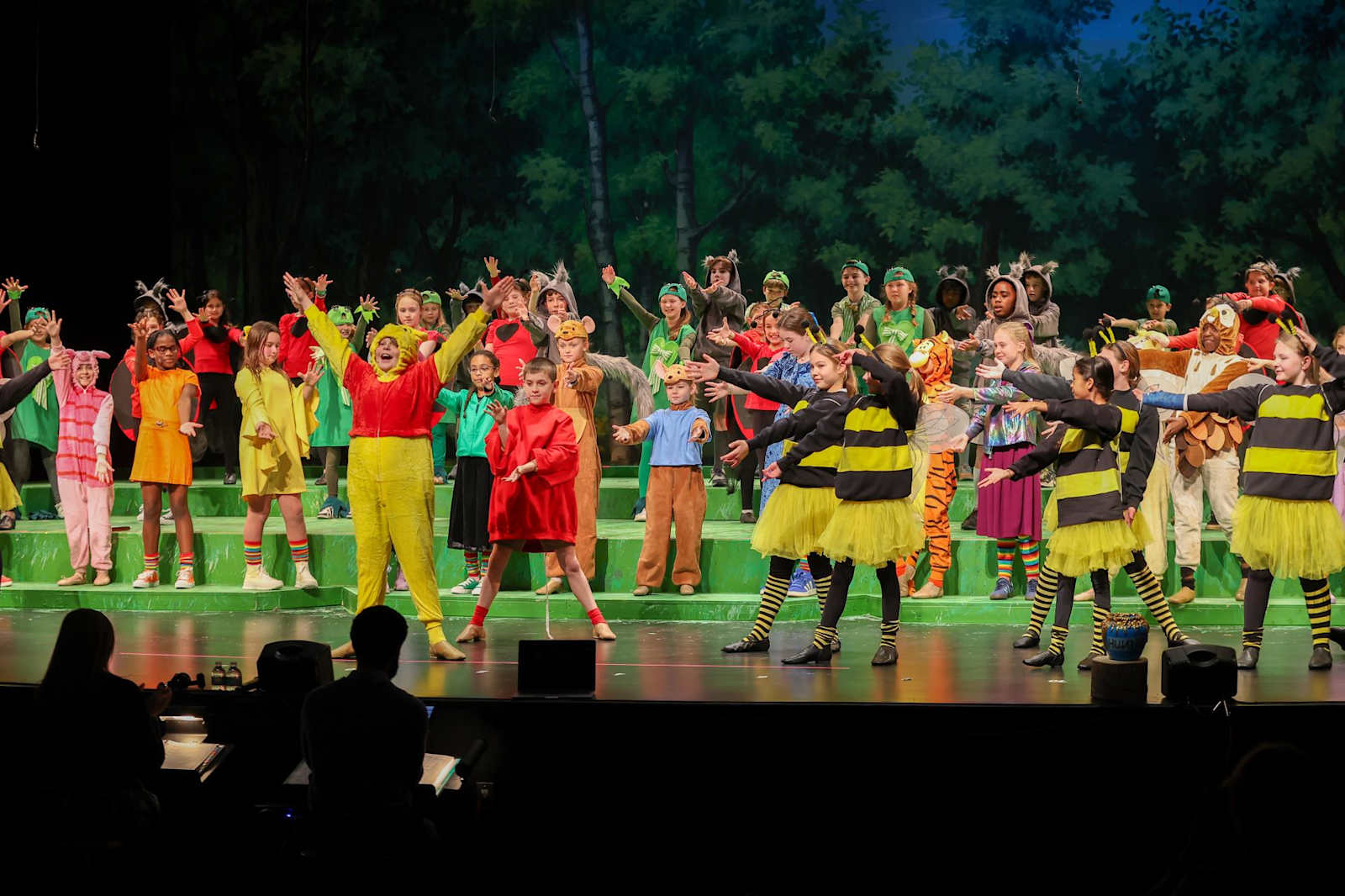
A TK–12 arts program built for breadth over selection — one band, one orchestra and one choir per division, with the stage "open to everyone." Over 80% of students participate (school-reported, no methodology published). Anchored by the Horne Performing Arts Center, six visual art studios, a Student Art Gallery and the permanent Arts Walk collection.
Theatre & the Blumeys
A Best Actress Blumey win in 2022 — the region’s marquee individual award — from a program whose recent record has cooled. The Blumeys are Blumenthal Performing Arts’ Charlotte-region high-school musical-theater awards; 59 schools competed in 2026. Latin has entered since the inaugural 2012 year.
Who runs it: Alicia Long heads the performing arts program. The tech track is genuinely articulated and undersold: the backstage/technical course starts in Grade 6 — a year before the acting course — and the Upper School sequence runs Stagecraft I → Stagecraft II → Advanced Design, plus an after-school stagecraft option. It produced a 2025 Blumey nomination for Best Student Stage Manager. For a student who would rather build than perform, this is stronger than most peer schools publish.
Latin runs a dedicated box office (boxoffice@charlottelatin.org) with waitlist handling for sold-out shows — the theatre program operates as a ticketed venue. No named theatre director or technical director is published, which is a real transparency gap versus peers.
Honest context: A Best Actress Blumey is the single most competitive individual honor in the region, and Latin has one — plus Best Featured Performer the same night. That is a genuine peak. But the trajectory since is modest: one stage-manager nomination in 2025, then zero nominations for Cabaret in 2026 against a 59-school field. Latin is a real participant, not a dominant one. Separately, no NCTC one-act festival results could be found anywhere — Latin’s competitive theatre identity is Blumey-based (musical), not NCTC-based (play festival). This ledger reflects four Blumenthal releases checked in one research pass and is a floor, not a complete history.
Music & the Honors Pipeline
One band, one orchestra and one choir per division — deliberately inclusive rather than tiered, with a two-step theory path to AP. The school’s own framing: a place for "both the most advanced student and those trying something new for the first time."
Alicia Long chairs performing arts; Pam Sweer is named as Assistant Band Director. No Director of Bands, orchestra director or choral director is publicly named — an odd gap. Orchestra splits into MS and US groups for spring concerts. Whether the Community Chorale is auditioned, or includes adults, is not published.
Latin’s publicly documented music-honors record is one named All-State student. For a 1,500-student school that is a thin external-validation trail, and the absence of auditioned ensembles means an already-advanced player has no published route to progress on campus — the sharpest question on the tour list.
Studio to Gallery
Six studios and an unusual Grade 8 self-designed course — but the ladder tops out at Art Studio IV, with no AP studio option at all. Documented Scholastic recognition across fashion, oil painting, drawing and photography, including a Gold Key.
Richard Fletcher chairs visual arts; no other visual-arts faculty are named anywhere on the school’s pages, which refer only to "a team of dedicated and experienced art educators." Scholastic Art & Writing recognition found: Ella Hennessy ’28 took a GOLD KEY for "Strike" (photography) — the top regional award, which advances to national judging; plus Hope Gottschling ’24 (fashion, "Silk Strength"), Anjali Rao ’27 (fashion, 2023), Cary Mone (oil painting, 2023) and Madison Nabors ’25 (drawing, 2023). Method caveat: those names, titles, media and the Gold Key level are read from image filenames in the school’s page HTML — reliable for identity, but Latin publishes no Scholastic results page with award tiers, so Gottschling’s frequently-cited "honorable mention" level could not be confirmed. The Fab Lab is referenced once in connection with portfolio work but sits under Innovation & Design rather than the arts department; there is no named cross-disciplinary art course, project or equipment list, so it is not presented here as an arts facility.
Verdict & Visit Checklist
A broad, inclusive arts culture with a real Blumey win and a strong tech-theatre track — but thin external validation and no AP studio path. The gaps here are unusually specific, which makes them good tour questions: no auditioned ensembles, no AP studio art, and an arts facilities page with no text on it.
Sports
Compare on SportsSports Offered
66 teams across 17 sports on a 128-acre campus, with about 90% of students in grades 7–12 playing something. The largest campus among Charlotte-area independent schools, and 165 state championships across 21 sports since the NCISAA formed in 1973.
The school publishes "17 sports / 66 teams" while its athletics directory lists 24 varsity programs counting boys’ and girls’ editions separately — both figures are the school’s own and are reproduced as published. JV and Middle School levels are confirmed only for the eight sports with distinct team pages; Latin does not publish a level-by-level breakdown of all 66 teams. Latin competes in NCISAA 4A and the CISAA, with football in the new "Big South" conference.
Winning Record
Eight NCISAA state championships in three seasons, led by four straight boys golf titles and a 26th wrestling crown. Latin’s strength is concentrated in the individual-scored sports — wrestling, golf and swimming — rather than the marquee team sports.
What they didn't win: volleyball (North Raleigh Christian) · field hockey and girls tennis (Charlotte Country Day) · girls lacrosse, girls soccer, football and girls swimming (Providence Day) · boys basketball (Forsyth Country Day) · girls basketball (Cannon) · boys lacrosse, boys tennis, girls cross country and girls track (Durham Academy) · boys soccer, boys cross country and boys track (Christ School) · boys swimming (Cary Academy) · baseball (Charlotte Christian) · softball (Covenant Day).
Volleyball: The clearest upward arc at the school: 13–11 and ranked 128th in NC, then 18–6 and 35th, then 29–2 and 17th with a state-final appearance — the 2025 team won 22 straight before its first loss, under Caitlin Peters.
Wrestling: 2024 champions with 250 points · 2025 runner-up by one point, 265.5 to 264.5, to Metrolina Christian · 2026 champions with 321 points, a 30–4 dual record and four individual titles.
Golf: Boys golf has won four straight NCISAA titles through 2026, and girls golf added a first title on a playoff hole in 2026. Golf is stroke-play scored, so no win–loss record exists for the school’s most successful current program.
The College Pipeline
48 college commitments across 2024–26, 14 of them Division I — and a pipeline led by swimming and golf, not football. That inverts the usual assumption about Latin: football has produced exactly one Division I commit across these three classes.
Twenty-nine of the 48 commitments — roughly 60% — are to NCAA Division III programs, heavily concentrated in academically selective conferences (NESCAC, UAA, ODAC, Centennial). Latin has no comprehensive alumni-in-college census; these 48 come from five published signing-day articles and may miss athletes who committed outside those events.
Latin’s D1 pipeline is swimming- and golf-led. Football produced one D1 commit (Neil Salvage to South Carolina) in three classes, despite the program’s eleven historic state titles. For most Latin families the realistic outcome is a Division III place at an academically strong college — Washington & Lee, Emory, Tufts, Swarthmore and Case Western recur repeatedly on the signing lists.
Wrestling supplies the genuine national credential: Spear Gorelick ’26 was a 2025 National Prep All-American and was pre-seeded No. 6 nationally at 150 lbs for the 2026 National Prep Championships, reaching 100 career wins before signing with Davidson. Freshman Jack Gilson also reached the national bracket at 138 lbs. In golf, Griffin Cheatwood was NCISAA medalist and Charlotte Observer Golfer of the Year; Aston Lee was CISAA Golfer of the Year. No Latin athlete currently appears in a 247Sports/On3/Rivals national top-100 for football or basketball.
Several Class of 2024 and 2025 signing-day announcements named the college but not the sport; those rows read "Not published" rather than being guessed at. Level labels and conferences were added by the researcher from each college’s NCAA status. P4 = SEC · Big Ten · ACC · Big 12.
Honors & Pro Alumni
An NFL starting quarterback, an NBA three-point record-holder, and an LPGA golfer — with an NC Mr. Basketball among them. Latin’s Athletic Hall of Fame, established in 2014, now carries five induction classes.
Coaching: Pedigree & Continuity
A ten-year NFL fullback on the football staff and a 32-year Latin lifer running two varsity programs. Athletic Director: David Gatoux, in the role since 2012 and current president of the CISAA.
One of the most recognizable former professional athletes coaching in Charlotte-area high school sports. Hoover played a full decade in the NFL for the Panthers, then led Cannon School’s program for six years before joining Latin in 2023. He also serves as Middle School baseball head coach and a PE teacher — a pro pedigree embedded in the daily life of the school rather than a figurehead appointment.
A Latin graduate who was All-Conference and All-State as a student, played at Queens University, and returned in 1994 as Jerry Faulkner’s varsity assistant. He ran JV for a decade before taking over boys basketball in 2009 and golf in 2014, and now heads two varsity programs while serving as Assistant AD for Equipment and Grounds — an unbroken coaching lineage from Faulkner’s 515–157 era to today.
Worth knowing: Latin’s strength & conditioning department is four people deep — and every one of them also runs a varsity program (Paige/wrestling, Mack/girls basketball, Peters/volleyball, Dayton/football), so strength programming is delivered by the same coaches who run the teams. Volleyball coach Caitlin Peters played twelve years professionally, finishing her final season left-handed after shoulder injuries; girls basketball coach Giavonni Mack played professionally in Istanbul.
Facilities & Athlete Care
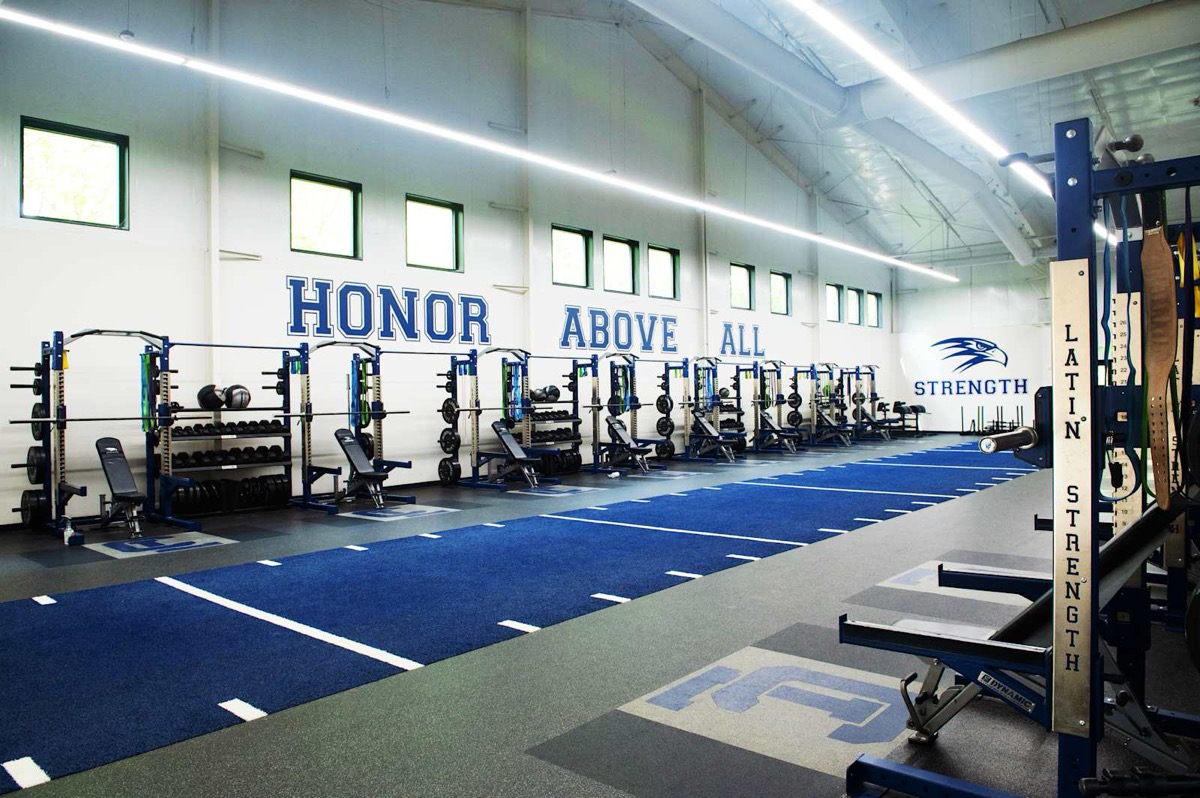
A 128-acre campus — the largest of any Charlotte-area independent school — with three gymnasiums, nine tennis courts and seven playing fields. Three certified athletic trainers and two treatment centers, run in-house rather than through a hospital system.
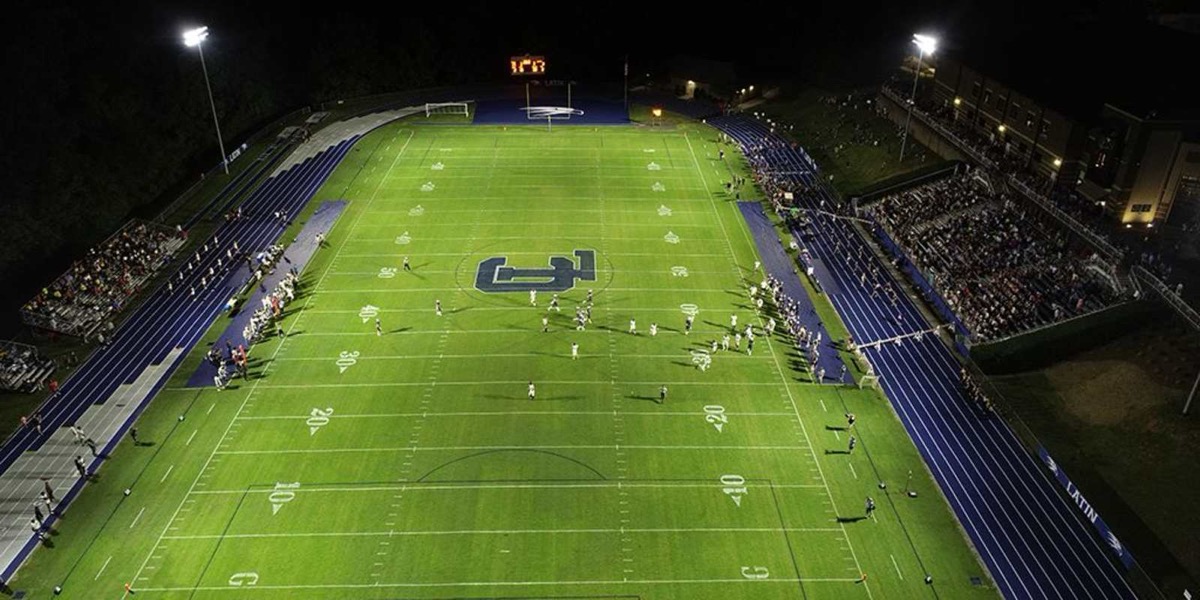
Broadcast & game day: Events stream on BoxCast and the NFHS Network, both home and away, with student broadcasters providing live commentary alongside media-production staff. Ticketing runs through GoFan. Angel Trimble serves as Assistant AD for Sports Information — and as head swimming coach.
Worth probing on a tour: Latin publishes no team physician, hospital partnership or concussion protocol, where Charlotte Country Day names OrthoCarolina, Cannon names Novant, Charlotte Christian names Atrium and Providence Day details a full in-house model. The pool is also owned and operated by SwimMAC Carolina, a third-party club, not the school.
College Support
Compare on College SupportAdmission Rates at the Top NC Public Universities
Across the six top-ranked NC public universities, Charlotte Latin School’s applicants were admitted at a pooled 45.5% over the last five entering classes — 334 acceptances from 734 applications. UNC-Chapel Hill is the hard one: 33.3% in Fall 2025 — 23 of 69 — against far higher rates at the less-selective universities. These are UNC-system figures published by the state, not the school’s own.
| Rank | University | Applied | Accepted | Admit rate from this school | 5-yr avg |
|---|---|---|---|---|---|
| #1 | UNC-Chapel Hill Flagship · Chapel Hill · the most selective of the six | 69 | 23 | 33.3% | 38.3%300 applied · 115 in |
| #2 | NC State University Flagship STEM · Raleigh | 67 | 23 | 34.3% | 33.1%251 applied · 83 in |
| #3 | UNC Charlotte Hometown campus | 14 | 11 | 78.6% | 83.0%53 applied · 44 in |
| #4 | East Carolina University Greenville · eastern NC · largest admit rates of the six | 10 | 10 | 100.0% | 90.7%43 applied · 39 in |
| #5 | UNC Wilmington Coastal · mid-selectivity | 25 | 13 | 52.0% | 51.5%68 applied · 35 in |
| #6 | UNC Greensboro Piedmont Triad | 8 | 8 | 100.0% | 94.7%19 applied · 18 in |
Read each row as a joint figure: the rate at which that university admitted this school’s applicants — not the university’s overall admit rate, and not a measure of the school’s own selectivity. Applied/Accepted are the Fall 2025 entering class; the 5-yr column pools Fall 2021–2025 as sum(accepted)/sum(applied), so a heavy year counts more than a light one. Counts travel with every rate because several cells are single-digit.
The Transcript Colleges See
Students in AP classes are required to sit the exam — but unlike its peers, Latin publishes no AP score distribution at all, so the results of that policy are invisible. What the profile does give a reader is an unusually candid warning about its own maths placement, and a 23-subject AP catalogue that now includes the very new AP Cybersecurity.
| Class | National Merit & College Board honors |
|---|---|
| 2026 | 12 Semifinalists · 18 Commended — all named in the school’s own announcement |
| 2024 | 6 Finalists · 16 Commended · 1 National Merit Scholar (Evan Li ’24) |
| 2023–25 | 20 Semifinalists · 46 Commended across the three classes (profile aggregate) |
| 2018–20 | 25 Semifinalists · 34 Commended · 7 National Hispanic Scholars |
| 2015–17 | 34 Semifinalists · 33 Commended · 2 National Achievement Semifinalists |
The Class of 2026 alone produced 12 Semifinalists — more than half the 20 recorded across the three preceding classes combined. Both figures are school-published and the surge is real per the sources, but the school does not explain it. Note too that the current profile reports Semifinalists and Commended only: it no longer reports Finalists, so Finalist counts for 2023, 2025 and 2026 are unpublished.
The Counseling Engine
Four full-time counselors inside a nine-person office — and, unusually, three dedicated essay specialists, a role most peer offices do not staff at all. Counselors are assigned in freshman year, and the office commits in writing to proofreading each essay and application before submission — a promise most schools decline to make.
Note two absences from that list. Teacher recommendations are not described as an office-owned process anywhere — there is no published account of how recs are solicited, assigned or capped. Neither is a scholarship search named as a service, and no scholarship platform is described.
Where Graduates Go
Three graduating classes produced acceptances at 300 institutions, 131 of them marked as places where at least one Latin student actually enrolled. The striking number is breadth: 62 of the 68 Power Four universities appear on the list, the absences being Minnesota, Nebraska, BYU, UCF, Houston and Kansas State.
| Tier | On list |
|---|---|
| Ivy League — all five matriculated; absent Columbia, Princeton, Penn | 5 / 8 |
| “Ivy Plus” — absent Johns Hopkins and Caltech | 12 / 17 |
| Top-75 National Universities | 53 / 75 |
| Top-75 Liberal Arts | 40 / 75 |
| Power Four — 18 ACC · 15 SEC · 16 Big Ten · 12 Big 12 | 61 / 68 |
| HBCUs — Historically Black Colleges & Universities | 7 / 107 |
Counts here are computed from the same 300-institution list you can filter at right, scored against the 2026 U.S. News tables. The Ivy and Power Four figures are exact — those memberships are fixed. The Top-75 counts are approximate to within a few places, because U.S. News publishes heavy ties around the 70–75 boundary. The three Ivy absences were confirmed by direct string search of the profile PDF; a summary of the school’s own web Acceptances page asserted Princeton was present, and the PDF governs.
298 college names link to their homepages.
The merit-dollar total stopped being published after the Class of 2023 — the 2024, 2025 and 2026 write-ups carry no figure, and whether the school stopped collecting or stopped publishing it is unclear. Morehead-Cain attaches to the Class of 2022, outside this list’s window. QuestBridge, Robertson, Jefferson, Belk, Stamps and Coca-Cola were not found for any recent class; Robertson, Jefferson and Belk are attested only in a 2017–18 historical paragraph and should not be read as current pipelines.
Honest caveat: this is a three-year aggregate acceptance list, not a matriculation list. The asterisk means at least one student enrolled at that college at some point across the Classes of 2023–25 — it is not a count, and it does not mean a student enrolled from every class. 169 of the 300 institutions carry no asterisk at all. The window starts at 2023, matching the floor the other schools here share; the school publishes no Class of 2026 acceptance list yet, so the window does not extend that far forward. Note also that the “100% to four-year colleges” claim carried by all three archived profile editions has been REMOVED from the current one, with no explanation, so it should not be carried forward to the present class.
The Applicant's Edge
Latin’s differentiators are narrow, deep and genuinely elite in two places — a top-20 national debate programme and an MIT-lineage Fab Lab — and the school leaves the assembly of a spike almost entirely to the student. There is no required capstone or senior project that manufactures one, which makes the two flagship programmes carry more weight than they would elsewhere.
There is still no required internship, capstone, senior project, independent study or school-wide research requirement — graduation requirements are purely credit-based, and there is no global-studies certificate or diploma. Athletic recruiting and arts-in-college support are informational programmes only: no named recruiting coordinator, highlight-film service, conservatory-prep track or portfolio review is published.
The net effect is a school whose real institutional strengths are verifiable elsewhere but are no longer argued for in the document colleges actually read.
Whole Class Analytics
Latin publishes almost no class-level analytics — no SAT, no ACT, no AP score distribution, no GPA distribution, and no rank, quintile or decile table. The absence is the finding, and it cuts both ways: it protects students in the middle of the class from unflattering comparison, and it removes every quantitative lever a strong student might otherwise use to stand out.
The published-invisibility problem, verified directly: every descriptive Learning Resources page on the live site now 404s, and the “Learning Resources” tile on the Student Support and Wellness page is an href="#" anchor with no body copy. The 1985 founding, the coaching model, the 504 process and the per-session billing survive only in archived captures — so a prospective family researching learning support today finds a tile that links nowhere. Upper School LR staffing levels and the number of students served are unpublished, and whether Margaret Sigmon is still Director could not be confirmed.
Verdict & Visit Checklist
Genuinely elite in two narrow places — debate and design engineering — with a stable, unusually well-staffed counseling office, wrapped in the least transparent profile in this set. Almost every open question here is answerable in one conversation, because the information exists; the school simply no longer publishes it.
After School
Compare on After SchoolThe Coverage Map
Hawks’ Club covers TK through grade 5 to 6:00 p.m. from a dedicated after-school building, with two credentialed adults in every room. Coverage then stops dead: there is no paid after-school care for Middle or Upper School at all, and Middle School is the worst served — its library closes at dismissal.
dismissal 1:30
dismissal 2:55
dismissal ~3:20
dismissal ~3:20
Prices on the bars are the full-time PER-SEMESTER rate — 5 days a week, and Latin bills twice a year rather than monthly, so double them for a school year. Pricing is otherwise linear, so 1–4 days a week costs proportionally less; open The Cost Planner below to price any combination.
TO VERIFYLatin’s own pages disagree on when Lower School dismisses. The After-School pages use 2:55 — the number the pricing table is built on — while Transportation says 3:05 for "TK-K Hawks Club students and Grades 1-5", and a third source says 3:10. Middle and Upper School are given as both 3:20 and 3:25.
PUBLICATION GAPThe cost of the full-day non-school-day program is never stated — it is not said whether those days are included in the semester rate or billed on top.
PUBLICATION GAPNo before-school care is published. The only morning data points are the 7:00–7:25 a.m. bus window and the 7:30 a.m. library opening.
The Cost Planner
Hawks’ Club bills PER SEMESTER, not per month — two charges a year, on 23 September and 20 January. Pricing is almost perfectly linear: the N-day rate is exactly N times the 1-day rate, with no volume discount — except on one row that appears to break the pattern.
| Grade · pickup slot (per semester) | 1 day VERIFIED | 2 days VERIFIED | 3 days VERIFIED | 4 days VERIFIED | 5 days VERIFIED |
|---|---|---|---|---|---|
| $345 | $690 | $1,035 | $1,380 | $1,725 | |
| $635 | $1,270 | $1,905 | $2,300 | $2,540 | |
| $930 | $1,860 | $2,790 | $3,720 | $4,650 | |
| $295 | $590 | $885 | $1,180 | $1,475 | |
| $600 | $1,200 | $1,800 | $2,400 | $3,000 |
Registration for 2026-27 opened on 14 May 2026 at 8:00 p.m. — an evening hard-open is the signature of a program where popular classes fill in minutes.
TO VERIFYThe TK/K 1:30–4:30 row does not compute. Every other row is exactly linear, but this one prices 4 days at $2,300 and 5 days at $2,540 where linear would give $2,540 and $3,175 — so five days costs what four days should. Either an unadvertised volume discount on the most popular tier or a published error, and a $635-per-semester question. The same two values appeared in an earlier research pass, which favours "real".
PUBLICATION GAPAlmost every ancillary fee is unpublished — registration, late pickup, schedule changes, cancellation and refunds, and any drop-in or occasional-use rate. No drop-in option is described anywhere; the model appears to be pre-registered fixed days only. Latin’s summer camp publishes all of these equivalents, so the school clearly can be transparent — the school-year program simply isn’t.
PUBLICATION GAPFinancial-aid applicability is unstated, and the framing is discouraging: the tuition page files after-school under "other optional costs… transportation and our Extended Day and enrichment programs", with no statement that aid applies.
A Day Inside + Enrichment
Hawks’ Club runs out of a dedicated after-school building — not a borrowed cafeteria or gym — with a lead teacher and an assistant teacher in every classroom. The school publishes what the afternoon contains but never when: there is no hour-by-hour rhythm anywhere. What it does publish is how each division gets there.
"A GREAT DAY DOESN’T NEED TO END" is the Hawks’ Club headline; the program is "a vibrant and engaging environment where students can build friendships, explore new interests, and be part of a connected after-school community" and "a welcoming space for children to transition from the school day to their home routines." In student voice, from the Lower School page: "Hawks’ Club gives us the space to transition from school to home each day. With plenty of activity and enrichment class options, we learn new skills, compete in sports, make friends, study, and play."
Latin publishes six-, eight- and ten-week enrichment classes "open to all Lower School students", taught by professional instructors. The class names below are exactly as published — but the school publishes no day, no grade range and no fee for any of them, so those columns are shown as not published rather than guessed.
| Class | Day | Grades | Fee |
|---|---|---|---|
| Atomz Lab Outside provider — hands-on science | — | LS | — |
| Book Adventures Reading and story-based enrichment | — | LS | — |
| Cheer Cheerleading fundamentals | — | LS | — |
| Chess Strategy and tournament play | — | LS | — |
| Chicks with Sticks Outside provider — field hockey | — | LS | — |
| Clayworks Pottery and hand-building | — | LS | — |
| Cooking with Flik Run by Flik, the school’s dining services provider | — | LS | — |
| Creative Dance and Movement Movement and choreography | — | LS | — |
| FabLab Engineering Design and fabrication challenges | — | LS | — |
| Field Hockey Stick skills and small-sided play | — | LS | — |
| Flag Football Non-contact football fundamentals | — | LS | — |
| Golf Swing fundamentals and short game | — | LS | — |
| Hands Create Art Mixed-media visual art | — | LS | — |
| Jewelry Designs Beading and jewellery making | — | LS | — |
| Karate Martial arts form and discipline | — | LS | — |
| Lacrosse Stick skills and team play | — | LS | — |
| Legos Building and construction challenges | — | LS | — |
| Matthews Playhouse Theatre Outside provider — performance and stagecraft | — | LS | — |
| Sumobots Competitive robot building | — | LS | — |
| Swim Mac Outside provider — SwimMAC Carolina | — | LS | — |
| Tennis Strokes and match play | — | LS | — |
| Ukulele Beginner string instruction | — | LS | — |
| Volleyball Passing, setting and game play | — | LS | — |
| Woodworking Hand tools and simple builds | — | LS | — |
| Wrestling Mat fundamentals and conditioning | — | LS | — |
| Yes I Can Basketball Outside provider — basketball skills | — | LS | — |
| Yoga Poses, breathing and mindfulness | — | LS | — |
PUBLICATION GAPEnrichment is a catalog of names with no operational detail — no day of week, no grade range and no fee for any of the 27 classes. The page that once carried that grid now returns a 404 and appears to have moved behind the parent portal.
PUBLICATION GAPNo hour-by-hour daily schedule is published, and no staff-to-child ratio or group size is given — only that each classroom has a lead teacher and an assistant.
TO VERIFYTalons youth sports runs alongside for grades 3–6 — field hockey, basketball, baseball, lacrosse, co-ed soccer and cross country, 2–3 days a week between 3:00 and 5:15 p.m., at $200–$350 depending on sport. Only Fall sessions are published; winter and spring are not.
Verdict & Visit Checklist
An unusually well-housed and well-staffed Lower School program with honest, linear pricing — that stops completely at grade 5. The TK/K cost cliff and the near-total fee opacity are the two things to press on, and Middle School families should ask what happens at 3:20 p.m.
Summer Programs
Compare on Summer ProgramsThe Camp Catalog
232 camp offerings across seven sessions — 169 distinct titles, from a $245 half-day sports clinic to an $850 two-week musical. Seven weekly sessions run June 8 to July 31, 2026, with no camps in the July 4 week. Camp Victor, the flagship traditional day camp, runs a different theme every one of the seven weeks.
Latin indexes every camp by age, not by grade — grade equivalents are not published anywhere on its site, so the bands below are the school’s own age bands. 56 of the 232 offerings are listed here, sampled across every price tier, session and category. Prices shown are the school’s Regular Price; a $10 early-bird discount applied on most camps in a five-day window in January.
| Camp | When | Grades | Price |
|---|---|---|---|
| Camp Victor: S'mores & LoresCamp Victor The flagship traditional day camp — a different theme every session, lunch included in the rate. | Mon–Fri 8:30am - 3:30pm Session 1 | 5 - 10y | $495 |
| Camp Victor: Pixar's Playground of PossibilitiesCamp Victor Session 2 of the flagship day camp. | Mon–Fri 8:30am - 3:30pm Session 2 | 5 - 10y | $495 |
| Camp Victor: Fan Fest Block Party & The Crown Town CarnivalCamp Victor Session 3 of the flagship day camp. | Mon–Fri 8:30am - 3:30pm Session 3 | 5 - 10y | $495 |
| Camp Victor: The Legends of OBX (Outer Banks, NC)Camp Victor Session 4 of the flagship day camp. | Mon–Fri 8:30am - 3:30pm Session 4 | 5 - 10y | $495 |
| Camp Victor: Color QuestCamp Victor Session 5 of the flagship day camp. | Mon–Fri 8:30am - 3:30pm Session 5 | 5 - 10y | $495 |
| Camp Victor: Monster MashupCamp Victor Session 6 of the flagship day camp. | Mon–Fri 8:30am - 3:30pm Session 6 | 5 - 10y | $495 |
| Camp Victor: Happy CamperCamp Victor The closing session of the flagship day camp. | Mon–Fri 8:30am - 3:30pm Session 7 | 5 - 10y | $495 |
| Berger/Fullwood Basketball Skills AcademySports Coach-led basketball skills, at the school’s flat sports rate. | Mon–Fri 8:30am - 11:30am Sessions 1, 4 | 7 - 14y | $245 |
| Boys' LacrosseSports Coach-led lacrosse on the HUB South Campus sports complex. | Mon–Fri 8:30am - 11:30am Session 1 | 7 - 14y | $245 |
| Girls' LacrosseSports The girls’ edition, run the same week. | Mon–Fri 8:30am - 11:30am Session 1 | 7 - 14y | $245 |
| Latin WrestlingSports Coach-led wrestling for the middle age band. | Mon–Fri 8:30am - 11:30am Session 2 | 7 - 14y | $245 |
| Latin Elite Wrestling Team CampElite sports The one camp in the catalog with its own hours and its own price — a team camp for rising 7th through 12th graders. | Mon–Fri 9:00am - 2:00pm Session 3 | 12 - 18y | $350 |
| Co-ed Flag FootballSports Coach-led flag football at the HUB complex. | Mon–Fri 8:30am - 11:30am Session 2 | 7 - 14y | $245 |
| Indoor Soccer Skills & ScrimmageSports The indoor soccer camp, for the youngest sports band. | Mon–Fri 8:30am - 11:30am Sessions 2, 5 | 5 - 9y | $245 |
| Baseball Summer Youth CampSports Coach-led baseball on the South Campus fields. | Mon–Fri 8:30am - 11:30am Sessions 3, 6 | 7 - 14y | $245 |
| Coach Mack's Girls' Basketball CampSports Girls basketball with the school’s own coaching staff. | Mon–Fri 8:30am - 11:30am Session 3 | 7 - 14y | $245 |
| Little Hawks TennisSports The youngest tennis band, on the HUB courts. | Mon–Fri 8:30am - 11:30am Sessions 3, 4, 7 | 4 - 7y | $245 |
| Tee It Up GolfSports Golf instruction at the South Campus complex. | Mon–Fri 8:30am - 11:30am Sessions 4, 5, 7 | 6 - 14y | $245 |
| MATI KarateSports Vendor-run karate, offered morning and afternoon in the same session. | Mon–Fri 8:30am - 11:30am Session 4 | 6 - 13y | $245 |
| Field Hockey with the HawksSports Field hockey with the school’s coaching staff. | Mon–Fri 8:30am - 11:30am Session 5 | 7 - 14y | $245 |
| Hawks Running Camp With Coach WeissSports Distance running for the older band. | Mon–Fri 8:30am - 11:30am Session 4 | 10 - 15y | $245 |
| Ultimate FrisbeeSports Vendor-run ultimate. | Mon–Fri 8:30am - 11:30am Session 5 | 9 - 14y | $245 |
| Nike TennisSports (external vendor) Run on campus by an external vendor (US Sports Camps), not by the school — Latin’s own listing gives no price for it. | Mon–Fri 8:30am - 3:00pm Sessions 1, 2, 5, 6 | 7 - 18y | See Website |
| Crazy ChemistrySTEM Vendor-run chemistry, at the base STEM rate. | Mon–Fri 8:30am - 11:30am Sessions 1, 5 | 5 - 7y | $255 |
| Rockin' RoboticsSTEM Introductory robotics for the middle band. | Mon–Fri 8:30am - 11:30am Session 1 | 8 - 11y | $255 |
| Creative CodingSTEM The most-repeated camp in the catalog — offered in five of the seven sessions. | Mon–Fri 8:30am - 11:30am Sessions 2, 3, 4, 5, 6 | 6 - 8y | $265 |
| Discover EngineeringSTEM Vendor-run engineering for the older half-day band. | Mon–Fri 12:30pm - 3:30pm Sessions 3, 7 | 8 - 12y | $255 |
| Vet AcademySTEM Veterinary science for the youngest science band. | Mon–Fri 8:30am - 11:30am Sessions 2, 6 | 6 - 8y | $265 |
| BattlebotsSTEM Combat robotics for the 9–12 band. | Mon–Fri 8:30am - 11:30am Session 5 | 9 - 12y | $265 |
| Adventures in LEGO LandSTEM Vendor-run LEGO engineering. | Mon–Fri 8:30am - 11:30am Sessions 3, 7 | 6 - 8y | $270 |
| Science Behind Sonic the HedgehogSTEM Themed science for the youngest campers. | Mon–Fri 8:30am - 11:30am Sessions 2, 7 | 4 - 5y | $270 |
| Very Young Makers: Everything RoboticsSTEM premium One of 41 offerings at the premium specialty tier, run by the school’s YEOT and FabLab partners. | Mon–Fri 8:30am - 11:30am Sessions 1, 4 | 6 - 8y | $320 |
| Becoming a Pirate: Building Ships, Rafts, & Finding TreasuresSTEM premium Premium build camp for the youngest maker band. | Mon–Fri 8:30am - 11:30am Session 1 | 6 - 8y | $320 |
| Young Makers WoodshopSTEM premium Premium woodworking in the school’s FabLab. | Mon–Fri 12:30pm - 3:30pm Sessions 1, 4 | 9 - 12y | $320 |
| 3D Printer Camps: Let's Learn How to Print Almost AnythingSTEM premium Premium 3D printing. | Mon–Fri 12:30pm - 3:30pm Sessions 2, 5 | 9 - 12y | $320 |
| Build the Future in a 21st Century FabLabSTEM premium The FabLab camp for the oldest half-day band. | Mon–Fri 8:30am - 11:30am Session 2 | 12 - 15y | $320 |
| Underwater RobotsSTEM premium Premium robotics for the oldest half-day band. | Mon–Fri 12:30pm - 3:30pm Session 6 | 12 - 15y | $320 |
| Heavy Metal RoboticsSTEM premium Premium metalwork robotics. | Mon–Fri 8:30am - 11:30am Session 6 | 12 - 15y | $320 |
| LEGO Sumo Bots: Robotic WrestlingSTEM premium Premium competitive robotics. | Mon–Fri 8:30am - 11:30am Sessions 3, 6 | 9 - 12y | $320 |
| Battle Royale: Nerf Blasters, Laser Tag, Water Balloons & MoreActive premium The premium active camp. | Mon–Fri 12:30pm - 3:30pm Sessions 3, 6 | 9 - 12y | $320 |
| RaceTech Dynamics: Racing Sim & RC CarsSTEM premium Premium simulation and RC engineering for the oldest band. | Mon–Fri 12:30pm - 3:30pm Sessions 1, 4 | 12 - 15y | $320 |
| Clay Camp: Ceramics, Pottery & GlazeArts The ceramics studio camp, offered in five of the seven sessions at its own price point. | Mon–Fri 8:30am - 11:30am Sessions 1, 2, 4, 5, 7 | 7 - 12y | $275 |
| Clay Camp: Next Level Ceramics, Pottery & GlazeArts The advanced ceramics band. | Mon–Fri 12:30pm - 3:30pm Session 3 | 11 - 14y | $275 |
| Mini MasterpiecesArts Fine art for the youngest campers. | Mon–Fri 8:30am - 11:30am Session 1 | 4 - 5y | $265 |
| Digital Photo, Painting & Art with AIArts & tech Digital art using AI tooling. | Mon–Fri 8:30am - 11:30am Session 1 | 9 - 12y | $265 |
| Digital Drawing & Painting with ProcreateArts & tech Tablet illustration. | Mon–Fri 12:30pm - 3:30pm Sessions 2, 6 | 9 - 12y | $265 |
| Stop Motion Animation & Music VideosArts & tech Animation and video production. | Mon–Fri 12:30pm - 3:30pm Session 5 | 9 - 12y | $265 |
| Open Art StudioArts Unstructured studio time for the older band. | Mon–Fri 8:30am - 11:30am Session 2 | 9 - 12y | $265 |
| Monogram, Vinyl & Cricut DesignsArts premium (full day) A full-day arts premium camp — one of only two at its price point. | Mon–Fri 8:30am - 3:30pm Session 2 | 7 - 10y | $515 |
| Dollhouse DesignsArts premium (full day) Full-day premium craft camp. | Mon–Fri 8:30am - 3:30pm Session 6 | 7 - 9y | $525 |
| Mean Girls Jr. (two-week production)Theatre (2-week production) The most expensive camp in the catalog — a two-week musical production run by IDA across sessions 5 and 6, priced once for both weeks. | Two weeks 8:30am - 3:30pm Sessions 5 + 6 | 11 - 15y | $850 |
| Seussical Jr. Musical TheatreTheatre (full day) A one-week full-day musical. | Mon–Fri 8:30am - 3:30pm Session 2 | 8 - 15y | $495 |
| Hip Hop DanceDance Vendor-run dance across a wide age band. | Mon–Fri 12:30pm - 3:30pm Sessions 2, 4 | 7 - 14y | $265 |
| Acrobatics Dance CampDance Acro-dance instruction. | Mon–Fri 8:30am - 11:30am Sessions 3, 5 | 6 - 13y | $265 |
| Musical Theater Character ChoreographyTheatre Half-day musical theatre. | Mon–Fri 8:30am - 11:30am Session 7 | 6 - 13y | $265 |
| Popstar Music VideoMusic Music video production. | Mon–Fri 12:30pm - 3:30pm Sessions 6, 7 | 6 - 13y | $265 |
| Junior Master Chess CampAcademic Chess instruction, offered in four sessions. | Mon–Fri 12:30pm - 3:30pm Sessions 2, 4, 5, 7 | 5 - 10y | $255 |
| Road to Success: Young Summer EntrepreneursAcademic Entrepreneurship for the younger band. | Mon–Fri 8:30am - 11:30am Session 2 | 6 - 9y | $265 |
| Shark Tank Strategies: Board Game EditionAcademic Strategy and pitching. | Mon–Fri 8:30am - 11:30am Session 7 | 9 - 12y | $265 |
| Word NerdsAcademic Vocabulary and wordplay. | Mon–Fri 12:30pm - 3:30pm Session 7 | 9 - 12y | $265 |
| Science of HappinessWellness (full day) A full-day wellness camp run by Atomz Lab, at its own price point. | Mon–Fri 8:30am - 3:30pm Session 2 | 11 - 14y | $450 |
| Pioneer CookingCulinary Hands-on cooking for the youngest culinary band. | Mon–Fri 12:30pm - 3:30pm Session 1 | 6 - 8y | $265 |
| Delicious DessertsCulinary Baking and dessert-making. | Mon–Fri 12:30pm - 3:30pm Session 2 | 6 - 8y | $265 |
| Baking With BooksCulinary Baking paired with reading. | Mon–Fri 12:30pm - 3:30pm Session 5 | 5 - 7y | $265 |
| Minecraft ProgrammingSTEM premium (full day) A full-day premium coding camp run by the school’s YEOT partner. | Mon–Fri 8:30am - 3:30pm Sessions 2, 5 | 9 - 12y | $525 |
| Roblox Learning to CodeSTEM premium (full day) Full-day premium coding. | Mon–Fri 8:30am - 3:30pm Sessions 1, 4 | 9 - 12y | $525 |
PUBLICATION GAPLatin publishes ages, never grades — there is no grade equivalent anywhere on its summer site. The bands above are the school’s own, and a registration form will ask for the child’s age as of August 1, 2026, not their grade.
TO VERIFYThe school does not publish which days of the week each camp meets. Every camp runs inside a Monday–Friday session, and the lunch option "includes lunch for five (5) days", so Mon–Fri is the reading rather than a published fact.
TO VERIFYNike Tennis is run on campus by an external vendor and Latin’s own listing gives its price only as "See Website" — so no rate for it appears here.
The Summer Cost Planner
Seven sessions, and Latin’s rates cluster into a handful of published tiers. Pick one, set the sessions, and add the care, lunch and bus a working family needs. Camp Victor’s $495.00 already includes lunch. For every other camp, lunch is a separate $65.00 a week.
| Camp tier | Per week |
|---|---|
26 offerings — the school’s flat coach-led sports rate. | $245 |
26 offerings. The only tier with no early-bird discount. | $255 |
The most common rate — 89 of the 232 offerings. | $265 |
19 offerings. | $270 |
9 offerings at the ceramics studio’s own rate. | $275 |
41 offerings — the second-largest tier in the catalog. | $320 |
The flagship day camp. This rate includes lunch. | $495 |
Minecraft, Roblox and Dollhouse Designs. | $525 |
Super Care bundles Before and After Care at $195/week — the school’s only published discount, $25 less than the $70 + $150 toggles above. Late pick-up after 5:30pm is $25 every 15 minutes.
Camp Victor’s $495/week includes lunch, so adding the lunch toggle above would double-count it. Every other camp charges lunch separately at $65/week, prepared by FLIK, the school’s own dining service.
The bus runs round-trip from Westminster Presbyterian Church on Colville Road for $70/week, per rider; riders must be at least 4 years old, and the school does not pro-rate it for a late registration.
PUBLICATION GAPLatin publishes no sibling discount and no multi-week discount, and no camp financial aid. The site was searched for all four terms; the only thing it calls a discount is the Super Care bundle.
Financial Aid & Tuition
Compare on Financial Aid & TuitionIn-Depth Report
Tuition & Financial Aid — Deep Dive Report
Unpublished ≠ deficient. "Not published" flags a transparency gap — never a judgement that the aid programme is small or unwelcoming.
Published ≠ current. Every dollar figure carries the school year it applies to. The transport and aid-document pages sit a year behind the 2026–27 tuition table — different cycles, not a contradiction.
K–12 aid only. Tuition assistance toward attending this school — not the FAFSA, CSS Profile or college merit money. Not financial advice. Roughly 75% of this series' questions could be answered from published sources.
Meters show how fully each section could be answered from published evidence — a disclosure score, not a rating of the school.
The Tuition Table — Price by Band
No prior-year bars: the school's live page shows only the current year and the archived copies could not be retrieved — a limit of our toolchain, not a school gap. Enrolment context: 1,555 students total, 586 in the Upper School (2025–26 Upper School Profile).
Four bands cover the full stated span of Transitional Kindergarten through Grade 12, so no grade is unpriced. The school labels the table "These fees are from the 2026-27 school year." Tuition includes most course and laboratory fees; textbooks are included in TK–5 but are an additional expense in grades 6–12, and that amount is not published.
Beyond Tuition — The Real Cost of Attendance
Six components are priced at 2026–27. The rest are unpriced or published only at 2025–26 rates. The school's own strategic plan confirms these charges are real: families "often arrive with tuition assistance but are unprepared for the additional costs … including the costs of athletics, school trips, and other activities."
Round trip $1,800 · one way $900 · activity bus $450 per season. The fee panel is headed "Bus Service Annual Fees 2025-26" while the tuition page has moved to 2026–27, so a family budgeting for next year cannot price the bus from the website.
Per-semester, TK–5, 2026–27. Three of five rows scale exactly with their own one-day rate; two do not. TK/K 1:30–4:30 p.m.: $635/day implies $2,540 for four days, but the table prints $2,300. Grades 1–5 2:55–4:30 p.m.: $295/day implies $1,180 for four days, but the table prints $1,880. Reproduced exactly as published rather than corrected — confirm both with the business office.
General activity, technology, facilities, new-family and graduation fees · arts, instrument or production fees · testing fees · a required device purchase · a costed summer coursework requirement. Silence on a fee schedule most likely means the charge does not apply, but confirm rather than assume.
Goal 5.1 of the published strategic plan commits the school to "conduct a comprehensive audit of the full costs of a Latin education, including tuition, trips, extracurricular programs, and out of school experiences." A family asking these questions is asking for something the school has already said it wants to produce.
The Aid Engine — Process, Forms & Timeline
platform, dates, method and decision-maker are all publishedClarity. One application covers all children in a family. Designed for a phone and stated to take 30 minutes or less, with progress saved and resumed. Federal 1040 and W2 documents transfer automatically from the IRS after a verification step. The family application guide and platform quick-reference are published in English and Spanish.
The school defines need plainly: "the difference between tuition and the family's ability to pay for tuition." It states it "strives to cover 100% of the identified family's need" — an aim, not a guarantee, and not read here as a promise of any particular award. A Financial Aid Committee conducts the review and decision.
The published financial aid questions-and-answers document states an applying family can expect "a need-blind decision" — the clearest available statement that applying for aid is described as not affecting the admission decision.
Nine financial aid documents are published — guiding principles, commonly-asked questions, scholarships, the Clarity guides in English and Spanish, and a non-custodial parent waiver form. All sit on a third-party document service our tools could not open; only each summary line was readable. These are public and open fine in an ordinary browser. The renewal policy, appeals process and mid-year change-of-circumstance policy are very likely inside them, and are recorded as not retrieved rather than not published.
What it costs a family to file (aid platforms commonly charge a fee; the pages do not say whether one applies) · when aid decisions arrive relative to admission decisions · the confidentiality policy — who inside the school sees a family's financial information, and how long it is retained.
The 2024–25 financial aid process presentation describes the mechanism in more detail: the platform produces an Estimated Family Contribution, demonstrated need is published tuition minus that contribution, and a Financial Aid Committee decides. It names School and Student Services as the 2024–25 platform against Clarity today — a change of platform between years, not a contradiction. Surfaced through a research pass and not re-read at the source.
The Aid Numbers — How Much, To Whom, How Far
unusually full disclosure for a public pageTotal awarded $3.25M, aid as 6% of operational budget, average award $17,900, and 36 students across 17 endowed scholarships — all 2024–25, all on the tuition page. Separately: $3.125M offered in 2021–22 (strategic plan) and an undated "over three million dollars" (policies page). These are not added together and are not a trend — different pages, different years, and in one case no year at all.
The measure most families look for first is published — but on the strategic-plan site, a separate web property from admissions, as "14% of students receiving some funding." The denominator is clear and it is the right one: a share of students, not of applicants or filers, which are different and usually larger-looking numbers. The year is not. The sentence sits beside a figure tagged 2021–22, but adjacency is not a year tag and is not treated as one here.
The median award — the published $17,900 average must not be read as a typical or middle award · the award range, smallest to largest · whether any need-based award covers full tuition · how many students or families receive need-based aid overall (the count of 36 is endowed scholarships only).
We normally divide the average award by the same year's tuition to show how far a typical award reaches. The average is published for 2024–25; the tuition table has moved to 2026–27; and the 2024–25 published rates could not be retrieved. Dividing across those years would produce a figure describing no actual year, so it is left out rather than printed precise and meaningless.
Beyond tuition assistance, the school states that for its highest-need families it also covers supplemental support for school essentials, including lunch. The scope beyond lunch, and the threshold at which a family qualifies, are not published.
Charlotte Latin Schools Inc, EIN 56-0944449, FY ending June 2024: grants to domestic individuals $3M, total revenue $55.7M, total expenses $55.1M. This is aggregate institutional accounting filed with the IRS, not a school statement about its aid programme — it runs one to two years behind the current school year and its definition of a grant need not match what the school counts as tuition assistance. Context only; it does not close the gaps above.
Merit, Discounts & Special Programmes
NORTH CAROLINA'S ONLY MALONE SCHOLARS SCHOOLCharlotte Latin states it is the only Malone Scholars School in North Carolina, endowed by the Malone Family Foundation to provide scholarships to highly capable students. The foundation's published basis for selecting its fifty partner schools nationally: academic calibre, quality of staff, accommodations for gifted and talented students, strong Advanced Placement and enrichment programmes, attention to individual student needs, and an economically, culturally, ethnically and socially diverse population.
The scholarships document states that the Malone, Sunny, Thrive, Wall and Kearney scholarships cover additional school expenses beyond tuition, that they are Middle and Upper School awards, and that they are made at the time of admission. That is a meaningful distinction: a scholarship reaching costs beyond tuition addresses precisely the gap Section 02 describes. (Document summary only — the body could not be opened.)
For each named fund the public record does not state the award amount, how many are awarded in a year, the eligibility criteria, or whether a scholarship can be held alongside need-based aid. The one quantitative anchor is that 36 students held awards from 17 endowed scholarships in 2024–25 — a reach figure, not an award size. Ask which scholarships an applicant would be considered for, whether consideration is automatic, and whether an award reduces need-based aid.
Sibling discounts · employee tuition remission · clergy, military or first-responder discounts · an indexed or variable tuition programme · whether merit awards may be held together with need-based aid. Each is recorded as not published rather than as not offered.
The endowed gifts page lists a wider set of named scholarship and award funds beyond the five above, including funds supporting Lower School students, a student-athlete fund, and an alumni-established fund. Surfaced through a research pass and not re-read at the source, so no count of funds is stated here. Fund names are institutional proper nouns; no recipient is named anywhere in this report.
Paying the Balance — Plans & Contract Terms
A service charge of 1.5% per month, which the school states as 18% annual, is added to tuition charges not received or postmarked by their due date and to any unpaid balance. All tuition must be paid before students may attend classes following the respective due dates. Miscellaneous charges must be paid before re-enrolment is offered, report cards issued, diplomas awarded or transcripts released.
Hawks' Club fees are billed per semester rather than with tuition: the first-semester fee (August–December) on 23 September 2026, the second (January–May) on 20 January 2027.
The public pages do not set out the withdrawal or mid-year departure obligation, any refund schedule, or the point at which full-year tuition becomes payable regardless of attendance. The optional Tuition Refund Plan at 0.53% of tuition implies some obligation survives a withdrawal — that is what such plans exist to cover — but the underlying terms are not on the public record. This is the single most consequential unpublished item in this report; read the contract carefully before signing.
Third-party tuition lenders or financing partners · any prepayment or single-payment discount · any prepaid multi-year or tuition-lock programme.
Trend, Reach & the Questions to Ask
A tuition page shows the current year and overwrites the last, so a multi-year trend has to come from web archive captures. Our retrieval tools could not reach the archive service across repeated attempts, in the initial pass and again in a deeper research pass, so there are no school-published rates for 2022–23 through 2025–26. This is a toolchain limit. It is not a finding that the school conceals its pricing history and should not be read as one. Third-party summaries exist but disagree with one another and none is reproduced.
$3.125M offered in 2021–22 and $3.25M awarded in 2024–25. These sit three years apart with nothing published in between, and come from different pages that may not count identically. Two points do not make a trend, and no line is drawn between them.
The totals above apply 2026–27 bands across a full run (2 years at $27,600; 5 at $32,600; 3 at $35,200; 4 at $36,500) as if today's prices held every year — which they will not, since published tuition is re-set annually and has historically risen. They are tuition only, net of nothing, and exclude the deposit, trips, insurance, transport, extended day, meals, books and every unpriced item in Section 02. They exist only to give a sense of scale.
The school publishes an aim to meet up to 100% of demonstrated need and a share of students receiving some funding. It publishes nothing about families above the aid threshold but below comfortable full-pay — no indexed tuition, no middle-income initiative, no guidance on where the threshold falls. A publication gap rather than a statement about who the school serves.
A stale page is still circulating. The live tuition page gives the aid deadline as 15 January 2027, but search engines still serve cached text from the same address giving 15 January 2026. Open the page directly rather than trusting the snippet. The contact address is misspelled in one place — the tuition page invites inquiries at an address whose domain has two letters transposed, while the correct address appears elsewhere on the same page. Mail to the misspelled version will not arrive; use the contact panel.
Each is unanswerable from published sources and materially affects what a family pays or receives.
- Q1What is the withdrawal and mid-year departure obligation, and is there a refund schedule?
- Q2What does a year of school meals cost, by division, and what do textbooks cost in grades 6, 9 and 12?
- Q3What are the participation costs for specific sports and activities?
- Q4What are the 2026–27 bus rates?
- Q5What is the current share of students receiving tuition assistance, and for which year?
- Q6What is the median award, what is the range from smallest to largest, and does any award reach full tuition?
- Q7For each named scholarship: the amount, how many are awarded, the criteria, and whether it can be held alongside need-based aid?
- Q8Must aid be reapplied for annually, do awards typically renew at a consistent level, and is there an appeals or change-of-circumstance process?
- Q9Please confirm the four-day and five-day Hawks' Club rates in the two rows flagged in Section 02.